
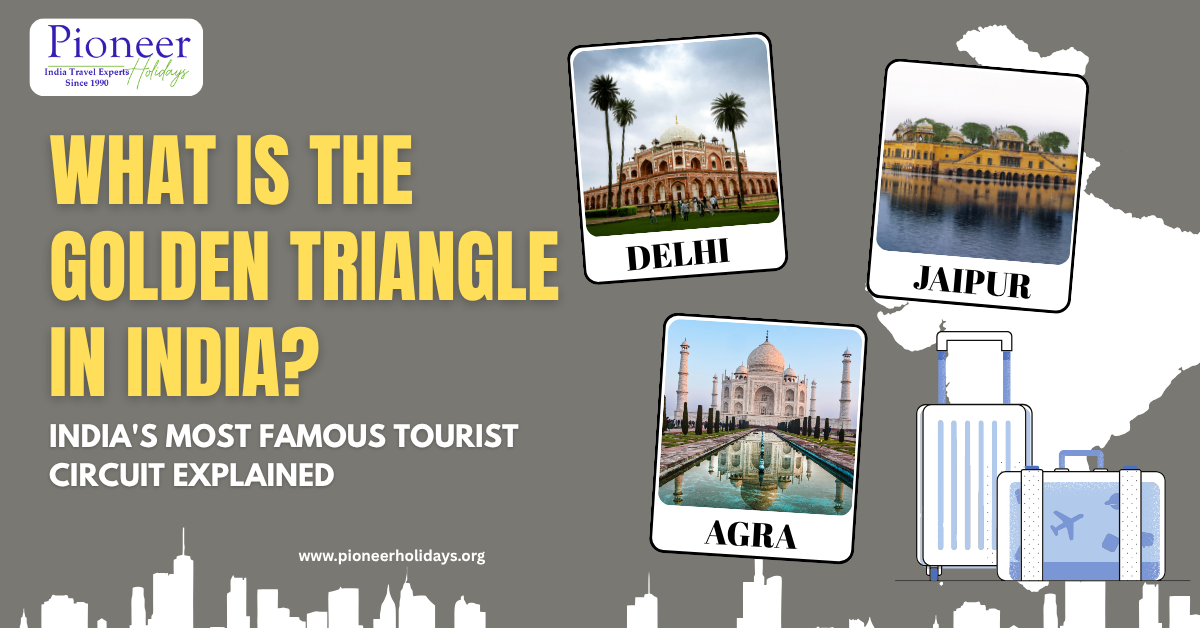
If you are planning your first trip to India and feel overwhelmed by the sheer size of the country, the Golden Triangle gives you a logical, rewarding, and manageable starting point. Three cities. Three completely different personalities. And enough history, food, colour, and architecture to keep you talking about the trip for years.
This guide breaks down everything you need to know about the Golden Triangle — what it is, why it matters, what each city offers, and how to make the most of your time there.
What is the Golden Triangle in India?
The Golden Triangle is a popular tourist circuit that connects three iconic Indian cities: Delhi, Agra, and Jaipur. These three cities form a rough triangle shape on the map of northern India, which is exactly where the name comes from.
Delhi sits at the top. Agra lies roughly 230 kilometres to the south-east. Jaipur sits about 240 kilometres to the south-west of Delhi. The three destinations together cover the cultural, historical, and architectural heartland of the Indian subcontinent.
Why is It Called the Golden Triangle?
The name has two layers of meaning. Geographically, connecting these three cities on a map does create a triangular route. But the word “golden” reflects the richness you experience at each destination — golden forts, golden temples, golden sunsets behind the Taj Mahal, and the golden warmth of Rajasthani hospitality. Some also attribute the name to the sheer commercial and cultural value this circuit brings to Indian tourism.
Golden Triangle Route Overview
| City | Distance from Delhi | Travel Time by Road | Key Attraction |
|---|---|---|---|
| Delhi | — | — | Red Fort, Qutub Minar |
| Agra | ~230 km | ~3–4 hours | Taj Mahal, Agra Fort |
| Jaipur | ~240 km from Agra | ~4–5 hours | Amber Fort, Hawa Mahal |
| Return to Delhi | ~260 km from Jaipur | ~4.5–5 hours | — |
You can also check the Golden Triangle tourist map guide to understand the full circuit visually before you book.
Delhi — Where Ancient and Modern India Collide
Delhi is not just a city. It is a layered civilisation. At least eight different empires built their capitals here over the centuries, and every one of them left something behind. Walking through Old Delhi feels like stepping back five hundred years. Crossing into New Delhi a few kilometres away, you land in a wide, leafy colonial city designed by the British architect Edwin Lutyens in the 1920s.
Best Attractions in Delhi
- Red Fort (Lal Qila) — A UNESCO World Heritage Site built by Mughal Emperor Shah Jahan in 1639. The evening light-and-sound show inside the fort is worth staying for.
- Qutub Minar — The tallest brick minaret in the world, built in 1199. The surrounding complex has ruins from multiple dynasties stacked one on top of another.
- Humayun’s Tomb — Often called the architectural forerunner of the Taj Mahal, and far less crowded.
- Jama Masjid — One of the largest mosques in Asia, located in the heart of Old Delhi’s narrow lanes.
- Chandni Chowk — A street market that has been trading since the 17th century. The chaos is part of the experience.
- India Gate and Rajpath — A ceremonial boulevard with war memorials and government buildings.
Food in Delhi
Old Delhi does street food better than almost anywhere in India. Try chole bhature (spiced chickpeas with fried bread) for breakfast at Sita Ram Diwan Chand in Paharganj, paratha stuffed with potato or radish on the famous Paranthe Wali Gali, and nihari (slow-cooked mutton stew) at Al Jawahar near Jama Masjid. For sweets, jalebi fresh from the oil at Old Famous Jalebi Wala is a rite of passage.
Shopping in Delhi
Connaught Place and Khan Market are clean, upmarket shopping areas. For handicrafts, textiles, and souvenirs with fair pricing, visit Dilli Haat — a permanent crafts bazaar near INA Metro station that brings artisans from all 28 states of India under one roof.
Agra — City of the World’s Most Recognised Monument
No matter how many photographs you have seen of the Taj Mahal, nothing quite prepares you for standing in front of it in person. The white marble seems to glow from within. It changes colour throughout the day — pale gold at dawn, brilliant white at noon, warm pink at dusk.
Why Agra Matters Historically
Agra served as the Mughal Empire’s capital during its most powerful centuries. Emperor Akbar, Jahangir, and Shah Jahan all held court here. The monuments they built turned Agra into one of the great architectural achievements of human history.
Best Attractions in Agra
Taj Mahal — Built between 1631 and 1653 by Shah Jahan as a mausoleum for his wife Mumtaz Mahal. Arrive at opening time (6 AM) to beat the crowds and catch the best light.
Agra Fort — A massive red sandstone fort located just 2.5 kilometres from the Taj Mahal. The fort has palaces, audience halls, and stunning river views.
Itimad-ud-Daulah — Called the “Baby Taj” by locals, this smaller marble mausoleum predates the Taj Mahal and is beautifully intricate with pietra dura (inlaid stone) work.
Mehtab Bagh — A garden across the Yamuna River from the Taj Mahal. The view of the Taj from here at sunset is spectacular, and almost no one mentions it.
Food in Agra
Agra has its own culinary identity beyond what most tourist itineraries mention. Petha (a translucent sweet made from ash gourd) is the city’s most famous export — try the original at Panchhi Petha on M.G. Road. For savoury food, look for bedai (a fried bread served with spiced potato curry) at small local shops near the Kinari Bazaar.
Shopping in Agra
Agra is the centre of India’s marble inlay craft tradition, the same pietra dura technique used on the Taj Mahal itself. Genuine marble items — decorative plates, boxes, and tabletops — make meaningful souvenirs. Be cautious of cheap alabaster items sold as marble at tourist entry points.
Jaipur — The Pink City of Rajasthan
Jaipur earns its nickname “Pink City” because in 1876, Maharaja Ram Singh ordered the entire old city painted terracotta pink to welcome the Prince of Wales. The colour stuck, and today the law still requires buildings in the old city to maintain the pink hue. Walking through the Walled City feels like walking through a living museum.
Historical Significance of Jaipur
Founded in 1727 by Maharaja Sawai Jai Singh, Jaipur was one of India’s first planned cities. Jai Singh was a polymath — an astronomer, mathematician, and military tactician who laid out the city using principles from ancient Hindu architecture. He also built Jantar Mantar, an open-air astronomical observatory with instruments that can measure time to within two seconds’ accuracy.
Best Attractions in Jaipur
- Amber Fort — The crown jewel of Jaipur’s architecture. Perched on a hill above Maota Lake, this fort took 150 years to complete. The Sheesh Mahal (Palace of Mirrors) inside is one of India’s most breathtaking interiors.
- Hawa Mahal — The “Palace of Winds” is the city’s most photographed facade. Built so royal women could observe street life without being seen, its 953 small windows create a latticed honey-comb appearance.
- City Palace — Still partly occupied by the royal family of Jaipur. One of the grandsons of the last maharaja gives occasional tours.
- Jantar Mantar — A UNESCO World Heritage Site and the largest stone astronomical observatory in the world.
- Nahargarh Fort — Sits high above the city and offers some of the best sunset views over Jaipur’s pink rooftops.
Food in Jaipur
Rajasthani cuisine is built for the desert climate — rich, hearty, and deeply flavoured. Try dal baati churma (lentils with baked wheat rolls dipped in clarified butter) at a traditional thali restaurant. Laal maas (a fiery lamb curry) and gatte ki sabzi (gram flour dumplings in yoghurt gravy) are local specialities. For street food, Johri Bazaar has vendors selling kachoris filled with spiced lentils — filling, cheap, and delicious.
Shopping in Jaipur
Jaipur is arguably India’s best shopping city for textiles and jewellery. The city produces block-printed cotton fabrics, hand-stitched quilts (razais), blue pottery, and semi-precious stone jewellery. Johari Bazaar (jewellery), Bapu Bazaar (fabrics and shoes), and Tripolia Bazaar (metalwork and bangles) are the three markets worth knowing. Fixed-price shops like Rajasthali (a government emporium) offer fair prices without the need to bargain.
City Comparison at a Glance
| Feature | Delhi | Agra | Jaipur |
| Best for | History, food, culture | UNESCO monuments | Forts, shopping, hospitality |
| Vibe | Cosmopolitan and hectic | Focused and emotional | Royal and vibrant |
| Time needed | 2–3 days | 1–2 days | 2 days |
| Top Landmark | Red Fort | Taj Mahal | Amber Fort |
| Street food highlight | Chole bhature, parathas | Petha sweets, bedai | Kachori, dal baati |
| Shopping strength | Handicrafts, textiles | Marble inlay | Jewellery, block print |
Best Time to Visit the Golden Triangle
| Season | Months | Weather | Recommendation |
| Winter (best) | October to March | Cool, 10–25°C | Ideal for sightseeing |
| Summer (avoid) | April to June | Very hot, 35–45°C | Not recommended |
| Monsoon (mixed) | July to September | Humid, some flooding | Manageable but sticky |
October through March is the peak season for good reason. The weather is pleasant enough to walk around forts and gardens without overheating. December and January are the coolest months but can get cold at night, especially in Jaipur. February and March offer beautiful wildflowers and perfect sightseeing conditions.
Suggested Golden Triangle Itineraries
The circuit works across a range of trip lengths. Here are practical options:
- 2 days — A fast-paced highlights run. A short Golden Triangle trip from Delhi covering the absolute essentials: Taj Mahal and a taste of Jaipur.
- 3 days — The most popular compact format. A classic 3-day Golden Triangle tour gives you one focused day in each city.
- 4 days — The sweet spot for first-time visitors who want to breathe a little. The balanced 4-day Golden Triangle journey allows proper exploration without rushing.
- 5 days — For travellers who want depth over speed. A relaxed Golden Triangle vacation means time for cooking classes, village visits, and unhurried meals.
- 6 days — Slows everything down further. An extended Golden Triangle travel plan gives you space for half-day excursions and day trips around each city.
Extending the Golden Triangle
Many travellers choose to extend the circuit into a broader North India journey:
- Complete Rajasthan and Golden Triangle itinerary — The grand version, covering thirteen days across north India’s most iconic destinations.
- Golden Triangle with wildlife safari — Adds Ranthambore National Park, one of India’s best places to spot Bengal tigers.
- Golden Triangle with spiritual Varanasi — The Ganges ghats and Varanasi’s ancient rituals add a deeply spiritual dimension.
- Golden Triangle with Amritsar — The Golden Temple and the Wagah Border ceremony create a powerful addition.
- Golden Triangle with Udaipur — Udaipur’s lake palaces and romantic atmosphere contrast beautifully with the circuit’s forts and monuments.
- Rajasthan and Golden Triangle exploration — Jodhpur and Udaipur together deepen the Rajasthan experience significantly.
Transportation Options
By Road: Private car with a driver is the most comfortable and flexible option for the Golden Triangle. You stop where you want, travel at your own pace, and avoid the logistics of stations and platforms. Most organised tours include this.
By Train: India’s railway network connects all three cities well. The Gatimaan Express (Delhi to Agra in 1.5 hours) is the fastest option for the Delhi-Agra leg. Jaipur is well connected to both Delhi and Agra.
By Bus: Government and private coaches run frequently between all three cities. They are cheaper but slower, and comfort varies significantly.
By Air: Delhi and Jaipur both have international airports. Internal flights are available but rarely worth it given the short road distances — a four-hour drive through the North Indian countryside has its own value.
Why the Golden Triangle Tour Is Perfect for First-Time Visitors to India
India can be overwhelming for first-time visitors. The scale, the sensory intensity, the cultural unfamiliarity — it all hits at once. The Golden Triangle works as an entry point precisely because it concentrates so much of what makes India extraordinary into a compact, navigable route.
You get to experience the country’s Mughal heritage in Agra, its Rajput royal culture in Jaipur, and its modern cosmopolitan identity in Delhi — all within a few days and a relatively small geography. The infrastructure along this route is also the most developed in the country. Hotels range from basic guesthouses to palace conversions. Guides are experienced and multilingual. Transport links are reliable.
If you want to understand India before committing to a more challenging itinerary, this circuit gives you a clear picture without throwing you into the deep end. You can review must-visit places in the Golden Triangle to plan your priorities before you arrive.
Common Mistakes Travelers Should Avoid
Spending only a few hours in each city. The Taj Mahal alone takes the better part of a morning if you want to experience it properly, not just photograph it. Budget at least a full day for Agra, not half a day squeezed between two drives.
Visiting the Taj Mahal at midday. The harsh overhead light flattens the marble’s appearance. Dawn and late afternoon give you the dramatic shadows and warm tones that make the monument photogenic.
Ignoring Agra’s other monuments. Most one-day visitors see the Taj Mahal and leave. Agra Fort, Itimad-ud-Daulah, and Mehtab Bagh are all within reach and genuinely worth your time.
Buying marble goods at tourist entry points. Street vendors near the Taj Mahal entry gates sell alabaster products at “marble” prices. Genuine marble items are heavier and cooler to the touch.
Not carrying cash. Many smaller shops, street food vendors, and auto-rickshaw drivers work on cash. While UPI payments are increasingly common, smaller businesses often prefer notes.
Over-scheduling Delhi. Delhi deserves at least two full days. Most itineraries squeeze it into one, leaving travellers feeling they only skimmed the surface.
Assuming Jaipur is compact. Jaipur’s major attractions spread across a wide area. Amber Fort is eleven kilometres from the city centre. Plan transport between sites, not just within the old city.
Hidden Experiences Most Tourists Miss
The stepwells near Jaipur. Abhaneri, about 95 kilometres east of Jaipur on the road to Agra, contains Chand Baori — one of the deepest and most architecturally striking stepwells in India, with 3,500 narrow steps descending thirteen stories into the earth. Almost no tourist on a standard itinerary visits it. It takes about two hours out of your way and is worth every minute.
Delhi’s Partition Museum at Town Hall. This relatively new museum documents the 1947 Partition of British India with personal testimonies, photographs, and artefacts. It gives you an emotional understanding of modern India that no fort or palace can provide.
The village of Fatehpur Sikri, between Agra and Jaipur. Built by Emperor Akbar as his capital and then abandoned within fourteen years, this ghost city of red sandstone is one of the most haunting and perfectly preserved Mughal complexes in existence. Most Golden Triangle tours mention it but skip it to save time. If you have any flexibility, add two hours for this stop.
Jaipur’s Johri Bazaar after 6 PM. Once the tourist rush dies down, the jewellery market takes on a completely different character. Local goldsmiths sit in open workshops, the air smells of marigolds from nearby temple offerings, and shopkeepers have time to actually talk to you about the craft.
Sunrise at Agra’s Mehtab Bagh. While thousands of tourists queue for the Taj Mahal’s eastern gate, Mehtab Bagh on the opposite bank of the Yamuna offers an unobstructed view of the Taj’s reflection in the river at first light. You can arrive here before dawn with almost no one else around.
Delhi’s Lodhi Art District. In the southern part of the city, the streets around Lodhi Colony have become an open-air gallery of large-scale murals by Indian and international artists. It takes an hour to walk through and provides a vivid picture of contemporary Indian creativity that most historic-focused itineraries never touch.
Budget Information
| Category | Budget (per person/day) | Mid-Range (per person/day) | Luxury (per person/day) |
| Accommodation | ₹800–2,000 | ₹3,000–8,000 | ₹12,000–50,000+ |
| Food | ₹400–800 | ₹1,000–2,500 | ₹3,000+ |
| Transport (private car) | ₹2,500–4,000 (shared cost) | ₹4,000–7,000 | ₹8,000–15,000 |
| Entrance fees | ₹500–1,500 | ₹1,500–3,000 | ₹3,000+ (with guides) |
Note: The Taj Mahal entrance for foreign nationals costs ₹1,300 (approximately USD 16). The combined ticket that includes Agra Fort and Fatehpur Sikri offers better value.
If you want to explore best Golden Triangle tour packages in India across different budgets, pre-organised packages often work out cheaper than booking each element separately — especially for accommodation and private transport.
Travel Safety Tips
- Registered guides only. At major monuments, hire guides only through official counters inside the entry gates or through your tour operator. Unofficial guides at entry points often give inaccurate information and overcharge.
- Use licensed taxis and app-based cabs. Ola and Uber operate in all three cities and use fixed metered rates. Avoid unmarked taxis offering flat rates outside airports and stations.
- Keep your documents safe. Carry digital copies of your passport and visa on your phone. Leave originals in your hotel safe.
- Dress modestly at religious sites. Mosques, temples, and Sikh gurudwaras require covered shoulders and legs. Scarves are cheap to buy at any market.
- Negotiate before you board an auto-rickshaw. In areas where meters are rare, always agree on a price before you get in, or use app-based alternatives.
- Stay hydrated but drink safe water. Stick to sealed bottled water throughout the trip. Most hotels provide complimentary bottled water, and reputable restaurants use filtered water for cooking.
Frequently Asked Questions
How long does the Golden Triangle tour take?
The minimum realistic duration is three days — one per city. Four to five days lets you explore each city properly without rushing between monuments and meals.
Is the Golden Triangle suitable for families with children?
Yes. The main attractions — Amber Fort’s elephant path and mirror palace, the scale of the Red Fort, and the Taj Mahal — all engage children well. Avoid the hottest months of April to June if travelling with young children.
What is the best way to travel between the three cities?
For comfort and flexibility, a private air-conditioned car with a driver is the most practical option. For budget travellers, the Gatimaan Express train from Delhi to Agra is an excellent choice.
Can I do the Golden Triangle independently without a tour?
Absolutely. Trains, buses, and app-based taxis make independent travel viable. However, organised tours handle the logistical complexity of timing, entry tickets, and local knowledge, which saves significant time and stress — especially on a first visit.
Do I need a visa for India?
Most nationalities require a visa to enter India. The e-Tourist Visa is available online and covers most standard Golden Triangle trips. Always check current visa requirements for your nationality before booking.
Is it safe for solo female travellers?
The Golden Triangle is one of the safer parts of India for solo travellers, including women. Tourist infrastructure is well-developed, guides are professional, and organised accommodation is readily available. Standard precautions apply as in any unfamiliar destination.
What is the best itinerary order for the Golden Triangle?
Delhi → Agra → Jaipur → Delhi works well. Alternatively, Delhi → Jaipur → Agra → Delhi gives you the Taj Mahal as the finale of your trip — a powerful ending.
Conclusion
The Golden Triangle is not just a convenient geographic loop. It is a genuine encounter with the foundations of Indian civilisation — Mughal imperial grandeur, Rajput warrior culture, and the heaving, modern energy of one of the world’s great capital cities. Every traveller who has done this circuit will tell you the same thing: it changes how you think about history, architecture, and the sheer ambition of the people who built these places.
Whether you plan a focused weekend Golden Triangle itinerary or a longer journey through Rajasthan, the route rewards travellers at every level of curiosity and every travel style. If you want help designing your ideal version of this trip, Pioneer Holidays offers customised itineraries built around your pace, interests, and budget — from compact two-day circuits to extended multi-week journeys across North India.
