
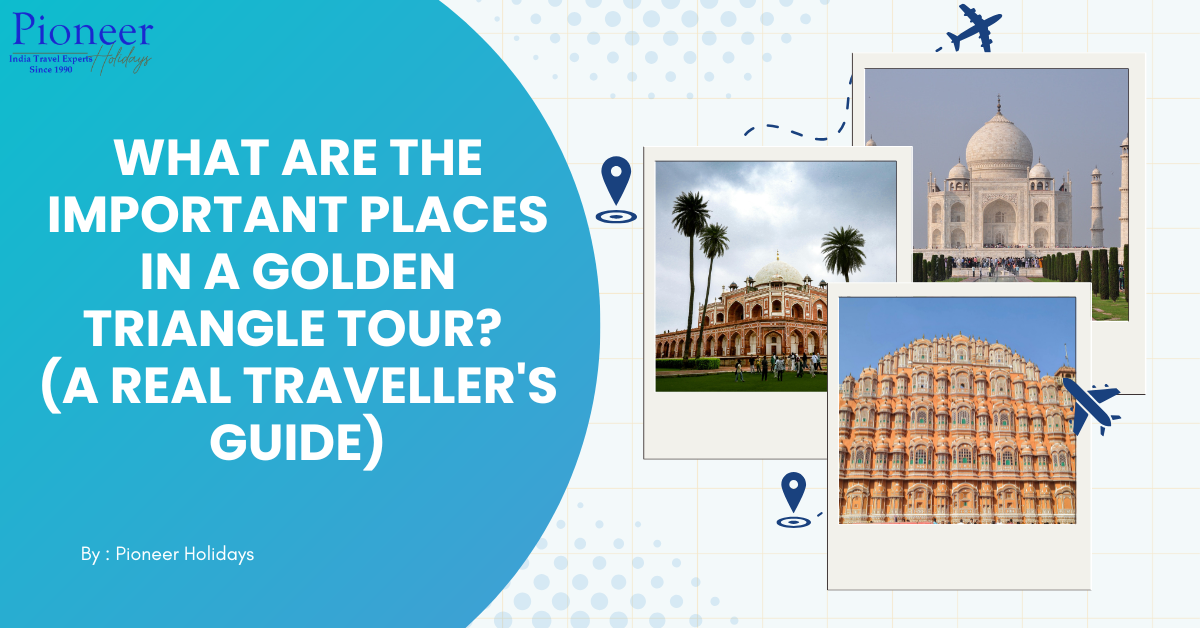
If someone asks me what is the single best way to see India for the first time, I always say the same thing — take the Golden Triangle Tour.
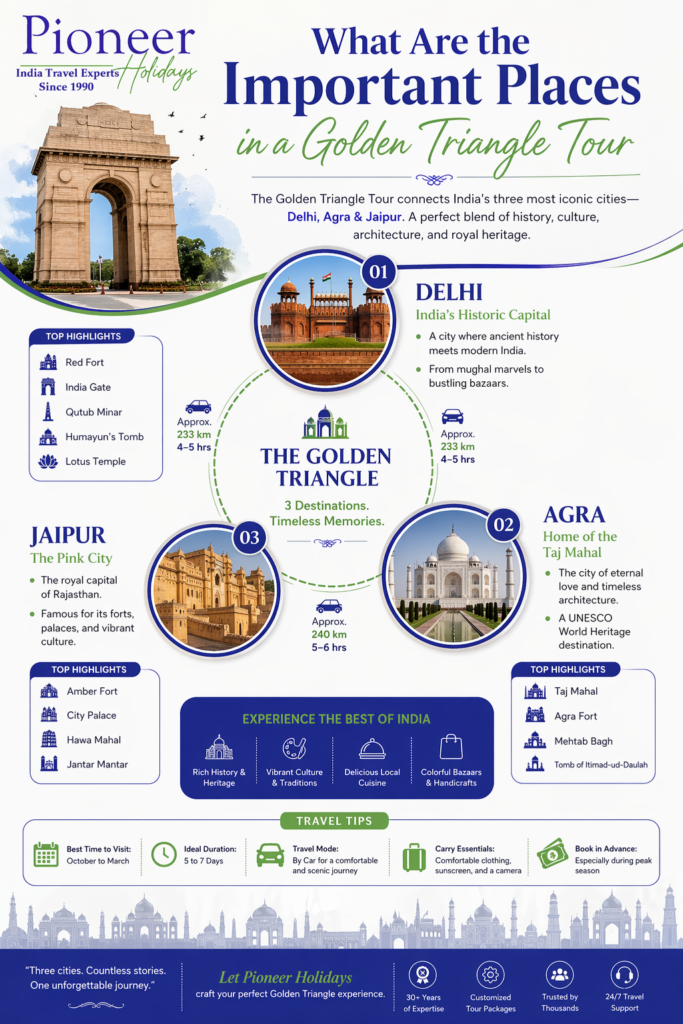
Three cities. One route. Centuries of history packed into a journey that actually makes sense geographically. Delhi, Agra, and Jaipur sit in a triangular shape on the map, roughly 200–250 km apart from each other, which makes travelling between them smooth and manageable even for first-time visitors to India.
But what makes this route truly special is not the convenience. It is what you actually see and feel along the way.
Delhi will make your head spin with its layers — Mughal forts beside modern flyovers, street food bazaars next to five-star hotels. Agra will stop your heart the moment the Taj Mahal comes into view. And Jaipur will wrap you in colour, royalty, and the warmest hospitality you have ever experienced.
This guide covers every important place on the Golden Triangle route — not just the names and facts, but what to actually expect when you stand there. If you are planning your trip, browse our Golden Triangle Tour packages to find the right one for your budget and style.
Delhi — Where Old India and New India Share the Same Street
People often underestimate Delhi. They see it as just a transit city before heading to Agra. That is a mistake.
Delhi is one of the oldest continuously inhabited cities in the world. Every neighbourhood hides a different era — the Sultanate period, the Mughal period, the British colonial era, and modern independent India all exist side by side here. Give Delhi at least two full days and it will genuinely surprise you.
1. Red Fort
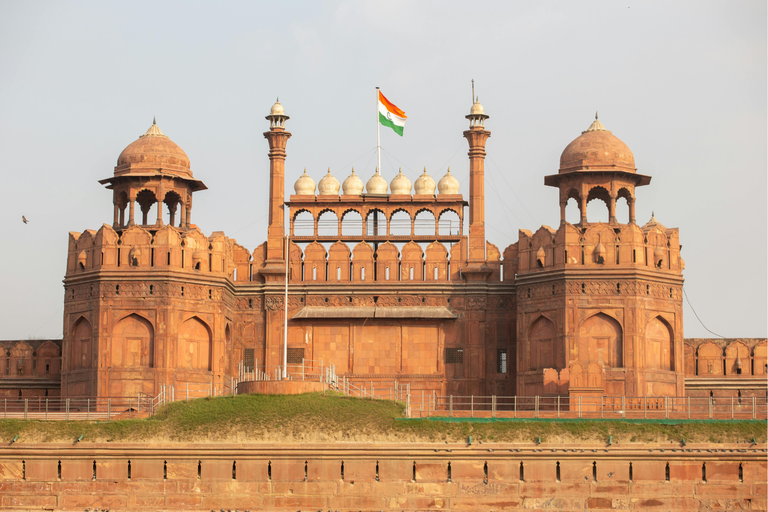
Red Fort is where you start. Not because it is the closest or the most convenient, but because it sets the tone for everything you are about to see.
Shah Jahan built this massive red sandstone fort in the 17th century as his imperial headquarters. The sheer scale of it hits you the moment you walk through the Lahori Gate. Inside, you find palaces, audience halls, gardens, and a small but excellent museum.
Every 15th August, the Prime Minister of India addresses the nation from here — which tells you everything about its place in Indian history and national identity.
Tip: Go on a weekday morning. Crowds build up fast by mid-morning, especially on weekends and national holidays.
2. Humayun’s Tomb
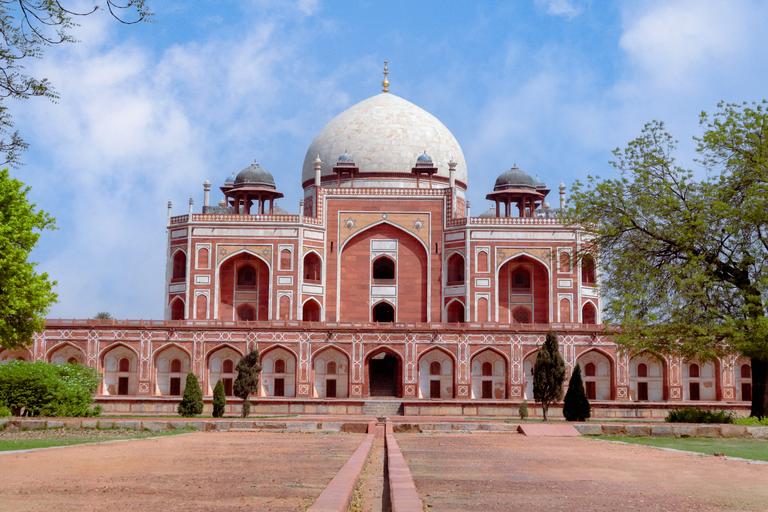
Most visitors skip Humayun’s Tomb in favour of the more famous monuments. That is their loss.
This is the tomb of the Mughal emperor Humayun, built by his grieving wife Haji Begum in the 1560s. Architecturally, it matters enormously — many historians call it the direct ancestor of the Taj Mahal. The same double dome, the same charbagh garden layout, the same use of red sandstone with white marble inlay.
When you visit Humayun’s Tomb before the Taj Mahal, you start to understand Mughal architecture as a living tradition — one that grew and refined itself over generations.
The gardens are immaculate and peaceful. Even on a busy day, you will find quiet corners here where you can sit and just absorb the space.
UNESCO World Heritage Site.
3. Qutub Minar
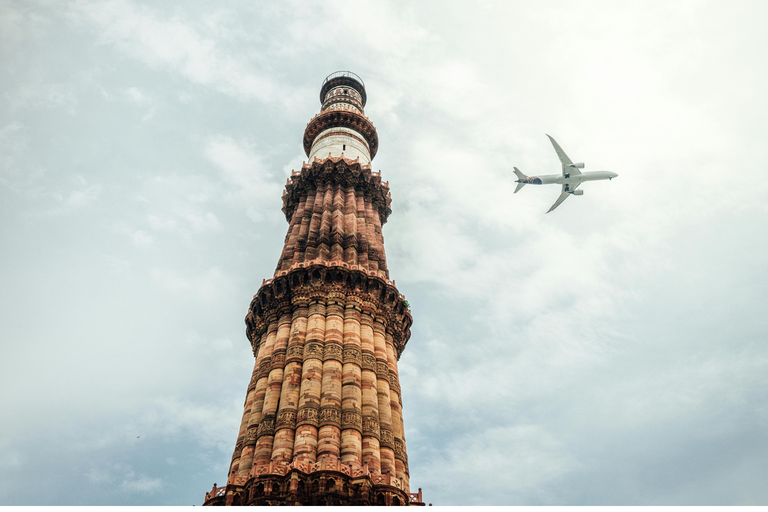
Qutub Minar is older than everything else on this tour — and it looks it. Not in a crumbling way. In a way that makes you stop and recalibrate your understanding of time.
Built in the 12th and 13th centuries, this 73-metre minaret of red sandstone and marble stands at the southern edge of Delhi. Qutb-ud-din Aibak started it and Iltutmish completed it. The carvings on its surface — Arabic inscriptions, floral designs, geometric patterns — remain sharp and detailed after nearly 900 years.
The complex around the minaret includes the ruins of Quwwat-ul-Islam mosque, a mysterious iron pillar that has stood without rusting for over 1,600 years, and several tombs. It rewards slow exploration.
UNESCO World Heritage Site.
4. India Gate
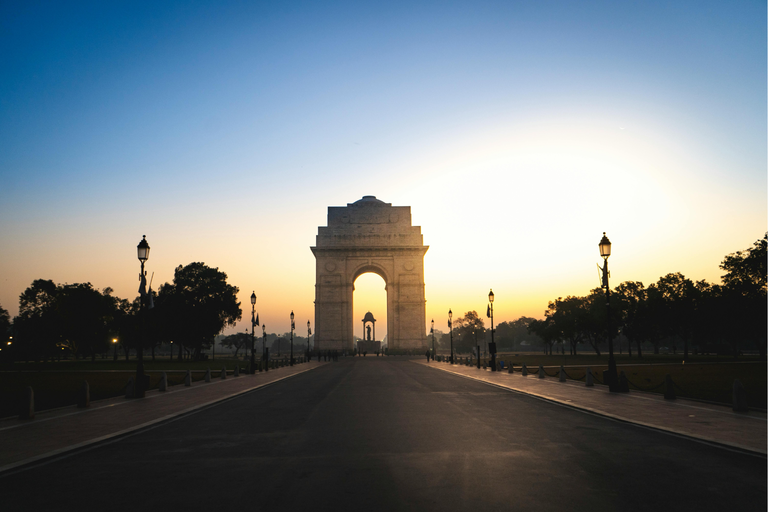
India Gate is not a tomb or a palace. It is a war memorial — built to honour the 84,000 Indian soldiers who died fighting for the British Empire in World War I. More than 13,000 names are inscribed on its walls.
It stands at the end of Rajpath, now renamed Kartavya Path, in the heart of New Delhi. The scale of the boulevard and the gate itself is deliberately grand — designed to project power and solemnity.
In the evenings, ordinary Delhi residents come here with their families, children run on the lawns, and vendors sell snacks along the pathways. Seeing that everyday life happening around a war memorial creates something genuinely moving.
The Eternal Flame, the Amar Jawan Jyoti, burns beneath the arch in honour of soldiers killed in more recent conflicts.
5. Lotus Temple
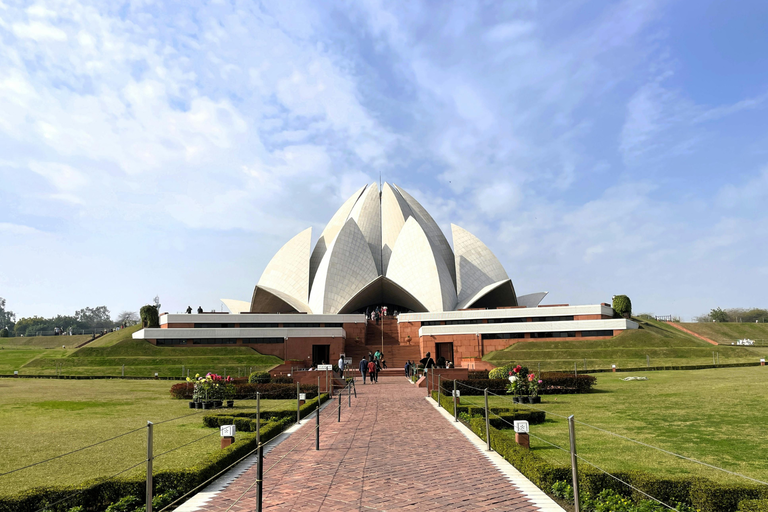
If you have been on your feet visiting forts and tombs all day, Lotus Temple offers something completely different — stillness.
This is a Bahá’í House of Worship, shaped like a half-opened lotus flower in white marble. People of any religion — or no religion at all — are welcome inside. There are no idols, no priests, no sermons. You simply sit in the central hall, which holds 2,500 people in perfect quiet, and breathe.
It sounds simple. In practice, after two days of sensory overload in Delhi’s lanes and monuments, it feels extraordinary.
Agra — The City That Built Its Fame in White Marble
The drive from Delhi to Agra takes roughly three hours on the Yamuna Expressway. As you enter Agra and start seeing the first glimpses of white marble peeking above rooftops, something shifts. You realise you are about to see something genuinely rare.
1. Taj Mahal
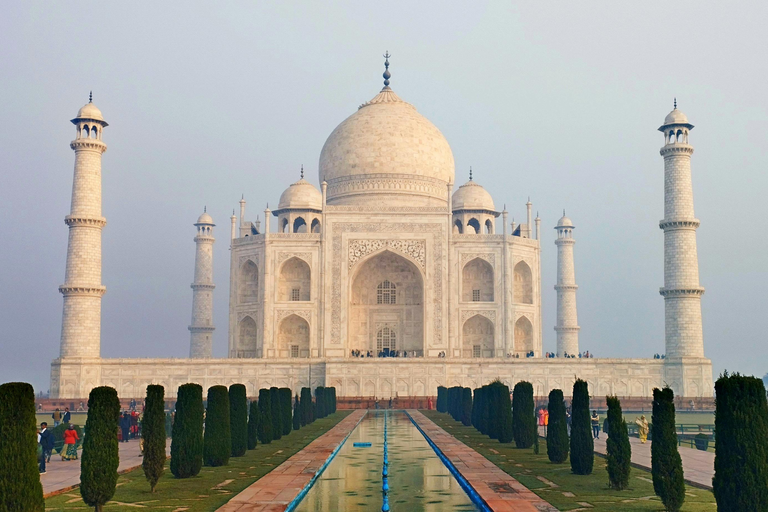
Let me be honest with you: no photograph, no description, and no amount of prior knowledge actually prepares you for the Taj Mahal.
Shah Jahan built it between 1632 and 1653 as a mausoleum for his wife Mumtaz Mahal, who died during childbirth. Over 20,000 workers and craftsmen from across India, Persia, and Central Asia worked on it. The white Makrana marble was brought from Rajasthan. Semi-precious stones — carnelian, lapis lazuli, turquoise, jade — were inlaid into the marble in intricate floral patterns.
What makes it architecturally astonishing is its symmetry. Every element — the four minarets, the reflecting pool, the gardens, the gateway arch — is placed with mathematical precision. The main dome appears to change colour throughout the day: pinkish at sunrise, brilliant white at noon, golden at sunset.
Inside the main chamber lie the cenotaphs of Mumtaz Mahal and Shah Jahan, surrounded by carved marble screens. The actual tombs rest in a chamber below.
See it at sunrise. The gates open before dawn for sunrise visitors. The light at that hour on white marble is unlike anything else. Crowds are also far thinner at that time.
Note: The Taj Mahal remains closed every Friday.
2. Agra Fort
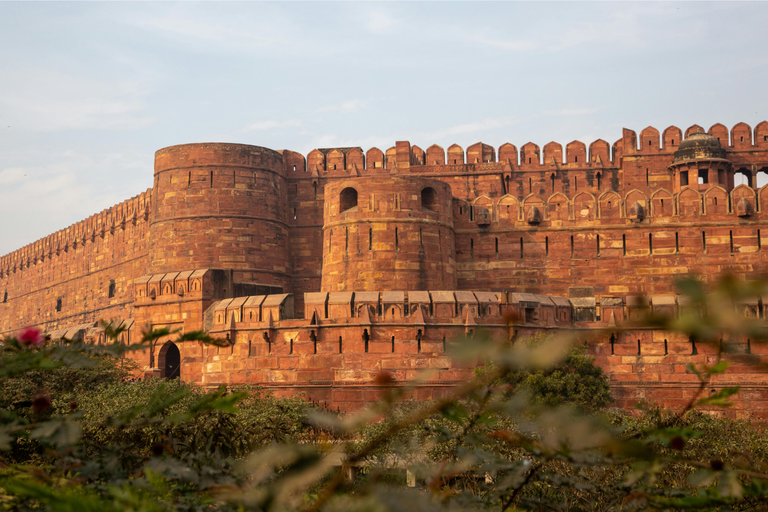
Most people see the Taj Mahal and then leave Agra. The ones who stay and visit Agra Fort understand the full story.
Akbar began building this enormous red sandstone fort in 1565. Shah Jahan later added marble palaces, audience halls, and pleasure pavilions inside its walls. The result is a city within a city — you can spend two to three hours walking through it and still not see everything.
The Diwan-e-Aam (Hall of Public Audience), the Diwan-e-Khas (Hall of Private Audience), and the Jahangir Palace are the highlights. Each shows a different aspect of Mughal court life.
The most poignant part of the fort is the Musamman Burj — an octagonal tower with a marble balcony overlooking the Yamuna river. Shah Jahan spent the final eight years of his life imprisoned in this tower by his own son Aurangzeb. From this tower, he could see the Taj Mahal in the distance — the tomb he had built for his beloved wife, which would eventually become his own resting place.
UNESCO World Heritage Site.
3. Mehtab Bagh
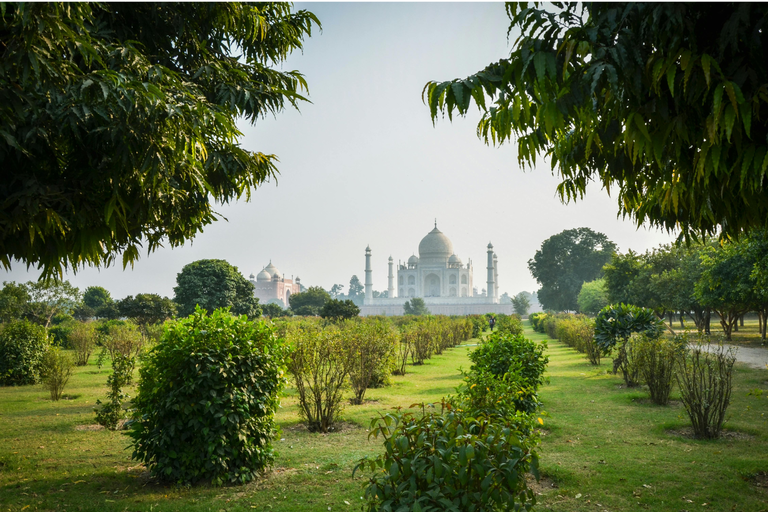
Mehtab Bagh means “Moonlight Garden.” Shah Jahan created it directly across the Yamuna from the Taj Mahal so he could view it from the north bank — the one direction where crowds and vendors do not gather.
Today, Mehtab Bagh offers the cleanest, most unobstructed view of the Taj Mahal available. The gardens sit slightly elevated above the riverbank. At sunset, the light turns the white marble a deep amber and the Taj reflects in the river below.
Photographers love this spot for obvious reasons. But even if you are not carrying a camera, come here. Stand quietly for a few minutes. The view is one you will carry with you for the rest of your life.
4. Fatehpur Sikri
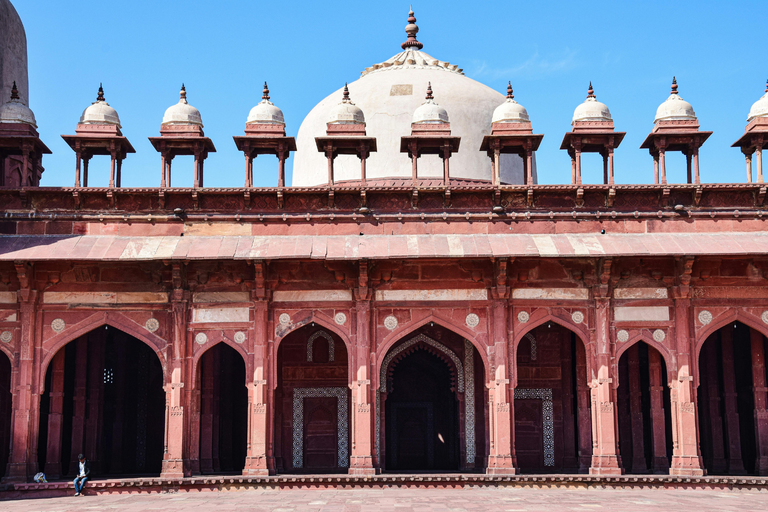
About 37 km west of Agra, the abandoned Mughal city of Fatehpur Sikri sits on a ridge of red sandstone as if time stopped there in 1585.
Akbar built this entire city from scratch as his new capital. He occupied it for only about 14 years before the water supply ran short and the court moved to Lahore. What he left behind is a perfectly preserved ghost city — palaces, courtyards, audience halls, and mosques still standing in near-original condition after 450 years.
The Buland Darwaza — the Gate of Magnificence — stands 54 metres tall and remains one of the largest gateways in the world. The Jama Masjid inside the complex is a working mosque. The Diwan-e-Khas has a single carved stone pillar in the centre supporting a circular platform where Akbar reportedly sat to debate with scholars of different faiths.
Fatehpur Sikri rewards visitors who take a local guide. The stories behind each structure are fascinating and not always obvious from the architecture alone.
UNESCO World Heritage Site.
Jaipur — Where Rajputana Royalty Still Feels Alive
Jaipur is different from Delhi and Agra in a way you sense immediately when you arrive. The other two cities carry the weight of Mughal history. Jaipur carries the pride of Rajput kings — a different kind of power, more theatrical, more colourful, and in some ways more alive today than it was centuries ago.
Maharaja Sawai Jai Singh II founded the city in 1727. He painted many of its buildings a warm terracotta pink in 1876 to welcome the Prince of Wales — and the colour stuck. Today Jaipur is officially the Pink City.
1. Amber Fort
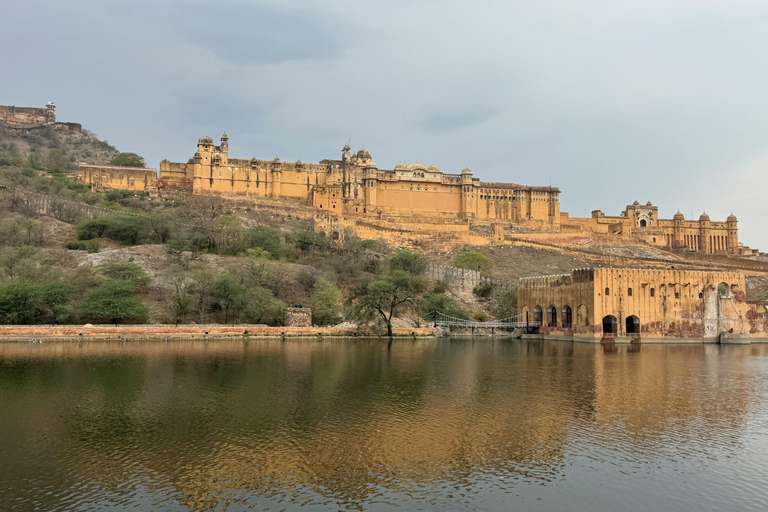
Amber Fort is the defining image of Jaipur — a golden-coloured fort rising in tiers up a rocky hillside, reflected in the Maota Lake below.
Raja Man Singh I began building it in 1592. Successive Rajput rulers expanded it over the following century. The result is an extraordinary complex that blends Rajput and Mughal architectural styles — something that happened nowhere else in India with quite the same elegance.
Walk up through the Suraj Pol (Sun Gate) into the main courtyard. From there, the Sheesh Mahal — the Palace of Mirrors — is the undisputed highlight. Tiny convex mirrors cover every centimetre of the ceiling and walls. When a guide lights a single candle inside, the entire chamber erupts in reflected light, filling every surface with moving stars.
The views down to the lake and across the valley from the fort’s upper terraces are excellent, especially in the early morning.
Tip: Walk up the ramp rather than taking an elephant ride. The walk takes about 15 minutes and gives you better views along the way.
2. City Palace Jaipur
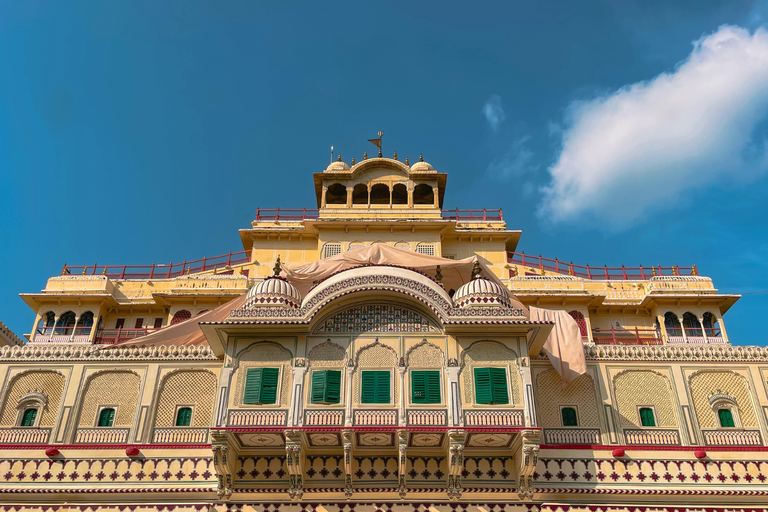
City Palace sits at the centre of Jaipur’s old walled city, and uniquely among Indian royal palaces, part of it is still the private residence of the royal family of Jaipur.
Maharaja Sawai Jai Singh II began building it when he founded the city. Successive rulers added to it across two centuries, which is why the complex today is a fascinating mix of Rajput, Mughal, and European architectural influences.
The museums inside hold an impressive collection — royal costumes, weapons, manuscripts, miniature paintings, and the famous pair of enormous silver urns that the Maharaja Madho Singh II reportedly used to carry Ganga water on his voyage to England in 1902 because he refused to drink foreign water.
The Mubarak Mahal and Chandra Mahal are the most photographed structures. The entire complex is active and maintained — which gives it a living quality that purely archaeological sites often lack.
3. Hawa Mahal
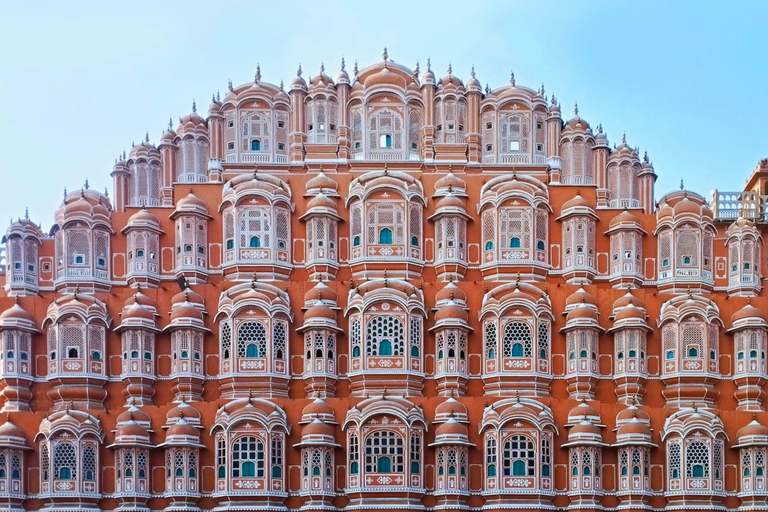
Hawa Mahal — the Palace of Winds — is Jaipur’s most recognisable landmark. It appears on every poster, every travel magazine, every Instagram grid from Jaipur.
Maharaja Sawai Pratap Singh built it in 1799. The five-storey pink sandstone facade has 953 small latticed windows called jharokhas, each one uniquely designed and carved. The palace was built so that royal ladies could observe street festivals and daily city life from behind the lattice screens without being seen — the system of purdah at architectural scale.
Seen from the street, Hawa Mahal looks like a solid monument. From the inside, it is remarkably thin — more of a screen than a palace. The upper floors offer good views over the bazaar streets below.
Visit in the morning when the eastern sun lights up the pink facade.
4. Jantar Mantar Jaipur
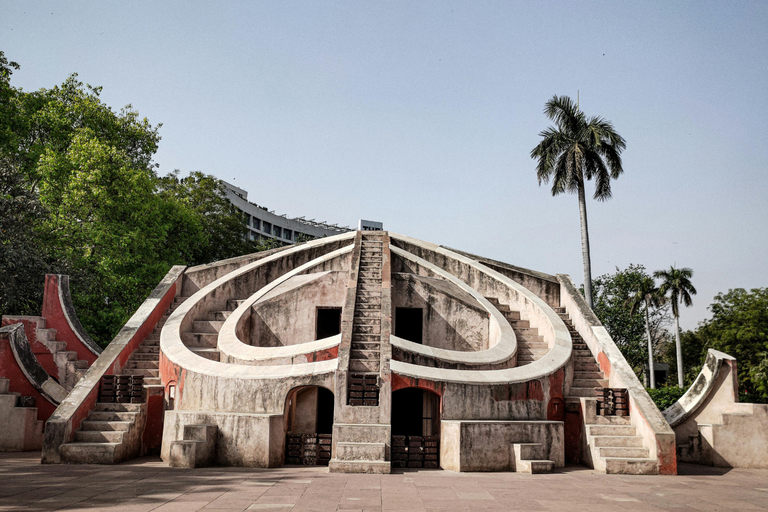
Jantar Mantar is the most intellectually surprising stop on the entire Golden Triangle Tour.
Maharaja Sawai Jai Singh II — who was a serious astronomer in addition to being a king — built this open-air observatory in the 1720s and 1730s. It contains 19 large stone and marble instruments, each designed to measure specific astronomical data: the position of stars, the time of day, the declination of celestial bodies, the prediction of eclipses.
The largest instrument, the Samrat Yantra, is a sundial that can tell time accurate to within two seconds. It stands 27 metres tall. Without any metal, any glass, any electricity, using only carefully calculated geometry in stone, it still works perfectly today.
Standing next to it forces a genuine recalibration of your assumptions about science and sophistication in pre-modern India.
UNESCO World Heritage Site.
5. Nahargarh Fort
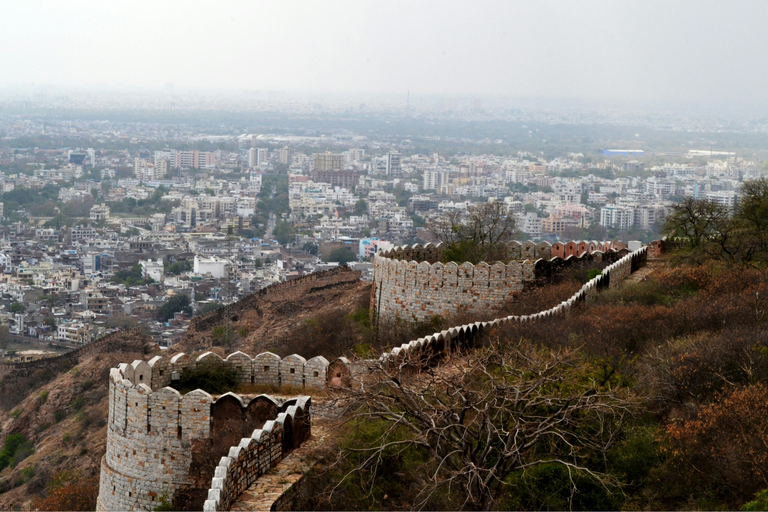
Nahargarh Fort sits high on the Aravalli ridge above Jaipur, and it is the best place in the city to watch the sun set.
Maharaja Sawai Jai Singh II built it in 1734 primarily as a defensive position protecting the new city below. It forms part of a three-fort defensive chain along with Amber Fort and Jaigarh Fort. The inner palace — Madhavendra Bhawan — has a fascinating layout: nine separate but connected suites, all built identically, reportedly one for each of the Maharaja’s nine queens.
The fort itself is less polished than Amber or City Palace — and that actually works in its favour. It feels rawer, more authentic, less curated.
But the main reason to come here is the view. From the ramparts, the entire city of Jaipur spreads out below you — the pink buildings, the city walls, the palaces, the bazaars, all the way to the distant Thar Desert horizon. At sunset, with the sky turning orange and the city lights beginning to flicker on, it is genuinely one of the most beautiful views in Rajasthan.
The Golden Triangle Tour at a Glance
| City | Key Highlights | Best Time to Visit | Distance from Delhi |
|---|---|---|---|
| Delhi | Red Fort, Humayun’s Tomb, Qutub Minar, India Gate | October to March | Starting point |
| Agra | Taj Mahal, Agra Fort, Mehtab Bagh, Fatehpur Sikri | October to March | ~200 km (3 hrs) |
| Jaipur | Amber Fort, City Palace, Hawa Mahal, Jantar Mantar, Nahargarh | October to March | ~260 km from Agra |
Practical Tips Before You Go
Start early every day. Every monument on this tour becomes significantly more crowded by 10 am. Reaching by 7 or 7:30 am means better light for photos, cooler temperatures, and far fewer people.
Wear comfortable shoes. You will walk on uneven stone floors, climb steep ramps, and cover large courtyards. Sandals or formal shoes will wear you out fast.
Carry cash. Many local guides, auto-rickshaws, and small food stalls do not accept cards or digital payments. Keep small denomination notes handy.
Hire a local guide at each site. The entry fees are small and the difference in understanding what you are looking at is enormous. A good guide transforms a walk through old buildings into a genuinely moving experience.
Book the Taj Mahal slot in advance. Especially during peak season (October to February), entry slots fill up. Book online before your trip.
Carry water. Especially in Agra and Jaipur, where you spend a lot of time outdoors in the sun.
Ready to Plan Your Trip?
The Golden Triangle is the perfect introduction to India — compact enough to cover in 5–7 days, varied enough to give you a genuine cross-section of the country’s history and culture, and well-connected enough to travel comfortably without specialist logistics.
Whether you want a private luxury experience or a value-packed group tour, we have Golden Triangle Tour packages designed for every type of traveller.
Pioneer Holidays is based in Agra, steps from the Taj Mahal. We have been guiding travellers through the Golden Triangle for years and we know these cities and their stories deeply. Get in touch and we will help you plan a trip that goes beyond the obvious.
Frequently Asked Questions
1. What cities are included in the Golden Triangle Tour of India?
The Golden Triangle Tour in India includes three major cities: Delhi, Agra, and Jaipur. These cities form a triangular route on the map and offer a perfect mix of history, culture, and architecture. Delhi showcases Mughal and modern India, Agra is famous for the Taj Mahal, and Jaipur represents royal Rajasthan with its forts and palaces.
2. What are the must-visit attractions in Delhi during the Golden Triangle Tour?
In Delhi, travelers usually explore iconic landmarks like Red Fort, Qutub Minar, India Gate, Lotus Temple, and Humayun’s Tomb. Old Delhi attractions such as Chandni Chowk and Jama Masjid are also popular for experiencing local culture, street food, and heritage.
3. Which monuments should not be missed in Agra?
Agra is best known for the Taj Mahal, one of the Seven Wonders of the World. Other important places include Agra Fort, a UNESCO World Heritage Site, and Mehtab Bagh, which offers a stunning view of the Taj Mahal at sunset. Many travelers also visit Fatehpur Sikri nearby.
4. What are the top attractions in Jaipur on the Golden Triangle route?
Jaipur, also known as the Pink City, offers stunning attractions such as Amber Fort, City Palace, Hawa Mahal, and Jantar Mantar. Visitors also enjoy local bazaars, traditional Rajasthani culture, and heritage experiences like elephant rides or folk performances.
5. How many days are enough to cover the main places in the Golden Triangle Tour?
A 5 to 7-day itinerary is ideal to cover the important places in the Golden Triangle Tour comfortably. This allows enough time to explore major attractions in Delhi, visit the Taj Mahal in Agra, and experience the forts and culture of Jaipur without feeling rushed.
