
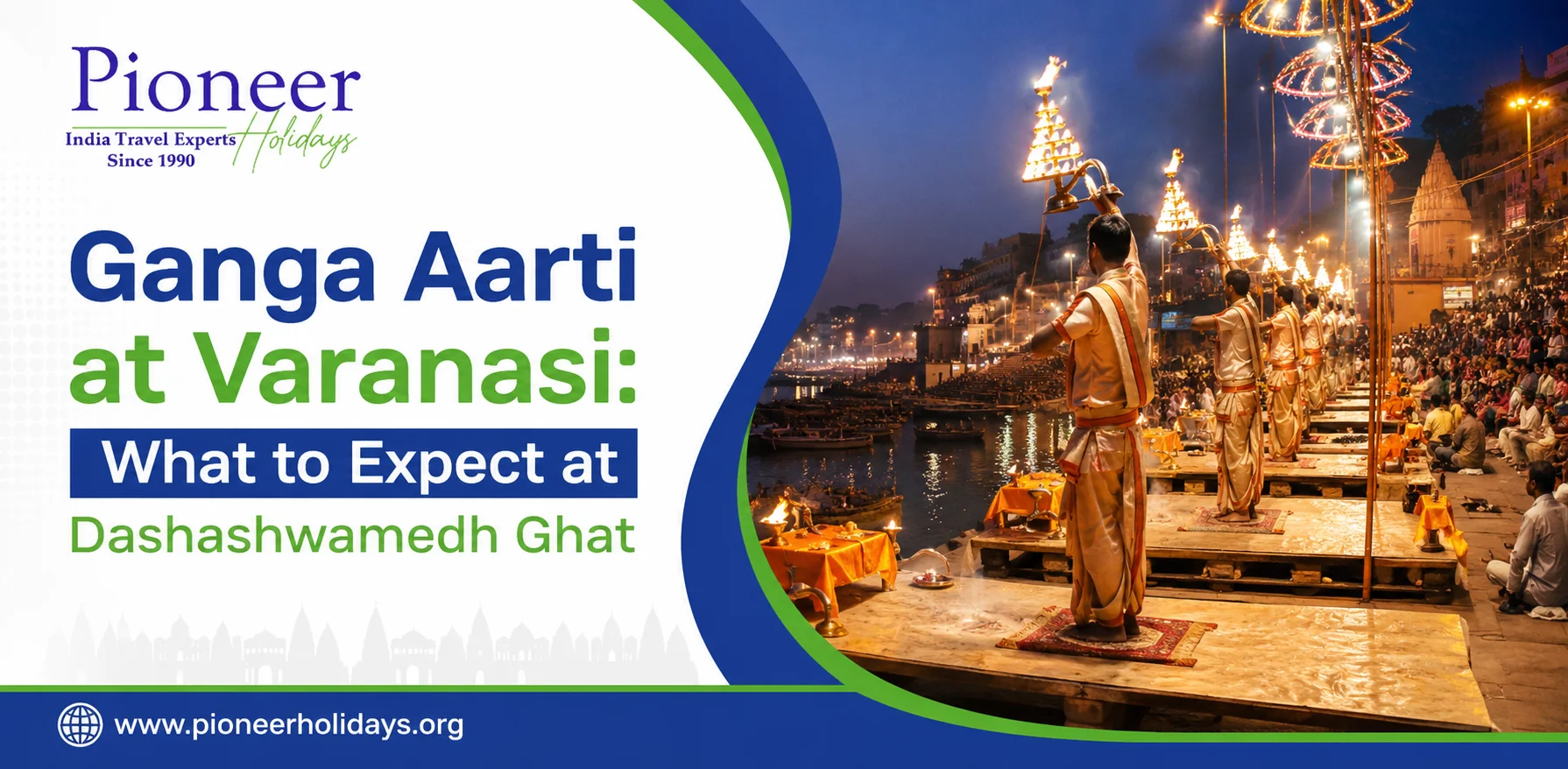
The Ganga Aarti at Varanasi is a fire and chant ceremony held every evening at Dashashwamedh Ghat, where priests offer flame, incense, and prayer to the river Ganga while thousands of visitors watch from the steps or from boats on the water. If you only have one evening in Varanasi, this is the experience most travelers remember longest.
What First-Time Visitors Usually Feel?
Most first-time visitors feel a mix of sensory overload and quiet stillness within the same ten minutes. The crowd noise, the smell of incense and diesel from boats, the drums, and the sheer number of people can feel overwhelming during the first few minutes on the ghat. Then the priests light the large brass lamps, the chanting settles into rhythm, and something shifts. Visitors who came expecting a tourist show often tell us afterward that it felt more personal than they imagined.
In our experience at Pioneer Holidays, many international travelers say the ceremony is louder and more crowded than they pictured from photos, but also more moving. Families sometimes worry their children will get restless, yet we’ve watched kids as young as six sit still through the entire forty-minute ceremony simply because the fire and drumming hold attention naturally.
Should You Attend the Evening Aarti at Dashashwamedh Ghat or Subah e Banaras at Assi Ghat?
Attend both if your schedule allows it, because they are genuinely different experiences, not repeats of the same thing. The evening Dashashwamedh Ghat evening Aarti is a large, choreographed ceremony with seven priests, fire, drums, and a big crowd. Subah e Banaras at Assi Ghat is a smaller, quieter morning ritual that includes yoga, classical music, and a sunrise Aarti with far fewer tourists.
If you can only choose one, here’s our honest guidance: choose the evening ceremony if you want spectacle and energy. Choose Assi Ghat morning Aarti if you prefer calm, fewer crowds, and better light for photography. After helping more than fifty thousand travelers since nineteen ninety, we usually recommend doing the evening Aarti on arrival day and the morning boat ride with Subah e Banaras the next day, since the two together give you the full emotional range of Varanasi in under 24 hours.
What Time Should You Leave Your Hotel to Get a Good Spot?
Leave your hotel at least 60 to 90 minutes before the ceremony starts, longer during festivals and peak season. The ghat fills up fast, and traffic near the old city moves slowly regardless of the distance on a map.
| Travel Method | Recommended Departure Time | Notes |
|---|---|---|
| Walking from a nearby ghat hotel | 45–60 minutes before | Lanes are narrow and crowded, walk slowly |
| Auto rickshaw from mid-city hotel | 75–90 minutes before | Traffic near Godowlia crossing gets heavy |
| Private car | 90 minutes before | Cars stop well before the ghat; expect a 10–15 minute walk in |
| Festival days (Dev Deepawali, Kartik Purnima) | 2.5–3 hours before | Roads close early, crowds arrive hours ahead |
| Peak season (Oct–Feb evenings) | 90–120 minutes before | This is when demand for seating is highest |
If you’re staying with us on a Private Varanasi Tour Packages itinerary, your guide will adjust this timing based on the specific date, since festival crowds and weekday crowds are not the same.
Ghat Steps or Boat: Our Honest Recommendation
We recommend the boat for most first-time visitors, and the ghat steps for anyone traveling with young children or limited mobility. Both have real advantages, and the right choice depends on who is in your group.
| Factor | Ghat Steps | Boat View |
|---|---|---|
| Atmosphere | Loud, immersive, close to chanting | Calmer, slightly distant, water reflections add mood |
| Comfort | Crowded seating, can get warm | Roomier, cooler with the breeze off the water |
| Photography | Close-up shots of priests and fire | Wide shots with skyline and reflected lights |
| Crowds | Very dense near the ceremony | Boats spread out, less physical crowding |
| Families with kids | Harder to move if a child gets tired | Easier to leave early if needed |
| Older travelers | Steps can be steep and uneven | Easier seating, less walking |
| Best overall experience | Best for energy and closeness | Best for comfort and unique photos |
Boat view Ganga Aarti bookings should be made through a licensed boatman, ideally arranged in advance by your hotel or tour operator, since unregulated last-minute boats near the ghat sometimes overcharge tourists.
What Is the Ganga Aarti Time at Dashashwamedh Ghat?
The ceremony usually begins around sunset, roughly between 6:00 PM and 7:15 PM depending on the season. Summer evenings push the start time later, closer to 7:00 or 7:15 PM, while winter ceremonies often begin around 6:00 PM since the sun sets earlier.
According to official tourism information, the Ganga Aarti is one of Varanasi’s most significant daily spiritual ceremonies, attracting visitors from around the world. Because exact timing shifts a little through the year and can move slightly for festivals, we always tell our travelers to confirm the local time with their hotel or guide on the day itself rather than relying on a fixed schedule found online.
Practical Tips Before You Arrive
A few small preparations make the evening far more comfortable, and most of these come from things we’ve watched go wrong for other travelers.
- Clothing: Wear light, modest clothing that covers shoulders and knees. Evenings can be humid even in cooler months.
- Shoes: Wear shoes you can slip off easily, since some viewing areas and nearby temples require removing footwear.
- Photography: A phone camera handles the low light better than most people expect. Tripods are impractical in the crowd.
- Crowds: Stay close to your group physically. It’s easy to get separated in the final ten minutes before the ceremony starts.
- Safety: Keep bags in front of you, not on your back, in dense crowd areas.
- Children: Hold hands on the steps closest to the water, they can be slippery.
- Weather: Carry a light shawl even in warm months, the breeze off the river cools quickly after sunset.
- Cash: Carry small denomination cash for boat rides, offerings, or street food afterward. Card payments are unreliable this close to the ghat.
- Toilets: Use hotel or restaurant facilities before you leave. Public options near the ghat are limited.
- Respectful behaviour: This is an active religious ceremony, not a performance. Avoid loud talking during the main chanting.
- Mobile network: Signal gets patchy in the dense crowd. Agree on a meeting point with your group beforehand.
- Meeting points: Choose a fixed, easy-to-describe landmark in case anyone gets separated.
What Surprises International Visitors the Most?
The scale of the crowd and the amount of movement around them surprises visitors more than the ceremony itself. People expect a quiet, contemplative event similar to a church service. Instead, there’s constant motion: boats arriving, vendors selling flower offerings, children weaving through the crowd, and photographers changing position. Once visitors accept that this is a living, working ghat and not a staged show, most say the energy becomes part of what makes it memorable rather than a distraction.
The second most common surprise is how young many of the priests performing the ceremony are, and how physically demanding the ritual looks, with synchronized movements of heavy brass lamps held for extended periods.
What nearby places should visitors explore after the Aarti or the next morning?
The hour right after the ceremony and the following sunrise are two of the best windows to see Varanasi at its most authentic, so don’t rush back to your hotel. Here’s where we send our travelers.
Kashi Vishwanath Temple area — Once the crowd on the ghat starts to thin, walk the short distance into the old city toward the Kashi Vishwanath corridor. The lanes here stay lively well into the night, with the temple lit up and a steady flow of pilgrims. Security checks apply before entering the temple itself, so if you want to go inside rather than just walk the corridor, keep bags to a minimum and carry a photo ID.
Local food streets near the ghats — This is the easiest win of the evening. Within a few minutes’ walk you’ll find vendors selling kachori sabzi, hot jalebi, and the city’s famous blue lassi. We tell first-time visitors to eat where the queue is local, not where the signage is in English, since that’s usually the better food and the fairer price.
Assi Ghat and Subah e Banaras (next morning) — If you only do one thing the next day, make it this. Assi Ghat morning Aarti is smaller and calmer than the evening ceremony, paired with yoga and classical music at sunrise. It’s a completely different mood from the night before, and most travelers tell us it’s the more peaceful of the two experiences.
Morning boat ride along the Ganga — Book this for first light, just after or during Subah e Banaras. Gliding past the ghats as the city wakes up, with the early sun hitting the stone steps, gives you a view of Varanasi that the evening crowd never lets you see. It’s calmer, cooler, and far better for photography than the evening boat ride.
Banaras silk shops — Varanasi’s handloom silk weaving is centuries old, and a short visit to a genuine weaving workshop (not just a retail showroom) is worth the hour if you’re at all interested in textiles. Ask your guide to take you to a shop connected to an actual weaving family rather than a large tourist-focused store, the quality and the story behind the fabric are both better.
Hidden lanes behind the main ghats — If you enjoy wandering without a fixed plan, the narrow lanes just behind Dashashwamedh and the surrounding ghats are full of small shrines, tea stalls, and everyday local life that most organized tours skip entirely. Fifteen or twenty minutes here, ideally with a local guide, gives you a much more grounded sense of the city than the main tourist stretch.
What to Do After Ganga Aarti?
Don’t rush back to your hotel immediately, the hour after the ceremony is one of the best times to explore the old city. Once the crowd thins slightly, walk toward the Kashi Vishwanath area to see the temple lanes lit up for the evening. If you have energy left, wander through the local food streets near the ghat for street snacks like kachori sabzi or hot jalebi, both good ways to end the evening.
The next morning, take a sunrise boat ride along the river, this is genuinely one of the best things to do in Varanasi and offers a completely different view of the same ghats you saw the night before. Afterward, Banaras silk shops in the old city are worth an hour if you want to see handloom weaving in person rather than buying from a generic tourist shop. If you enjoy getting lost a little, the hidden lanes behind the main ghats reveal small shrines and local life that most tour buses skip entirely.
Common Mistakes Tourists Make
Most mistakes come from underestimating the crowd and overestimating how much time they have. Here’s what we see most often:
- Arriving too late and ending up far from the main viewing area with an obstructed view.
- Booking an unlicensed boat at the last minute for a higher price than necessary.
- Wearing shoes that are hard to remove, causing delays at temple entrances nearby.
- Expecting silence and feeling frustrated by the noise and movement instead of adjusting expectations beforehand.
- Leaving immediately after the ceremony ends, missing the calmer, atmospheric period right after.
- Not carrying cash, then struggling to pay for a boat, offering, or snack.
- Falling for unofficial guides near the ghat offering “special seating” for a high fee, always book through a verified source.
Best Season, Month, and Festivals to experience the Ganga Aarti
October through March is the best time to visit Varanasi and see the Ganga Aarti comfortably, with November and December offering the most pleasant evening weather.
| Season | Advantages | Disadvantages |
|---|---|---|
| Oct–Mar (Best time to visit Varanasi) | Cool evenings, comfortable crowds, clear skies | Peak season means higher hotel prices |
| Apr–Jun (Summer) | Fewer tourists, easier hotel booking | Very hot and humid, uncomfortable evenings |
| Jul–Sep (Monsoon) | Dramatic river views, lush surroundings | Rain can disrupt the ceremony, ghats can flood |
| Festival days (Dev Deepawali, Kartik Purnima) | Thousands of extra lamps, unforgettable atmosphere | Extremely crowded, requires much earlier arrival |
Dev Deepawali, usually in November, is the single most spectacular night to witness the ceremony, when the entire ghat is lined with lit lamps. It is also the most crowded night of the year, so it suits travelers who prioritize atmosphere over comfort.
Questions Our Travelers Ask Most
How long does the Ganga Aarti ceremony last?
The full ceremony usually runs between 45 minutes and an hour, though the atmosphere builds for a while before the priests actually begin.
Who performs the Ganga Aarti at Dashashwamedh Ghat?
A group of trained young priests perform the synchronized ritual each evening, following a routine passed down through generations of ghat families.
What should I wear to the Ganga Aarti?
Wear modest, breathable clothing that covers shoulders and knees, along with shoes that are easy to remove near temple areas.
Where is the best place to watch Ganga Aarti for families with young children?
The ghat steps near the back of the main viewing area work well for families, since it’s easier to move a tired child without pushing through the dense front crowd.
When should first-time visitors book their boat for the Aarti?
Book at least a day in advance through your hotel or tour operator to avoid inflated last-minute pricing near the ghat.
How do I avoid scams near Dashashwamedh Ghat?
Avoid anyone offering “VIP seating” or unusually cheap boat rides on the spot. Arrange boats and guides through a verified operator before you arrive.
What is Subah e Banaras and is it different from the evening Aarti?
Subah e Banaras is the morning ceremony at Assi Ghat, combining yoga, music, and a sunrise Aarti. It’s quieter and less crowded than the evening ceremony at Dashashwamedh Ghat.
Planning Your Varanasi Visit
If you’re building a longer India itinerary, our Complete Varanasi Travel Guide covers everything from where to stay to how many days you need in the city. For travelers combining Varanasi with Delhi, Agra, and Jaipur, our Private Golden Triangle Tour with Varanasi is designed entirely around private transport and flexible timing, so you’re never stuck matching someone else’s schedule around the Aarti. Pioneer Holidays has arranged private tours for international travelers since 1990, with over 50,000 travelers served and more than 7,100 TripAdvisor reviews, and every Varanasi itinerary we build is private, with no fixed groups and no rushed schedules.
