
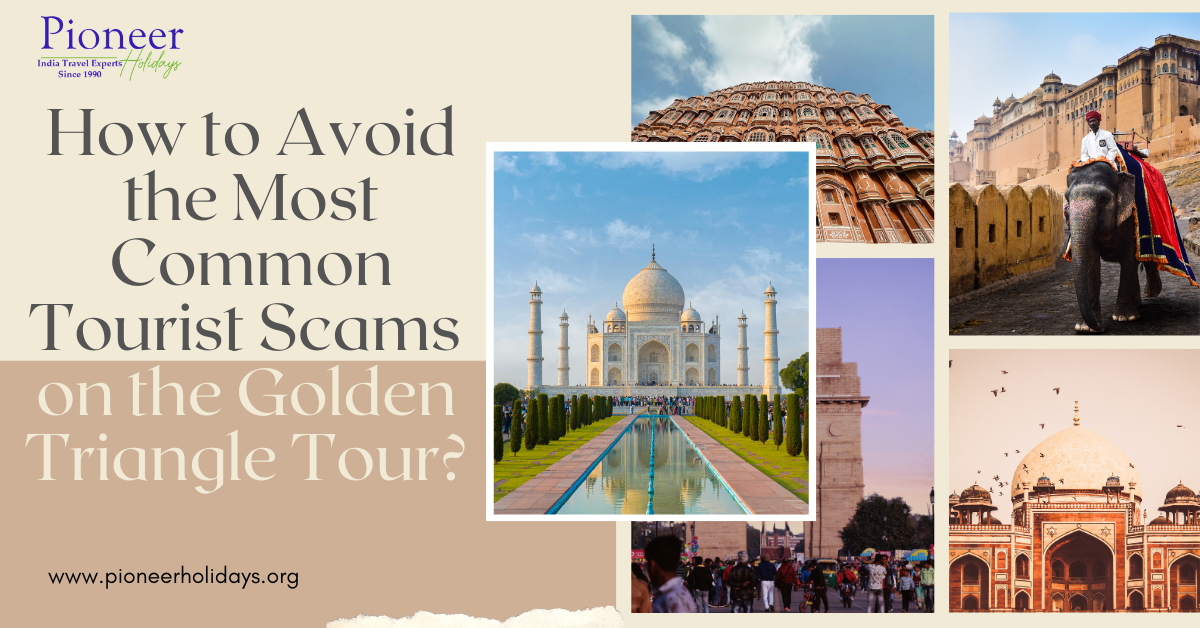
India’s Golden Triangle, comprising Delhi, Agra, and Jaipur, draws more first-time visitors than almost any other route in the country. Most travelers return home talking about the Taj Mahal at sunrise rather than anything that went wrong. Still, the concern is real. Anyone researching the trip eventually comes across a story about a taxi driver who took a “shortcut” or a shop that suddenly became part of the itinerary. That concern is understandable, but it is also avoidable. Almost every scam on this route follows a recognizable pattern, and once you know how to spot that pattern, the risk drops sharply.
This guide walks you through the scams travelers actually encounter on the Delhi, Agra, and Jaipur circuit, city by city, with clear warning signs and simple ways to respond. Think of it as part of the broader safety advice for first-time visitors to India, helping you travel with confidence instead of suspicion. By the end, you will know exactly what to watch for and exactly how to deal with it.
What Are the Most Common Tourist Scams on the Golden Triangle Tour (Delhi, Agra, Jaipur)?
The most common Golden Triangle scams revolve around money and misdirection — taxi overcharging, fake officials, commission-driven shopping detours, and strangers who insert themselves into your plans before you realize what’s happening.
These scams aren’t random. They’re built around a handful of repeatable setups that work because they exploit a traveler’s natural instinct to trust a friendly face or a uniform.
- Fake tour guides approach near monuments, claim to be “government certified,” and charge inflated fees for a tour you never asked for. They target people standing alone near ticket counters, looking slightly lost.
- Delhi taxi scams involve a meter that “isn’t working,” a flat rate that’s three times the real fare, or a driver who insists your hotel is “closed” or “full” so he can take you to one that pays him commission.
- Fake government tourism offices sit near real tourist hubs with official-sounding names and government-style decor. Staff sell overpriced “mandatory” tours and fake train tickets.
- Unofficial ticket sellers wait outside monument gates and sell tickets at double the price, sometimes for entry that’s already free for foreign visitors with a real ticket.
- Overpriced taxis and autos quote a number before checking the meter, then add “extra” charges for luggage, tolls, or waiting time that were never mentioned upfront.
- Forced shopping happens when a driver or guide takes you to a “cooperative” or “government emporium” that is, in reality, a commission shop with steep markups.
- “Attraction closed today” tricks are used to redirect you to a shop or a different paid attraction, claiming the site you wanted is shut for a holiday, VIP visit, or maintenance.
- Currency exchange tricks appear at informal exchange counters that quote a good rate, then shortchange the count or charge a hidden “service fee” at the very end.
- Overly helpful strangers offer free directions, then walk you toward a shop, a “special” taxi, or a fake office — friendliness as the entry point, not the goal.
- Fake photographers at monuments offer to take your photo, then demand a steep “tip” or claim they need payment for “professional” equipment use.
- Tuk-tuk scams combine a cheap initial fare with an unplanned detour through several shops, each one paying the driver a commission for bringing customers through the door.
How to avoid all of these: Confirm prices before you get in any vehicle, buy tickets only from official counters, and treat unsolicited help with polite distance rather than rudeness. A scam that doesn’t get your trust doesn’t get your money.
What Practical Advice Does Pioneer Holidays Give Every Traveler Before the Golden Triangle Tour?
Before any trip starts, Pioneer Holidays walks travelers through a short list of habits that quietly remove most scam opportunities — none of them complicated, all of them effective.
After guiding travelers across this route for decades, a few habits come up again and again as the ones that matter most:
- Keep emergency contacts saved in your phone and written on paper, including your guide, driver, hotel, and embassy.
- Carry small cash denominations. Large notes invite “no change” excuses that work in the seller’s favor.
- Avoid random offers from strangers near monuments, stations, and hotel entrances, no matter how official they sound.
- Buy only official tickets from the counter or your tour operator — never from someone selling outside the gate.
- Trust verified guides only, ideally ones provided through your tour company with traceable identification.
- Confirm prices before any service starts — taxi fares, photography, souvenirs, everything.
- Stay alert in crowded areas, where distraction techniques work best.
- Respect local customs and dress codes, which also reduces unwanted attention in religious sites and markets.
- Use your hotel’s front desk whenever you’re unsure about a price, a route, or a recommendation — most hotels are genuinely happy to help.
Which Tourist Scams Are Unique to Each City on the Golden Triangle?
Delhi, Agra, and Jaipur each have one scam that shows up more often than any other, and recognizing it by name makes it far easier to sidestep in the moment.
Delhi: The Airport “Helpful Stranger”
This one starts the moment you land. A friendly local, sometimes near the taxi stand and sometimes inside the arrivals hall, offers to help with your luggage, provide directions, or find you a “better” taxi rate. They then lead you to an unmetered cab or an unofficial booth that charges far more than a prepaid or app-based taxi.
Tourists fall for it because jet lag and unfamiliar surroundings make a confident, friendly voice feel like relief. The fix is simple: walk straight to the prepaid taxi counter or your pre-arranged pickup, and don’t engage with anyone offering “help” before you reach it.
Agra: The “Monument Closed Today” Trick
Near the Taj Mahal, a stranger or even a uniformed-looking person tells you the monument is closed for a holiday, VIP visit, or cleaning, and offers to take you somewhere else “just as good” instead.
This works because travelers don’t want to waste a trip they planned for months, so they accept the alternative without checking. The Taj Mahal’s actual closures are rare and predictable — confirm timing through your hotel or guide, not through anyone you meet on the street.
Jaipur: The Gem Scam
A friendly local, sometimes posing as a fellow tourist or a teacher, strikes up a conversation and eventually mentions a “government export scheme” where you can buy gems cheaply and resell them at home for profit. The gems are worthless, and the “scheme” doesn’t exist.
This one targets travelers who enjoy a good conversation and don’t expect a stranger to pitch an investment. No legitimate export programs work this way — if anyone frames buying jewelry as a financial opportunity, walk away.
The Tuk-Tuk Commission Shop Circuit
This pattern appears in all three cities, though it’s especially common in Jaipur and Agra. A tuk-tuk driver offers a suspiciously cheap city tour, then “suggests” stops at several shops along the way, each one paying him a commission for the visit.
Tourists go along because the fare was so low it feels like a bargain. Agree on a fixed route and price in advance, and tell the driver clearly that you won’t be stopping at shops.
| City | Common Scam | Best Prevention Tip |
|---|---|---|
| Delhi | Airport “helpful stranger” taxi redirect | Go straight to the prepaid taxi counter or pre-arranged pickup |
| Agra | “Monument closed today” redirect | Confirm Taj Mahal timings through your hotel or guide only |
| Jaipur | Gem export scheme | Treat any gem “investment” pitch as a red flag, no exceptions |
| All three | Tuk-tuk commission shop circuit | Fix the route and price before getting in, and say no to shop stops upfront |
What Warning Signs Should Travelers Notice Before They Get Scammed?
Most scams share the same handful of warning signs: rushed pressure, vague pricing, and missing paperwork. Learning to recognize these signs within the first ten seconds of an interaction is often enough to avoid the entire situation.
- People rushing your decision want you to agree before you have time to compare or think.
- Cash-only demands with no card option or receipt are a common sign of an unofficial transaction.
- Very cheap offers that seem far below the going rate are usually a setup for hidden costs later.
- No official ID on a guide or seller who claims to represent a government body or licensed company.
- No receipt offered after a purchase or service, especially for anything described as “official.”
- Changing prices between the initial quote and the final amount due.
- Pressure selling, where a calm “no” is met with repeated persuasion rather than acceptance.
- An attraction suddenly described as closed, especially by someone other than official staff.
- Strangers who are unusually friendly right from the first exchange, before any real conversation has happened.
- Unexpected detours added to a route you didn’t agree to.
A fact worth holding onto: travelers who pause and ask one clarifying question before agreeing to anything are far less likely to lose money to any of these patterns.
Why Is Booking Through an Experienced Local Travel Company Safer Than Booking Randomly After Arrival?
A trip booked with an established local operator removes most scam opportunities before they exist, because the guides, drivers, and pricing are already vetted instead of negotiated on the street under pressure.
This isn’t about claiming a private tour makes scams impossible — nothing does that. It’s about removing the moments where scams usually happen: unplanned taxi negotiations, unverified guides, and unclear pricing.
Pioneer Holidays has built its approach around exactly this gap, having guided more than 50,000 travelers since 1990, with feedback reflected in over 7,100 TripAdvisor reviews. That track record comes from focusing on a few specific things: verified guides with real credentials, professional drivers who don’t work on shop commissions, reliable itineraries that don’t change mid-route, transparent pricing agreed before the trip starts, no hidden costs added later, and support available throughout the journey if something feels off.
Understanding what a fully guided Golden Triangle tour covers makes the value clearer: it’s not just transport and a guidebook recitation, it’s a buffer between you and every situation where a scam typically begins. Government-approved guides and built-in emergency assistance mean you’re never navigating an unfamiliar negotiation alone.
Choosing the right neighbourhood in Delhi reduces unnecessary risk
Where you stay in Delhi has more effect on your scam exposure than most travelers expect. Choosing the right Delhi neighbourhood reduces scam risk because well-connected, tourist-friendly areas mean shorter, more predictable journeys, fewer unplanned taxi negotiations, and less time spent navigating unfamiliar streets where opportunistic approaches are more common. Staying somewhere central and established also means hotel staff are used to assisting international guests with exactly these situations, which gives you one more reliable resource any time you’re unsure about a price or a route.
What Common Myths About Scams in India Would You Like to Clear Up?
The biggest myth is that scams are everywhere and unavoidable — in reality, most interactions in India are completely honest, and the small number of scam patterns that do exist are well documented and easy to plan around.
- “Most locals are dishonest.” This isn’t true. The overwhelming majority of people you’ll meet — shopkeepers, drivers, hotel staff, strangers on the street — are simply going about their day with no interest in scamming anyone.
- “Scams are unavoidable.” They’re avoidable in nearly every case once you recognize the handful of patterns covered in this guide.
- “Planning won’t make a difference.” It makes the biggest difference of all. Most scams rely on a traveler making a fast, unprepared decision.
- “India isn’t welcoming to tourists.” The opposite is closer to the truth — hospitality is a deeply held value across the country, and most travelers experience far more genuine kindness than friction.
- “Good preparation doesn’t matter much.” It’s the single biggest factor separating a smooth trip from a frustrating one.
What Safety Practices Does Pioneer Holidays Follow to Protect Travelers from Scams?
Every safety practice below exists to remove a specific decision point where scams typically happen, not as a marketing checklist.
- Verified guides mean you’re never relying on someone who approached you on the street.
- Trusted drivers are vetted and don’t earn side income from shop detours.
- Transparent pricing is agreed before the trip, so there’s nothing to renegotiate under pressure later.
- Government-approved guides carry real credentials, which closes the door on fake-guide approaches entirely.
- 24/7 support means a quick call resolves any moment of doubt, instead of you having to decide alone on the spot.
- Emergency assistance is available if something unexpected happens anywhere along the route.
- Private transportation removes the shared-taxi negotiations where overcharging usually starts.
- No forced shopping is a firm policy, not a suggestion — your itinerary stays your itinerary.
- No hidden charges appear after the fact, because everything is settled upfront.
- Personal assistance throughout the journey means questions get answered before they turn into problems.
| Scam | How It Works | Warning Signs | Best Response |
|---|---|---|---|
| Fake tour guide | Approaches near monuments claiming official status | No ID, pushes a tour you didn’t request | Ask to see credentials; book only through your operator |
| Taxi overcharging | Meter “broken” or flat rate quoted high | Price refusal to confirm before the ride | Agree on fare first, or use prepaid/app taxis |
| Fake tourism office | Official-looking storefront sells inflated “mandatory” tours | Pressure to buy immediately, no government markings | Book only through verified operators or official counters |
| Forced shopping | Driver/guide detours to a commission shop | Unplanned stop, strong sales pressure | State upfront that you won’t stop at shops |
| “Closed today” trick | Stranger claims your destination is shut | Comes from someone outside official staff | Verify through your hotel or guide directly |
| Currency exchange shortchange | Informal counter miscounts or adds fees | No printed receipt, vague final total | Use licensed exchange counters or hotel services |
| Gem investment pitch | Friendly stranger frames jewelry as resale opportunity | Talk of “export schemes” or guaranteed profit | Decline any gem purchase framed as an investment |
Frequently Asked Questions
How common are tourist scams on the Golden Triangle route?
Scams happen, but they follow a small number of repeatable patterns. Most travelers who know what to watch for — fake guides, taxi overcharging, forced shopping — complete the trip without ever running into a real problem.
Who do scammers usually target on this route?
Scammers generally target travelers who look unfamiliar with the area, are traveling alone, or are visibly checking maps or directions. Confident, prepared travelers are far less likely to be approached at all.
Is it safe to use taxis in Delhi without a tour operator?
It can be, but always confirm the fare before getting in, or use a metered/app-based taxi. Avoid drivers who approach you first, especially near the airport or train stations.
Are gem shops in Jaipur always a scam?
Not always — many sell genuine, fairly priced jewelry. The scam version specifically involves a stranger framing the purchase as a profitable export or resale scheme, which is the part to avoid entirely.
What should I do if a guide approaches me without an ID?
Politely decline and walk away. Legitimate, government-approved guides carry verifiable credentials and won’t pressure you to start a tour on the spot.
Do hotels help with scam concerns?
Yes, most hotel front desks are genuinely useful for confirming fair prices, recommending reliable transport, and answering questions about local attractions.
How do solo travelers stay safe on the Golden Triangle?
Solo travelers benefit most from pre-arranged transport, verified guides, and confirmed pricing before any trip starts, since most scams target the gap left by last-minute, unplanned decisions.
Does booking a private tour eliminate scam risk completely?
No service can promise that, but a private, vetted itinerary removes most of the situations — random taxis, unverified guides, unplanned stops — where scams typically begin.
Final Thoughts
None of this is meant to make India sound risky. It’s meant to do the opposite — once you know what a scam actually looks like in practice, the worry tends to fade fast, and what’s left is a clearer, calmer way to enjoy Delhi, Agra, and Jaipur. Preparation, not fear, is what gets travelers through this route smoothly, and that’s exactly the approach Pioneer Holidays has refined since 1990. If you’d rather skip the guesswork entirely, you can book a vetted private Golden Triangle guide and focus on the part of the trip that actually matters: seeing one of the most remarkable stretches of India with confidence.
