
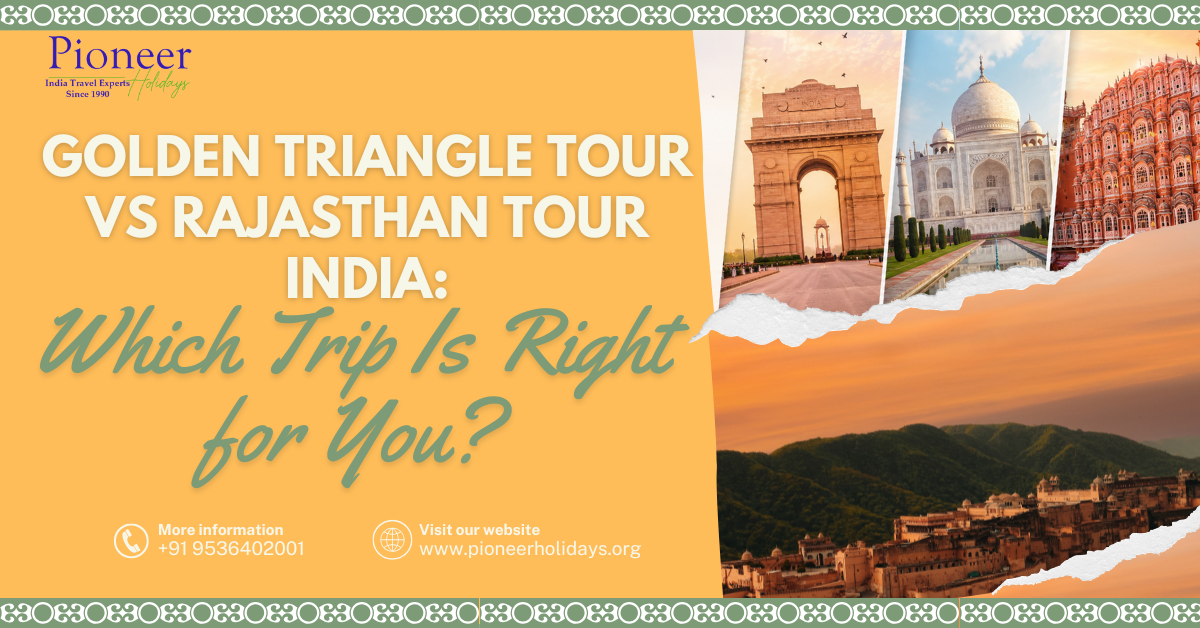
Every year, thousands of international travellers land in Delhi with the same question circling their heads: should I book a Golden Triangle Tour vs Rajasthan Tour India — or is there a way to combine both? These are two very different experiences in pace, scale, and what they ask of you as a traveller.
The answer depends on how much time you have, what you genuinely want to feel and see, and whether this is your first visit or your second.
The Golden Triangle connects Delhi, Agra and Jaipur in a circuit that most travellers cover in five to six days — the most popular Golden Triangle duration for first-timers gives you enough time at each city without feeling rushed. Rajasthan, by contrast, is a state the size of France, and doing it properly takes ten days at the absolute minimum.
In this guide, I’ll walk you through both options honestly — the highlights, the trade-offs, the costs, and the type of traveller each suits best. Whether you are weighing a Golden Triangle Tour vs Rajasthan Tour India for the first time or trying to plan a combined itinerary, this comparison covers everything you need to decide.
Quick Comparison: Golden Triangle vs Rajasthan
Before diving into the detail, here is a side-by-side look at how a Golden Triangle Tour vs Rajasthan Tour India stacks up across every major travel factor.
| Factor | Golden Triangle Delhi Agra Jaipur | Rajasthan Extended Circuit |
| Duration | 5–7 days ideal | 10–16 days ideal |
| Main Destinations | Delhi, Agra, Jaipur | Jaipur, Jodhpur, Udaipur, Jaisalmer, Ranthambore + more |
| Travel Pace | ● Relaxed, manageable | ● Slow or demanding depending on route |
| Culture | ● Strong — Mughal & Rajput heritage | ● Exceptional — living royal culture |
| History | ● Dense historical content | ● Deeper, more layered history |
| Architecture | ● World-class — Taj Mahal, Amber Fort | ● Extraordinary — Mehrangarh, City Palace, Jaisalmer Fort |
| Wildlife | ● Limited | ● Ranthambore Tiger Reserve |
| Food | ● Excellent variety, familiar to most | ● Distinct Rajasthani cuisine, more regional |
| Ease of Travel | ● Easy — short drives, well-trodden | ● Longer distances between cities |
| Best for First-Timers | ● Yes — highly recommended | ● Better as a second visit |
| Budget | ● Wide range — budget to luxury | ● Wide range — includes heritage hotels |
| Photography | ● Iconic shots, well-known angles | ● Exceptional — vast, varied, dramatic |
| Family Suitability | ● Very family-friendly | ● Good, but distances need planning |
What Makes the Golden Triangle Special?
When travellers research a Golden Triangle Tour vs Rajasthan Tour India, the Golden Triangle consistently stands out as the more accessible starting point — and for good reason. Three cities, three distinct identities, and some of the most photographed monuments on earth — all connected by well-maintained roads and regular train services.
Delhi is a city of layers. Mughal mosques stand beside colonial architecture and modern business districts. Old Delhi’s lanes around Chandni Chowk are one of the most sensory experiences in Asia, while Humayun’s Tomb gives you a quieter, deeply moving encounter with Mughal craftsmanship before you even reach Agra.
Agra is home to the Taj Mahal — a monument that genuinely surpasses every expectation. Most people also visit Agra Fort and the ghost city of Fatehpur Sikri nearby. Two full days in Agra feels right; one feels rushed.
Jaipur brings you into Rajput territory. The Amber Fort, Hawa Mahal, and City Palace show you a different India from Agra — more festive, more colourful, and full of local market culture that rewards slow exploration.
The drive from Delhi to Agra runs about four hours on the expressway. Agra to Jaipur is another four to five hours, or you can take the train. No destination is remote, no road is intimidating, and every city has a well-established tourism infrastructure with good hotels at every budget level.
For most first-time visitors to India, the Golden Triangle is the stronger starting point — the cities are well-connected, the sights are iconic, and the logistics are straightforward. You can view Our Golden Triangle tour packages to find one that fits your dates and travel pace.
What Makes Rajasthan Different?
In any honest Golden Triangle Tour vs Rajasthan Tour India comparison, Rajasthan is not simply a longer version of the same trip — it is a fundamentally different experience. Where the Golden Triangle distils India into three landmark cities, Rajasthan unfolds across sand dunes, hilltop forts, painted havelis, tribal villages, and one of India’s best tiger reserves.
Jodhpur’s Mehrangarh Fort is among the most dramatic pieces of military architecture in Asia. The blue city below it rolls out in every direction, and the local food culture — particularly the spice market and the dal baati churma — is a genuine discovery rather than a tourist performance.
Udaipur operates at a completely different frequency. Lake Pichola, the City Palace rising straight from the water, and the gentle pace of the old city make it the most romantic destination in India for many travellers.
Jaisalmer takes you into the Thar Desert — golden sandstone forts, camel treks at dusk, and a stillness that feels unlike anywhere else in India. Getting there from the other Rajasthan cities takes time, which is why most Rajasthan itineraries need ten days or more to feel satisfying rather than rushed.
Heritage hotels are a genuine feature of Rajasthan travel in a way they simply aren’t elsewhere in India. Former royal residences converted into hotels — the Umaid Bhawan in Jodhpur, Taj Lake Palace in Udaipur — offer experiences that are inseparable from the journey itself.
Distances are the one honest challenge. Jodhpur to Jaisalmer, for instance, takes five hours by road. You need to accept slower travel as part of the experience, not an obstacle to it.
If Rajasthan is pulling you in but you don’t want to skip the Taj Mahal, you don’t have to choose — a Golden Triangle trip extended into the Rajasthan desert cities covers Jodhpur and Udaipur without sacrificing Delhi or Agra.
Who Should Choose the Golden Triangle Tour?
- First-time visitors to India who want a confident, well-structured introduction to the country’s most celebrated history and culture.
- Families with children who benefit from shorter travel days, predictable logistics, and easy access to guides and facilities at every stop.
- Travellers with five to seven days who cannot stretch their leave but still want a substantive India experience rather than a surface skim.
- Business travellers combining a short leisure extension with work in Delhi, for whom efficiency and quality of experience matter equally.
- Travellers wanting iconic India — the Taj Mahal, Amber Fort, Red Fort, Qutub Minar. If your list includes monuments you have seen in photographs your entire life, the Golden Triangle delivers them all.
Who Should Choose Rajasthan?
- Repeat visitors who have already done the Golden Triangle and want to go deeper, further, and further off the tourist trail.
- Culture lovers interested in living traditions — folk music, textile arts, village life, Rajput customs — that exist beyond the standard monument circuit.
- Heritage enthusiasts who want to sleep in former palaces, understand the architecture of Rajput fortification, and trace royal history through the landscape rather than just through museums.
- Photographers drawn to extraordinary light, dramatic desert landscapes, vivid local colour, and architectural subjects that reward a week of unhurried shooting.
- Slow travellers who would rather know three cities deeply than move through six at a sprint.
Travellers with two weeks and a genuine appetite for India’s royal history will find Rajasthan deeply rewarding — the full Rajasthan circuit for travellers with two weeks covers the Golden Triangle + Ranthambore, Jodhpur and Udaipur in a single itinerary.
Delhi Agra Jaipur vs Rajasthan: Which Gives Better Value?
The Golden Triangle Tour vs Rajasthan Tour India value question is one the most common ones travel planners hear — and the honest answer is that both deliver exceptional value, just in different ways.
The Golden Triangle is cost-efficient. Accommodation, guides, transport, and entry fees at three concentrated destinations add up to a predictable, manageable budget. A well-guided seven-day tour with good hotels rarely feels like a compromise, and the density of what you see per day is genuinely high.
Rajasthan costs more in time, and sometimes in money — particularly if you stay in heritage properties rather than standard hotels. But what you spend, you get back in depth. A night at a fort hotel in Jaisalmer or a palace property in Udaipur is not just accommodation; it is part of the experience itself.
The biggest value question is really about time. If you have eight days and spend five of them travelling between Rajasthan cities, you arrive at each destination tired and short on time. That is not value — it is stress. The Golden Triangle, by contrast, delivers fully within its natural timeframe.
For first-time visitors managing a limited trip, the Golden Triangle wins the value calculation clearly. For repeat visitors with two weeks, Rajasthan wins it just as clearly. The mistake is forcing either tour into the wrong timeframe.
Best Choice Based on Trip Length
Trip length is often the deciding factor in any Golden Triangle Tour vs Rajasthan Tour India comparison. Here is a straightforward guide.
| Trip Length | Recommended Option | Why |
|---|---|---|
| 5 Days | Golden Triangle | Just enough for Delhi, Agra and a day in Jaipur. Rajasthan is not feasible at this length. |
| 6 Days | Golden Triangle | The ideal Golden Triangle duration — one full day per city with comfortable travel days in between. |
| 7 Days | Golden Triangle + Pushkar extension | Add a night in Pushkar after Jaipur for a taste of Rajasthan without overcommitting on distance. |
| 10 Days | Golden Triangle + Jodhpur & Udaipur | A well-paced combined itinerary that covers the iconic sights and adds two of Rajasthan’s best cities. |
| 14 Days | Full Rajasthan Circuit | Golden Triangle + Ranthambore + Jodhpur + Jaisalmer + Udaipur. This is the definitive itinerary for serious India travellers. |
Common Mistakes Travellers Make When Choosing
These are the errors travel consultants see most often when clients are deciding between a Golden Triangle Tour vs Rajasthan Tour India.
- Underestimating travel distances in Rajasthan. Jodhpur to Jaisalmer, Jaisalmer to Udaipur — these are long drives. Many travellers only realise this after booking and then feel the whole trip is spent on the road.
- Trying to see too much in one trip. Fitting seven cities into nine days sounds ambitious; it usually just means never fully arriving anywhere.
- Choosing Rajasthan on a first visit with limited time. The experience rewards travellers who can move slowly. Rushing through Rajasthan is a particular kind of disappointment.
- Ignoring the weather calendar. April to June is brutally hot across both regions. October to March is the ideal window. Travelling in peak summer without preparing for 42°C heat is a common and avoidable mistake.
- Not considering travel style honestly. Some travellers genuinely prefer well-organised, landmark-focused itineraries. Others want immersion and detours. The right tour matches your style, not the one with the longest list of sights.
Frequently Asked Questions
Golden Triangle or Rajasthan — which is better for first-time visitors?
The Golden Triangle is the stronger choice for a first visit. When comparing a Golden Triangle Tour vs Rajasthan Tour India for debut travellers, the Triangle covers India’s most iconic monuments, operates within a manageable timeframe, and gives you a confident, satisfying experience without complex logistics.
Is Rajasthan more expensive than the Golden Triangle?
Not necessarily, but it can be. The base cost of accommodation and food across both routes is broadly similar at equivalent standards. Rajasthan becomes more expensive when travellers choose heritage hotels — which are worth considering — and when longer internal travel distances add driver and fuel costs across more days.
Can I combine the Golden Triangle and Rajasthan?
Yes — and for travellers with ten to fourteen days, this is actually the most popular format. The Golden Triangle cities feed naturally into Rajasthan, and Jaipur acts as the hinge point between both. A combined itinerary lets you tick off the Taj Mahal and Agra Fort before heading into the desert forts of Jodhpur or the lake city of Udaipur.
Is 10 days enough for Rajasthan?
Ten days is enough if you focus. A well-designed ten-day trip might cover Delhi, Agra, Jaipur, Jodhpur and Udaipur — that is a full and satisfying itinerary. Trying to add Jaisalmer or Ranthambore at ten days starts to feel rushed. Fourteen days opens the itinerary up considerably.
Which trip offers better cultural experiences?
Rajasthan offers broader cultural depth — living royal traditions, distinct regional cuisine, folk arts, and rural life are all more accessible there. But the Golden Triangle is not culturally thin. Delhi’s diversity and Jaipur’s local culture are both genuinely rich. The Golden Triangle Tour vs Rajasthan Tour India cultural comparison really comes down to whether you want a concentrated dose or a wider, deeper immersion.
Which tour is easier for families?
The Golden Triangle is easier to manage with children. Shorter travel days, well-established tourist infrastructure, and a tighter geographic footprint mean less time on the road and more time doing things. Rajasthan works well for families with older children and more time available — but it requires more patience with distances.
If you’ve already visited the Golden Triangle and want something more immersive on your next trip, the deep-dive Rajasthan experience for serious India travellers is designed for exactly that — it goes well beyond the tourist circuit into culture and landscape most visitors never reach.
So, Which Should You Choose?
The Golden Triangle Tour vs Rajasthan Tour India decision ultimately comes down to three things: your available time, your travel experience, and what kind of India you are ready for.
If this is your first trip to India and you have five to eight days, choose the Golden Triangle. You will leave with a genuine understanding of Mughal history and Rajput culture, having stood in front of the Taj Mahal at sunrise, walked the ramparts of Amber Fort, and navigated Old Delhi’s lanes. That is not a consolation prize — it is an extraordinary trip in its own right.
If you want to see what a typical itinerary looks like before committing, a comfortable Golden Triangle pace with time to breathe shows how six days across Delhi, Agra and Jaipur can be structured without feeling like a sprint.
Whatever itinerary suits you, the team at Pioneer Holidays can help you build it properly — matching your travel dates, pace, and interests to the right India experience, whether that is a classic Golden Triangle circuit, a full Rajasthan journey, or the best of both in a single well-planned trip.
