
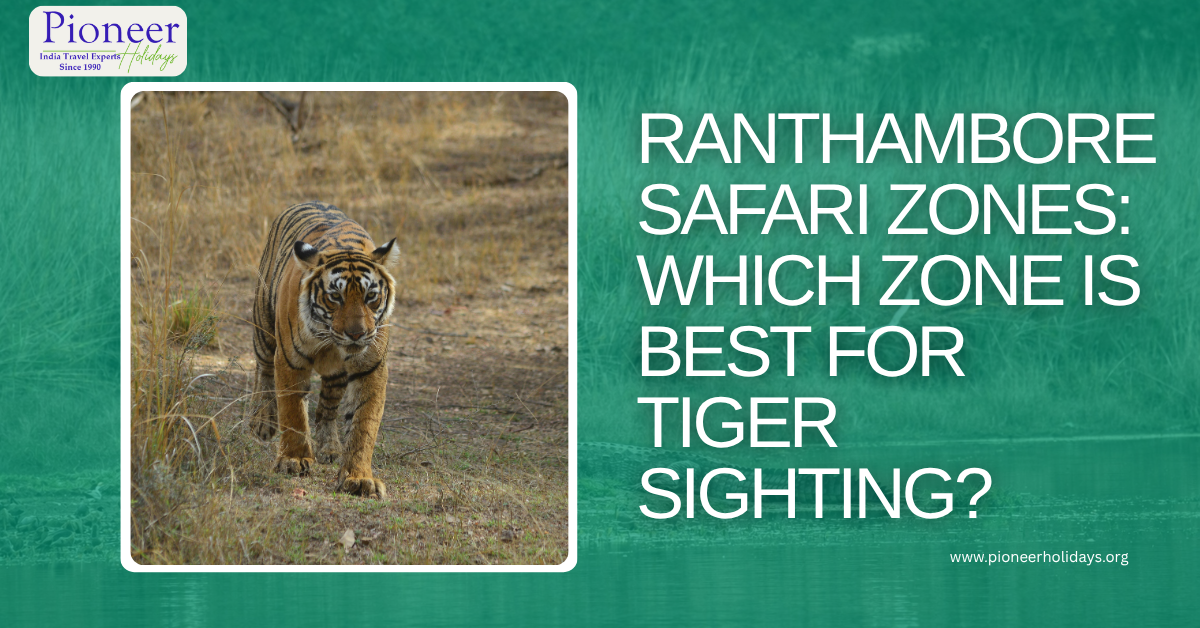
The jeep had barely crossed the gate at Zone 3 when our guests spotted a tigress walking along the edge of Padam Talao — unhurried, utterly indifferent to us. That morning was luck, yes. But it was not random. We were in the right zone, at the right time, with a naturalist who knew exactly where to position the vehicle. That’s the difference between a frustrating safari and one your guests talk about for years. And it all starts with understanding which Ranthambore safari zones actually deliver.
A Quick Map of All Ranthambore Safari Zones
| Zone Number | Core/Buffer | Terrain Type | Tiger Sighting Frequency | Best For |
|---|---|---|---|---|
| Zone 1 | Core | Rocky ridges, dry scrub, ruins | Moderate | History lovers, leopard sightings |
| Zone 2 | Core | Mixed forest, grassland patches | Moderate | Birding, sloth bear sightings |
| Zone 3 | Core | Open lake shore (Padam Talao), meadows | High | First-timers, best overall tiger zone |
| Zone 4 | Core | Rajbagh Lake, dense tree cover | High | Tiger by water, photography |
| Zone 5 | Core | Malik Talao, open scrub, valley terrain | High | Tiger tracking, experienced wildlife visitors |
| Zone 6 | Buffer | Thin forest, agricultural edges | Low–Moderate | Budget option, quieter experience |
| Zone 7 | Buffer | Mixed scrub, buffer woodland | Low | Off-beat, fewer vehicles |
| Zone 8 | Buffer | Semi-open terrain near park boundary | Low | Leopard, hyena, fox sightings |
| Zone 9 | Buffer | Open farmland interface, dry riverbeds | Low | Bird watchers, casual visitors |
| Zone 10 | Buffer | Sparse woodland, human-wildlife interface | Low | Unusual sightings, very few crowds |
First-time visitors should focus entirely on Zones 3, 4, and 5. The core zones concentrate wildlife around permanent water sources, which means your odds of a tiger sighting are meaningfully higher. Buffer zones suit experienced wildlife travellers or those who specifically want quieter game drives with fewer vehicles.
Which Ranthambore Safari Zones Have Given Our Guests the Highest Tiger Sighting Success Rate?
Zones 3, 4, and 5 consistently perform best — and there are solid, terrain-based reasons for each one.
Zone 3 sits around Padam Talao, the largest lake inside the park. Tigers move through open grassland to drink, and the flat, open terrain means you spot them from a distance before they disappear. Our guests have had sightings here even in peak afternoon heat when animals avoid denser zones. The Jogi Mahal ruins nearby funnel movement through predictable corridors, which experienced naturalists know well.
Zone 4 covers Rajbagh Lake. The tree cover is denser here, which makes sightings feel dramatic — tigers emerge from thick brush right at the waterline. This zone works particularly well during summer months (March to May), when the lake shrinks and wildlife concentrates at the remaining water. The light over Rajbagh in early morning is also exceptional for photography.
Zone 5 includes Malik Talao, a smaller, shallower lake that marsh crocodiles use heavily — and tigers know that. The valley terrain creates natural pathways that tigers follow regularly. Guests who’ve done two or three safaris and want to track tigers with more intent often prefer Zone 5 for exactly this reason.
No zone guarantees a tiger sighting — anyone who tells you otherwise is selling something. Tigers are wild animals with territories that span dozens of kilometres. But zones 3, 4, and 5 put the odds solidly in your favour.
What Do We Personally Recommend to Travellers?
After years of curating safaris for international guests, our go-to recommendation for a two-day Ranthambore visit is this: Zone 3 or 4 on Day 1, Zone 5 on Day 2. This combination covers all three primary lakes and gives your naturalist the best chance to read fresh pugmarks and track recent activity.
A few practical things to lock in before you go:
- Book your zones at least 45–60 days in advance. Core zone permits sell out fast, especially between November and April. Same-week bookings almost never get Zone 3, 4, or 5.
- Choose the morning slot over evening. Tigers are far more active in early light. The 6:00–6:30 AM departure windows are the ones worth getting up for.
- Pick a jeep over a canter for core zones. A jeep holds 6 people and moves quickly and quietly through narrow forest tracks. Canters carry 20 passengers and work better in open areas — they can’t navigate some of Zone 3 and 4’s narrower paths.
- Tell your operator your priorities upfront. If you specifically want a tiger sighting, say so. Your naturalist will plan the route differently than for someone who wants birds or landscape photography.
Which Season Offers the Best Safari Experience? Our Honest Opinion
Three distinct windows shape what you’ll actually see and feel inside the park.
October to February
- Visibility: excellent — trees shed leaves, sight lines open up
- Crowd level: moderate to high by December
- Temperature: cool mornings (8–12°C), warm afternoons
- Tiger behaviour: tigers roam wide territories; sightings happen but require more tracking
March to May
- Visibility: outstanding — dry season strips vegetation completely
- Crowd level: high in March, thins out by May as heat increases
- Temperature: 35–44°C by afternoon; go early
- Tiger behaviour: this is peak sighting season — water scarcity drives tigers to the lakes predictably
June to September
- Park mostly closed during monsoon (July–September)
- Brief opening possible in October post-monsoon
- Lush and green, but dense vegetation makes sightings difficult
Our personal pick: March to mid-April. Tigers visit Padam Talao and Rajbagh Lake almost daily during this window. The heat is manageable in early morning, crowds haven’t peaked yet, and the dry landscape means you’ll spot a tiger from 200 metres away rather than 20. This is when our guests have had the most dramatic sightings.
Wildlife Beyond Tigers — What Our Guests Commonly See
A Ranthambore safari never disappoints when guests come with open eyes — even on mornings without a tiger. Here’s what comes up regularly on our drives:
- Sloth bear — spotted most often near rocky outcrops in Zones 1 and 2
- Leopard — elusive but present, often seen near Zone 1’s ruins and border areas
- Marsh crocodile — visible at all three lakes, especially Malik Talao
- Sambar deer and spotted deer (chital) — in every zone, often in large herds
- Nilgai (blue bull) — common in open grasslands near Zone 3
- Indian jungle cat and caracal — rare but real; our naturalists have spotted both
- Over 320 bird species — from painted storks and sarus cranes to crested serpent eagles and the Indian paradise flycatcher
When guests miss a tiger, the sloth bear sighting or a crocodile stalking deer at the lake’s edge often ends up being the moment they photograph most. Ranthambore rewards patience and attention — not just luck.
How Ranthambore Fits Into Our Golden Triangle with Ranthambore Itinerary
The classic Golden Triangle route — Delhi, Agra, Jaipur — takes most foreign visitors through Rajasthan’s heritage circuit. Ranthambore slots in naturally between Jaipur and Agra, with Sawai Madhopur as the base town (roughly 180 km from Jaipur, about 3.5 hours by road or a direct train).
Most of our guests add two full safari days here, which gives time for one morning and one evening drive — or two mornings if you book early slots back to back. If you want the full experience, our 7-day Golden Triangle Tour with Ranthambore covers Delhi, Agra, Jaipur, and two full safari days in Ranthambore. You can also browse our Golden Triangle tour packages to find the right fit for your group and budget.
Adding Ranthambore doesn’t require rerouting the trip — it adds depth. Heritage and wilderness in one arc.
What Foreign Travellers Ask Us Most Before Visiting Ranthambore?
“Do we need to book safari zones in advance?” Yes — and earlier than most people expect. Core zone permits (Zones 1–5) open 90 days before the safari date on the government booking portal. For peak months (November to April), we strongly recommend booking 45–60 days out minimum. Last-minute bookings almost always end up in buffer zones, which have lower tiger sighting rates.
“Is a canter or jeep better for tiger sightings?” For core zones, the jeep wins. Jeeps carry 6 passengers, move quietly, and can navigate tracks a 20-seater canter simply cannot. If you book a canter in Zone 3 or 4 and a tiger appears in a narrow forest path, the canter stops at a distance while jeeps get closer. Canters work well in open terrain but they’re a group experience, not a personalised one.
“What if we don’t see a tiger?” It happens — even to us, and we’ve done hundreds of safaris in Ranthambore. Ranthambore has over 70 tigers across roughly 1,334 sq km. On any given morning, you’re searching a vast area. What we guarantee is that your naturalist will give you the best possible route and reading of animal signs. And on most safaris, you’ll see enough — crocodiles, deer, eagles, forest, ruins — to come back wanting more.
“Is Ranthambore safe for solo female travellers or families with children?” Completely safe. Ranthambore is one of India’s most visited national parks, with well-managed gates, fixed safari routes, and licensed naturalists on every vehicle. Families with children aged 6 and above handle the bumpy jeep tracks fine. Solo female travellers join group jeeps regularly, and the gypsy drivers and naturalists are professional and respectful. The town of Sawai Madhopur has good accommodation options at every budget level.
What Unique Expertise Does Pioneer Holidays Bring?
We’ve been pairing wildlife with heritage travel for over a decade, and Ranthambore is a destination we return to personally, not just send guests to. We assign naturalist guides based on each group’s specific interests — a photography-focused group gets a different zone strategy than a family on their first Indian wildlife trip. We also hold flexible zone selection until close to the safari date, so we can adjust based on recent tiger activity reports from the field. That ground-level responsiveness is something a generic package simply can’t replicate.
Frequently Asked Questions
Q: How many safari zones does Ranthambore National Park have?
A: Ranthambore National Park has 10 designated safari zones in total. Zones 1 through 5 sit inside the core area of the park and offer the highest wildlife density, including the best tiger sighting frequency. Zones 6 through 10 are buffer zones — less trafficked, with thinner forest and lower sighting rates, but useful for guests who want a quieter, more solitary drive. The Forest Department regulates the number of vehicles allowed per zone per session, which keeps the core zones from becoming overcrowded.
Q: Which zone in Ranthambore has the highest tiger sighting rate?
A: Zones 3, 4, and 5 consistently record the highest tiger sighting frequency, with Zone 3 often leading the count. Zone 3 covers the Padam Talao area — a large open lake surrounded by meadows where tigers come to drink and hunt. The open terrain makes spotting far easier than in forested zones. Zone 4 (Rajbagh Lake) and Zone 5 (Malik Talao) are close behind, particularly during the dry season when water sources shrink and animal movement concentrates around these lakes. No zone guarantees a sighting, but these three give the best statistical chance.
Q: How do I book a safari in a specific zone at Ranthambore?
A: Safari permits are available on the Rajasthan Forest Department’s official online booking portal. You can specify your preferred zone during booking, though availability isn’t guaranteed — core zones fill up weeks in advance. The most reliable approach is to book through an experienced tour operator like Pioneer Holidays, who monitors permit availability and can book multiple zones across different days to maximise your options. Booking 45–60 days out for peak season is the practical minimum.
Q: What is the difference between a jeep and canter safari in Ranthambore?
A: A jeep (locally called a Gypsy) seats 6 passengers plus the driver and naturalist. It’s smaller, quieter, and far more manoeuvrable on narrow forest tracks. A canter is an open-sided bus carrying up to 20 passengers — better suited to open areas and good for budget travellers who don’t mind a shared experience. For core zones and serious tiger tracking, a jeep is the clear choice. Canters are not permitted in all areas of the core zones, which limits where they can go during a safari.
Q: Which zone is best for families visiting Ranthambore for the first time?
A: Zone 3 is the strongest recommendation for first-time family visitors. The terrain around Padam Talao is open, which means even young children can easily spot wildlife — no straining through dense foliage. The routes here are also less rocky than Zones 1 and 2, making for a more comfortable jeep ride. Families who are interested in the fort ruins inside the park will also enjoy Zone 3’s proximity to the Ranthambore Fort area, adding a heritage layer to the wildlife experience.
Q: How early should I arrive at the safari gate in Ranthambore?
A: Aim to reach the gate at least 20–30 minutes before your scheduled departure time. Morning safaris typically depart between 6:00 and 6:30 AM depending on the season, and the gates open only once. Late arrivals forfeit their slot without a refund. Your naturalist or driver will confirm the exact timing the evening before — take that seriously. Early mornings are when tiger activity peaks, and the first vehicles into the zone often have the best positioning.
Q: What should I carry on a Ranthambore safari?
A: Pack light but smart. Bring binoculars (8×42 magnification works well in open terrain), a camera with a 300mm+ zoom lens if you’re serious about wildlife photography, and a dust cover for your gear — the tracks are unpaved and dusty. Wear neutral, earthy colours — avoid white, red, or bright blue. Carry water, a light jacket for early morning (even in summer), sunscreen, and a hat. Leave strong perfumes behind; scent disturbs animal behaviour. Mobile phones should stay on silent mode throughout.
Q: Who should I contact to plan a Ranthambore safari as part of a Golden Triangle trip?
A: Pioneer Holidays specialises in exactly this combination — Delhi, Agra, Jaipur, and Ranthambore in one seamless itinerary. We handle zone selection, permit booking, naturalist assignment, accommodation in Sawai Madhopur, and all transfers. Reach us through our website to discuss your group size, travel dates, and budget. We customise every itinerary rather than running fixed departures, which means your safari gets built around your actual priorities — whether that’s photography, tiger tracking, family comfort, or a bit of everything.
Ranthambore rewards guests who arrive prepared — and the zone you’re in matters more than most people realise before they get here. At Pioneer Holidays, we’ve spent years learning which zones deliver and when, so our guests spend their safari time watching wildlife, not second-guessing logistics. If you’re thinking about adding Ranthambore to your India trip, reach out and tell us what matters most to you. We’ll build it from there.
