
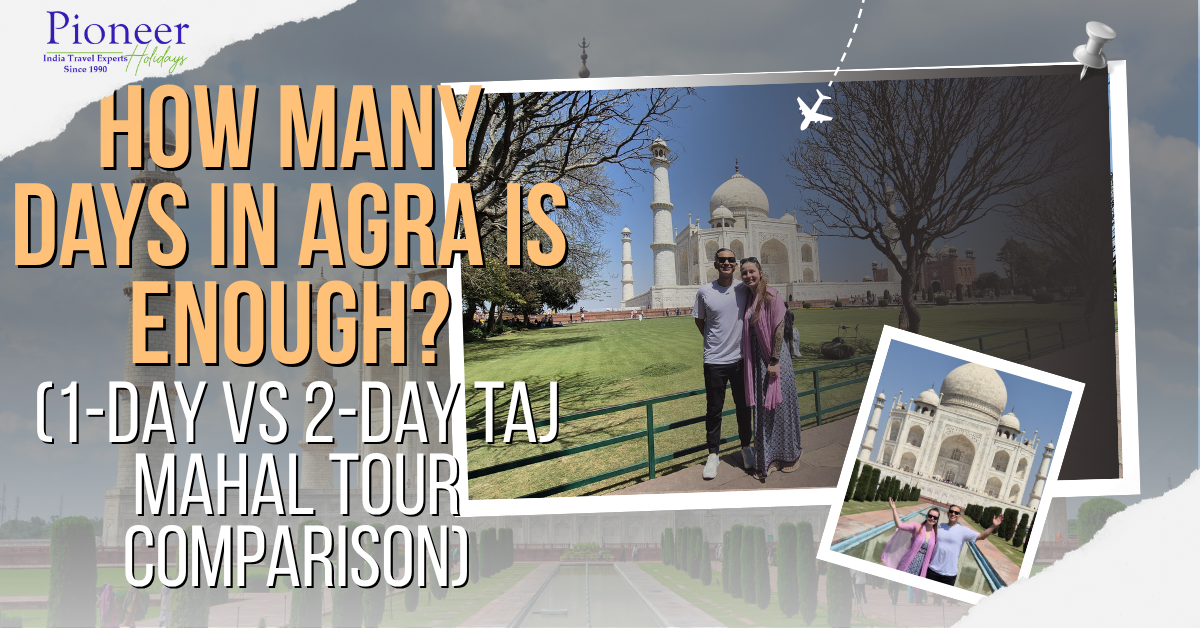
Most travelers ask this question after they have already booked their Delhi flight and are staring at a Google Map wondering how far Agra actually is. Here is the short answer: one day in Agra is manageable but leaves you feeling rushed. Two days gives you time to actually experience the city rather than tick a box. If you are visiting India for the first time, have a camera in your hands, or are traveling with family, stay two days. If you are on a strict itinerary with limited time,One day still be enough, provided you plan your itinerary carefully.
Why the Number of Days in Agra Changes Everything
Agra is a three-hour drive from Delhi on a good morning, which is rarely guaranteed on NH19. Once you factor in travel time each way, a one-day trip from Delhi gives you roughly six to seven hours on the ground. That sounds fine until you realize the Taj Mahal alone deserves at least two hours, Agra Fort is another ninety minutes minimum, and the queues at the east gate during peak season can eat thirty minutes before you have even bought a ticket.
Two days removes that pressure entirely. You wake up in Agra. You watch the Taj Mahal at sunrise when the marble turns a pale gold that photographs cannot fully capture. You walk Kinari Bazaar in the afternoon without watching the clock. You sleep, and the next morning you visit Itimad-ud-Daulah before the tour buses arrive.
A two-day Agra itinerary lets you experience the same monuments at three different light condition: sunrise, afternoon sun, and golden hour and each one looks like a completely different building.
How Many Days Are Enough for Agra — Our Honest Recommendation
For First-Time Visitors to India
Stay two days, without question. You are not just seeing the Taj Mahal. You are processing India for the first time such as the chaos of the road, the smell of street food, the overwhelming visual noise of a north Indian city. One day does not give you enough time to absorb any of it properly. Two days lets you settle in.
For Domestic Tourists
One day is usually enough if you have seen Agra before. If this is your first visit, however, treat it like an international traveler would and give yourself two days. The monuments are extraordinary regardless of where you come from.
For Couples
Two days is ideal. A sunrise visit to the Taj Mahal and a quiet dinner at a rooftop restaurant overlooking the monument afterward is an experience that tends to stay with people for a long time. We have had couples tell us years later that the Agra overnight was the highlight of their entire India trip.
For Families with Children
Stay two days. Children tire faster, move slower, and need food breaks at inconvenient moments. Trying to rush a family through Agra in one day usually ends with frustrated parents and unhappy children. Spread it across two days and everyone has a better time.
For Photographers
Two days is the absolute minimum. Three days is better. You need sunrise at the Taj Mahal from the east gate, sunset from Mehtab Bagh across the river, and the mid-morning light at Itimad-ud-Daulah which turns the white marble into something that looks almost translucent. You cannot do all of that in one day.
What Most Travelers Actually Choose?
After running private Agra tours for more than thirty years and serving over 50,000 travelers, we see patterns that booking data confirms year after year.
- One-day Agra trip: Around 35% of our clients. Mostly travelers on very tight itineraries, domestic travelers on weekend trips, or people who genuinely could not extend their stay.
- Two-day Agra itinerary: Around 55% of our clients. The most popular choice by a clear margin, especially among international travelers on Golden Triangle tours.
- Overnight stay (one night, partial two days): Included in the 55% above. Almost everyone who stays overnight comes away saying they are glad they did.
The honest truth is that most travelers who choose one day wish afterwards that they had stayed longer. We rarely hear the reverse.
What are the biggest mistakes people make when planning Agra?
Rushing Down from Delhi on the Same Morning
The NH19 highway is unpredictable. We have seen three-hour drives become five-hour drives due to accidents, fog, or festivals. If you plan to be at the Taj Mahal at 6am and you are leaving Delhi at 4am, you are gambling with the best part of your day.
Missing the Sunrise
The Taj Mahal at 6am and the Taj Mahal at 11am are not the same place. The morning light is soft. The crowds have not arrived yet. The marble glows rather than bleaches. Missing sunrise to save a hotel night is almost always a decision travelers regret.
Booking the Wrong Taj Mahal Entry Gate
Most first-timers head for the South Gate because it is the most visible. The East Gate typically has shorter queues and puts you directly in line with the main axis of the monument. This is a small detail that can save forty-five minutes.
Skipping Mehtab Bagh
Almost every travel agent leaves Mehtab Bagh off the itinerary. This is a garden on the opposite bank of the Yamuna River that gives you a completely unobstructed view of the Taj Mahal from the north. At sunset, the reflection in the river turns golden. It is one of the most beautiful views in India and most visitors to Agra never see it.
Visiting the Taj Mahal on a Friday
The Taj Mahal is closed every Friday. We have received panicked calls from travelers who discovered this at the gate. Always confirm your visit day before finalizing your itinerary.
Eating at the Wrong Places
The area immediately around the east and west gates is full of restaurants that charge tourists ten times the local price for poor food. Walk two streets back and you will find local dhabas serving genuinely good food at honest prices.
Ignoring the Heat Window
Between April and June, temperatures in Agra regularly cross 45°C by noon. If you visit in summer and arrive at the Taj Mahal at 10am rather than 6am, you will be standing on white marble that acts like a heated floor in direct sun. Start early or suffer.
Your Agra Itinerary — Practical Plans for Both Options
One Day Agra Itinerary
Early Morning (5:30am – 9:00am) Leave Delhi by 4:30am at the latest. Aim to reach the Taj Mahal east gate by 6:00am or just after sunrise. Spend 90 to 120 minutes inside. Walk slowly. Take your time at the main platform. Go inside the tomb.
Mid-Morning (9:30am – 12:00pm) Drive to Agra Fort, a ten-minute ride from the Taj Mahal complex. Spend 90 minutes exploring the Diwan-i-Am, the Diwan-i-Khas, and the Musamman Burj where Shah Jahan is said to have spent his final years looking across the river toward his wife’s tomb.
Afternoon (12:30pm – 3:00pm) Lunch at a reliable rooftop restaurant with a Taj view. Then a quick visit to Itimad-ud-Daulah if energy levels allow — it is only fifteen minutes from Agra Fort and usually quiet in the early afternoon.
Late Afternoon (3:30pm – 5:30pm) Mehtab Bagh for sunset, then back on the road to Delhi. Expect to arrive in Delhi between 8:00pm and 9:00pm depending on traffic.
Two Day Agra Itinerary
Day One
Morning: Leave Delhi by 6:30am. Check into your hotel in Agra by 10:00am if early check-in is available, or drop luggage. Head straight to Agra Fort for a relaxed 2-hour exploration.
Afternoon: Lunch, then visit Itimad-ud-Daulah. This 17th-century tomb is sometimes called the Baby Taj. The inlay work on the walls is finer than anything at the Taj Mahal itself and is almost never crowded.
Evening: Check in properly. Freshen up. Walk through Kinari Bazaar for marble inlay souvenirs, leather shoes, and local street food. Dinner at a rooftop restaurant with the Taj Mahal lit up in the distance.
Day Two
Pre-Dawn: Wake at 5:00am. Be at the east gate by 5:30am. Watch the sky change from black to purple to deep orange as the sun rises behind you and the Taj Mahal changes colour in front of you. This is the moment people talk about for the rest of their lives.
Late Morning: Return to your hotel for breakfast. A full Indian breakfast after a sunrise Taj visit feels well earned. Check out at a relaxed pace.
Midday: Drive to Mehtab Bagh before heading back toward Delhi. The mid-morning light here is excellent for photography and the garden is usually quiet. Begin your drive back to Delhi by noon, arriving comfortably by 3:30pm.
Which places do most travel agents ignore but we regularly recommend?
Mehtab Bagh (Moonlight Garden)
We mentioned it already, but it deserves a section of its own. This Mughal garden was originally designed as the viewing point for the Taj Mahal from across the river. The symmetry is perfect. The crowds are minimal. Sunrise and sunset visits here are, in our opinion, more memorable than many moments inside the Taj Mahal complex itself.
Itimad-ud-Daulah
The father-in-law of Shah Jahan is buried here. The building is sometimes dismissed as a secondary attraction, but the pietra dura work — semi-precious stone inlaid into white marble — is extraordinary up close. Every pattern tells a story and the craftsmanship is arguably more intricate than anything at the Taj Mahal.
Kinari Bazaar
This is the real Agra that most tour groups never see. It is a narrow lane market that has been selling marble, leather, textiles, and food since the Mughal period. Walk it slowly. Talk to the shopkeepers. Try the petha, a crystallised gourd sweet that Agra has been famous for since the 17th century. Do not buy at the first stall you see.
Street Food Near Sadar Bazaar
The chaat at the corner stalls near Sadar Bazaar is exceptional. Dahi bhalla, aloo tikki, and the local version of pani puri are all worth trying if your stomach is accustomed to Indian street food. Ask your driver where locals eat. They always know.
The View from Your Hotel Rooftop
If you book a hotel close to the Taj Mahal, ask which rooms face the monument. Some hotels have rooftop restaurants where you can see the dome rising above the rooftops at sunset. This is a view that does not require a ticket and is entirely underrated.
Real Client Stories
The Traveler Who Left a Day Early
A solo traveler from the UK booked a one-day Agra trip as part of a tight five-city India itinerary. He saw the Taj Mahal at 11am, rushed through Agra Fort, skipped Itimad-ud-Daulah entirely, and was back in his Delhi hotel by 9pm. He messaged us two days later from Jaipur to say he had made a mistake. He had seen the Taj Mahal in full sun with three hundred other tourists and felt he had not really experienced it. He asked if there was any way to fit in a return visit. There was not. He vowed to come back specifically for the sunrise.
The Couple Who Planned the Sunrise
A couple from Australia booked a two-day private Golden Triangle tour with us. We arranged an early morning Taj Mahal visit on day two. They arrived at the east gate at 5:45am and were among the first inside. The woman told us afterward that standing in front of the Taj Mahal as the sky turned orange was the moment she genuinely felt the scale of what she was looking at. They sent us a photograph from that morning. We still use it occasionally as an example when clients ask whether the overnight is worth it.
The Family That Needed the Pace
A family of four consisting of parents and two children aged eight and twelve, booked a two-day Agra itinerary with us after we advised against trying to compress everything into one day. Day one was relaxed: Agra Fort in the morning, a long lunch, Itimad-ud-Daulah in the afternoon, and an early dinner. The children slept well. Day two was the sunrise Taj Mahal visit, and the twelve-year-old, who had been resistant to the whole trip, sent a photograph of the dawn sky to his friends from the Taj Mahal lawn. The father messaged us later to say it had been the best decision they made on the trip.
How the Season affects how many days you need ?
Summer (April to June)
The heat is brutal. If you visit in summer, you must do outdoor sightseeing before 9am and after 5pm. This makes a two-day itinerary almost mandatory because you cannot get everything done in one day if you have to avoid the middle of the day entirely. The Taj Mahal at 6am in summer is actually extraordinary — the crowds are thin and the early light is beautiful.
Winter (November to February)
This is the ideal season. The temperature sits between 10°C and 25°C, the light is clear, and the air quality is generally better. Winter fog can occasionally disrupt early morning visibility in December and January, but when the sky is clear, winter mornings at the Taj Mahal are genuinely spectacular. One or two days both work well in winter.
Monsoon (July to September)
The crowds drop significantly and the prices follow. The Taj Mahal and its gardens look lush and green. Humidity is high, but the reduced footfall makes the experience much more personal. Two days in monsoon is excellent value and the photography can be remarkable — especially if you catch a storm building over the river at Mehtab Bagh.
Peak Tourist Season (October to March)
This is when international travel peaks in India. The Taj Mahal complex can see 10,000 to 15,000 visitors on busy days. An early morning visit on a non-Friday weekday is the only reliable way to avoid the worst of the crowds. This makes staying overnight in Agra an even more valuable choice — you can be at the gate before the day-trippers from Delhi arrive.
One Day vs Two Days
| Factor | One Day Agra Trip | Two Day Agra Itinerary |
| Pace | Rushed, clock-watching | Relaxed, comfortable |
| Cost | Lower (no hotel night) | Higher (one hotel night) |
| Attractions covered | Taj Mahal + Agra Fort | All major sites including Mehtab Bagh and Itimad-ud-Daulah |
| Sunrise opportunity | Very difficult from Delhi | Built into the itinerary |
| Photography value | Limited (midday light only) | Excellent (multiple lighting conditions) |
| Family suitability | Challenging with young children | Comfortable and recommended |
| Couples experience | Adequate | Memorable |
| Overall experience | Good | Excellent |
| Regret factor | Higher | Very low |
Who is Best Suited for One Day vs Two Days ?
| Traveler Type | Best Option | Reason |
| First-time India visitor | Two days | Context and pacing matter enormously |
| Domestic tourist, repeat visit | One day | Already familiar with the scale and pace |
| Couple on honeymoon or anniversary | Two days | Sunrise experience is genuinely romantic |
| Family with children under 12 | Two days | Children need time and rest |
| Solo photographer | Two to three days | Multiple light conditions are essential |
| Business traveler with limited time | One day | Focus on Taj Mahal and Agra Fort only |
| Budget traveler | One day | Saves hotel cost but misses sunrise |
| Traveler on Golden Triangle tour | Two days | Standard recommendation for good reason |
Transportation Options Our Clients Use Most
Private Car from Delhi
This is what we recommend and what the vast majority of our clients use. A private car with a driver gives you complete flexibility on timing, no waiting for other passengers, and the ability to stop for photographs or food whenever you want. The drive takes two to four hours depending on departure time and traffic. The advantage is total control. The disadvantage is cost relative to a train — though that gap narrows considerably once you factor in how much easier and more comfortable the experience is.
Train (Gatimaan Express or Shatabdi)
The Gatimaan Express is the fastest train between Delhi and Agra, covering the distance in 100 minutes. It is reliable, air-conditioned, and affordable. The challenge is that trains operate on fixed schedules, which constrains your timing. You also need a taxi at the Agra end to reach the monuments. For independent travelers comfortable with Indian train bookings, this is an excellent option. For families with luggage or travelers who prefer door-to-door service, a private car is more practical.
Same-Day Tour from Delhi
Various companies offer same-day Agra tours by bus, departing from Delhi in the early morning and returning the same night. These are group tours with fixed schedules and no flexibility. You will see the Taj Mahal, but the experience is very different from a private tour. You spend a lot of time waiting for the group, moving at someone else’s pace, and sharing the experience with strangers. We do not offer this format because it does not suit the kind of travel we specialize in.
Private Driver and Guide Combined
Many of our Agra Tour Packages include a driver and a licensed English-speaking guide. The guide makes an enormous difference — especially at the Taj Mahal where the history, symbolism, and architectural detail is dense and the experience deepens substantially with good commentary. Our guides are all licensed by the Archaeological Survey of India and have been with us for years.
Attractions We Genuinely Recommend (And Why)
The Taj Mahal — But at the Right Time
This needs to be said plainly: the Taj Mahal at sunrise and the Taj Mahal at noon are not the same experience. The marble changes colour constantly through the day and the early morning version — when the light is soft, the crowds are thin, and the reflection pools are still — is the version that actually matches the photographs you have seen your whole life. Our Taj Mahal Tour Packages are built around this principle. If you cannot do sunrise, sunset is the second-best option. Avoid the 10am to 3pm window if at all possible.
Agra Fort — More Than a Secondary Attraction
Most travelers treat Agra Fort as the second item on the checklist after the Taj Mahal. It deserves more respect than that. The fort is a working piece of Mughal military and palace architecture spread across forty acres. The views from the Musamman Burj — the octagonal tower where Shah Jahan was imprisoned by his son and where he died looking toward the Taj Mahal — are deeply affecting if you know the story. Take a guide here.
Itimad-ud-Daulah — The Most Undervisited Major Monument in Agra
We have never understood why this gets left off itineraries. The stonework here is extraordinary. The garden setting is beautiful. The crowds are almost nonexistent compared to the Taj Mahal. We consider it essential.
Mehtab Bagh — The View That Changes Everything
We have already mentioned this twice. It deserves a third mention. If you visit Agra and do not go to Mehtab Bagh at either sunrise or sunset, you have missed one of the best views in India.
Why a Private Tour Makes Agra Better ?
There is a specific problem with Agra that most travelers do not anticipate: the gap between what the city promises and what a rushed visit actually delivers.
The Taj Mahal is one of the most beautiful buildings ever constructed. But surrounded by crowds, noise, and a strict two-hour average visit time, it can feel strangely underwhelming to some first-time visitors. The secret is time, pacing, and knowledge.
Pioneer Holidays has been running private tours in India since 1990. We have taken more than 50,000 travelers through Agra and earned more than 7,100 reviews on TripAdvisor — almost all of them from clients who chose private over group travel for exactly this reason. Our tours have no fixed departure times, no shared vehicles, and no generic commentary. Your driver knows the traffic patterns. Your guide knows which gate to use, where to stand, and how to help you actually see what you are looking at.
That is not a promotional claim. It is simply what thirty years of doing this work teaches you.
Conclusion
If you have to choose, choose two days.
Not because one day is impossible — it is not — but because one day in Agra almost always produces some version of the same regret: that you were too rushed, that you missed the sunrise, that you did not have time for the places that turned out to be the most memorable.
Two days costs roughly one extra hotel night and gives you a fundamentally better experience of one of the world’s most extraordinary monuments. For international travelers especially, Agra is not the kind of place you want to look back on and think “I wish I had stayed longer.” Book the extra night. Wake up early. Be at the east gate before sunrise. You will not regret it.
Frequently Asked Questions
How many days are enough for Agra?
Two days is the ideal duration for most travelers. It allows a comfortable sunrise Taj Mahal visit, relaxed exploration of Agra Fort and Itimad-ud-Daulah, and time at Mehtab Bagh for sunset. One day works if your schedule genuinely does not allow more, but it requires precise planning.
How many days do I need in Agra to see the Taj Mahal properly?
You can see the Taj Mahal on a one-day visit, but to experience it properly — meaning at sunrise when the light is best and the crowds are thin — you need to stay overnight in Agra. Plan for at least one night to make the most of the monument.
When is the best time to visit the Taj Mahal?
Sunrise is the definitive answer. Arrive at the east gate around 5:30am, about thirty minutes before sunrise. The soft morning light, the thin crowds, and the changing colours of the marble at dawn make this the experience people remember for a lifetime.
Can I do a one-day Agra trip from Delhi?
Yes, it is possible. Leave Delhi by 4:30am, arrive at the Taj Mahal by 6:30am, cover Agra Fort and ideally Itimad-ud-Daulah during the day, and return to Delhi by 9pm. The main trade-off is sunrise — you will likely arrive after the best morning light has passed.
Why do most travel agents recommend two days in Agra?
Because the data supports it. Travelers who stay two days almost universally rate their Agra experience higher than those who do one day. The sunrise visit alone justifies the extra hotel night, and the relaxed pace allows you to see monuments that a rushed itinerary always skips.
Who should skip the overnight and do a one-day Agra trip?
Domestic tourists who have visited Agra before, travelers on very tight business itineraries, and anyone visiting Agra as a secondary stop who has already seen the Taj Mahal once. For first-time visitors, the overnight is almost always the better choice.
Which gate should I use to enter the Taj Mahal?
The East Gate. It typically has the shortest queue, especially in the morning. The West Gate is the most heavily signposted but also draws the largest crowds. The South Gate sits between the two in terms of queue length. Check current conditions with your driver or guide on arrival.
Can I visit the Taj Mahal on a Friday?
No. The Taj Mahal is closed every Friday for prayers. This is one of the most common planning mistakes we see. Always confirm your visit day does not fall on a Friday before finalising your Agra itinerary.
What is the best season to visit Agra?
October to March is the sweet spot. November and February are particularly good — cool temperatures, clear skies, and manageable crowds compared to the December–January peak. Summer is manageable if you plan early morning visits, and monsoon offers a quieter, greener experience.
How do I get to Agra from Delhi on a private tour?
The most comfortable option is a private car with a driver, which takes two to four hours depending on traffic. The Gatimaan Express train is faster at 100 minutes but less flexible on timing. Our Agra tours include private car transfers and an experienced guide, with full flexibility on your departure and return times.
