
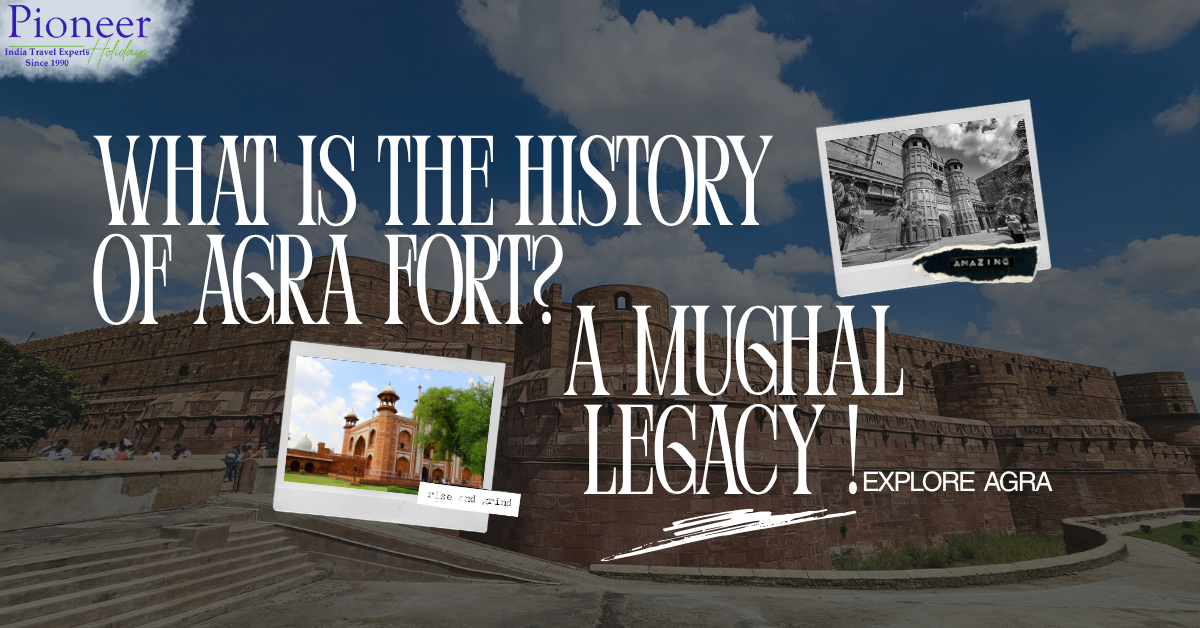
Stand at the gates of Agra Fort and you feel the weight of four centuries pressing down on you. This massive red structure rising above the Yamuna River has watched empires rise, kings fall, a grieving emperor die in captivity, and a new nation reclaim its past. It is one of the most layered historical sites in all of Asia — and yet many visitors walk through it in two hours and miss almost everything.
This guide takes you deep into its story.
Introduction to Agra Fort
What is Agra Fort?
Agra Fort is a massive walled fortress and former royal palace complex built primarily in red sandstone, located in Agra, Uttar Pradesh, northern India. It served as the main residence of the Mughal emperors for nearly a century and housed some of the most consequential events in Indian history. Today it stands as a UNESCO World Heritage Site and one of the most visited monuments in South Asia. The fort is not just a military structure. Inside its high walls, you will find palaces, mosques, audience halls, gardens, and private chambers — an entire city within a city, built over generations by rulers who each added something of their own.
Historical importance of Agra Fort in India
For over a century, Agra Fort was the political heart of one of the most powerful empires the world has ever seen. The Mughal Empire at its peak controlled most of the Indian subcontinent, and the decisions made inside these walls shaped the lives of hundreds of millions of people. It is where Akbar held court, where Jahangir received foreign ambassadors, where Shah Jahan transformed stone into poetry, and where Aurangzeb imprisoned his own father.
Why tourists visit Agra Fort today
Most people coming to Agra have the Taj Mahal at the top of their list. But seasoned travelers quickly discover that Agra Fort deserves equal time. Unlike the Taj — which is a single, breathtaking memorial — the fort is a layered, walkable world of history. You can stand in the very room where Shah Jahan spent his final years gazing at the Taj Mahal from captivity. That experience is difficult to put into words.
Where Is Agra Fort Located?
Location of Agra Fort in Uttar Pradesh
Agra Fort sits in the center of Agra city, in the state of Uttar Pradesh in northern India. Agra itself lies along the banks of the Yamuna River, roughly 200 kilometers south of New Delhi. The fort covers an area of about 94 acres and is enclosed by massive walls that rise about 21 meters high.
Distance between Agra Fort and Taj Mahal
The two monuments are about 2.5 kilometers apart from each other. You can walk between them in around 30 minutes along the riverfront, though auto-rickshaws and cycle taxis make the trip faster. Many visitors combine both sites in a single day — the fort in the morning, the Taj in the golden hour before sunset.
Connection with the Yamuna River
The eastern walls of Agra Fort run directly along the Yamuna River. This was intentional — the river acted as a natural moat and a line of defense on the fort’s most exposed side. Today the Yamuna is far quieter than it once was, but standing at the riverside ramparts, you can still imagine how imposing this fortification must have appeared to approaching armies.
Who Built Agra Fort?
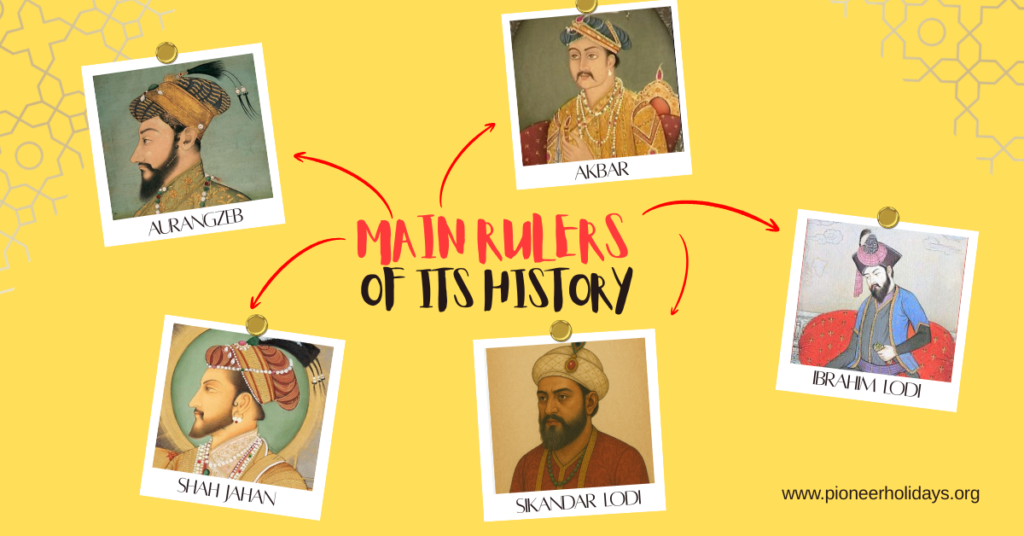
Early fort built during Sikandar Lodi’s period
The earliest fortification at this site predates the Mughals entirely. Historical accounts suggest that a fort made of baked bricks stood here as early as 1080 CE. Sikandar Lodi, the Sultan of the Lodi dynasty who ruled from Delhi, moved his capital to Agra in 1504 and made the existing structure his base of operations. When he died in 1517, his son Ibrahim Lodi continued to use it — until the Battle of Panipat in 1526 changed everything.
Akbar’s reconstruction using red sandstone
After Babur’s victory at Panipat, the Mughals took control of Agra and found the old Lodi fort in poor condition. It was Babur’s grandson, Emperor Akbar, who decided to build something entirely new and worthy of the empire he was consolidating. Starting in 1565, Akbar tore down most of the old structure and began a massive construction project using deep red Rajasthani sandstone. Over 4,000 builders worked on it over eight years.
Mughal military planning behind the fort
Akbar was both an artist and a military strategist. The fort’s design reflects this dual thinking. The walls were built in a crescent shape hugging the riverbank, with bastions positioned to allow defenders maximum coverage. The gate placements were deliberate — approaching enemies would be forced to turn and expose their flank to archers above. It was a fortress designed by someone who had survived real battles.
4,000+ – Builders worked on Akbar’s reconstruction
94 acres – Total area enclosed within the fort walls
21 m – Height of the surrounding defensive walls
1565 – Year Akbar began the red sandstone rebuild
When Was Agra Fort Built?
c. 1080 CE – First fortification recorded on this site — a brick structure of uncertain origins.
1504 – Sikandar Lodi moves his capital to Agra and occupies the existing fort.
1526 – Babur defeats Ibrahim Lodi at Panipat; Mughals gain control of Agra Fort.
1565 – Akbar begins systematic reconstruction in red sandstone — the fort as we know it takes shape.
1573 – Primary construction under Akbar is completed after eight years of work.
1628–1658 – Shah Jahan adds marble palaces and transforms the interior into his architectural vision.
1803 – British forces capture Agra Fort after the Second Anglo-Maratha War.
1983 – UNESCO declares Agra Fort a World Heritage Site.
History of Agra Fort During the Mughal Empire
Akbar’s royal residence
Akbar ruled from Agra Fort for most of his reign. He held public audiences here, received tributary kings, planned military campaigns, and oversaw the vast administrative machinery of his empire. The court he ran was famously cosmopolitan — Hindu Rajput nobles, Persian poets, and Jesuit priests all moved through these halls. Akbar’s famous religious discussions, which he called Ibadat Khana gatherings, were held within the fort’s walls.
Jahangir’s rule and contributions
When Akbar died in 1605, his son Jahangir inherited both the empire and the fort. Jahangir was a lover of beauty — he spent more time in the gardens and pleasure palaces of Agra than his father ever did. He made some additions to the fort’s interiors, though his reign is more associated with Lahore as his seat of power. His memoir, the Tuzuk-i-Jahangiri, describes life in the fort with vivid detail.
Shah Jahan’s architectural changes
Shah Jahan’s impact on Agra Fort is visible everywhere. He inherited a sandstone palace from his grandfather and father, and he transformed it. Wherever he could, Shah Jahan replaced red sandstone with white marble, inlaid with pietra dura — the technique of setting semi-precious stones into marble in floral and geometric patterns. The Khas Mahal, Musamman Burj, and Sheesh Mahal all carry his unmistakable aesthetic fingerprint.
Aurangzeb period
Aurangzeb was different from the emperors before him. More austere, more orthodox in his religious views, he found the lavish beauty of his father’s and grandfather’s constructions somewhat excessive. His most notable addition to the fort was the Moti Masjid, or Pearl Mosque — a restrained, elegant mosque in pure white marble that many historians consider his finest architectural work.
Decline of the Mughal Empire
After Aurangzeb’s death in 1707, the Mughal Empire began its long disintegration. Agra Fort passed through many hands — various Mughal successors, the Jat rulers of Bharatpur, the Marathas, and finally the British. Each period left its mark, often not for the better. By the time the British formally took control in 1803, parts of the fort had been damaged or repurposed for military use.
Why Was Agra Fort Important for the Mughals?
Political headquarters of the empire
Agra Fort was the nerve center of Mughal governance for much of the 16th and 17th centuries. The emperor’s court — called the Diwan-i-Aam for public affairs and Diwan-i-Khas for private matters — operated from within the fort. Petitions, judicial decisions, diplomatic negotiations, and tax collection all flowed through this administrative hub.
Royal residence of Mughal emperors
The fort was not just an office — it was a home. The Mughal emperors lived here with their families, their wives, their servants, and their courts. The zanana, or women’s quarters, occupied an entire section of the fort. The kitchens reportedly served hundreds of dishes at each royal meal.
Military defense center
The fort’s thick walls, raised bastions, and strategic location made it the strongest military position in the region. It held the imperial treasury and armory, and in times of conflict it served as the last refuge for the royal family and their allies.
Treasury and administration hub
The Mughal treasury was housed within the fort, making it the financial heart of the empire as well. Revenue from across the subcontinent flowed here before being redistributed to fund wars, construction projects, and the enormous expenses of the royal household.
Architecture of Agra Fort
Massive red sandstone structure
The first thing that strikes you about Agra Fort is the color. The walls glow a warm, deep red in the morning and evening light — a color unique to the Rajasthani sandstone quarried specifically for this project. From a distance, the fort looks almost monolithic. Up close, every surface reveals intricate carvings, latticework screens, and decorative arches.
Blend of Islamic, Persian, and Hindu architecture
Agra Fort is a living document of cultural synthesis. Akbar was deliberately inclusive — his fort blends traditional Islamic arches with Hindu column styles borrowed from Rajput architecture. Persian influences appear in the garden layouts and the decorative calligraphy. Shah Jahan’s later additions brought in Mughal Baroque, heavier with marble, lighter in feeling.
Defensive walls and security design
The outer walls are 2.4 kilometers in circumference. They range from 8 to 11 meters thick at the base — wide enough that defenders could ride horses along the top. The walls feature rounded bastions at regular intervals, designed to eliminate blind spots. A wide dry moat surrounds the landward sides.
Important gates and towers
The fort originally had four gates, of which two are accessible today. The Amar Singh Gate, on the south, is the entrance tourists use. The Delhi Gate, on the west, faces the city and was once the ceremonial entrance for the emperor. Both gates feature elaborate defensive structures — multiple turns, overhead murder holes, and heavy iron-studded doors designed to slow any attack to a crawl.
Main Attractions Inside Agra Fort
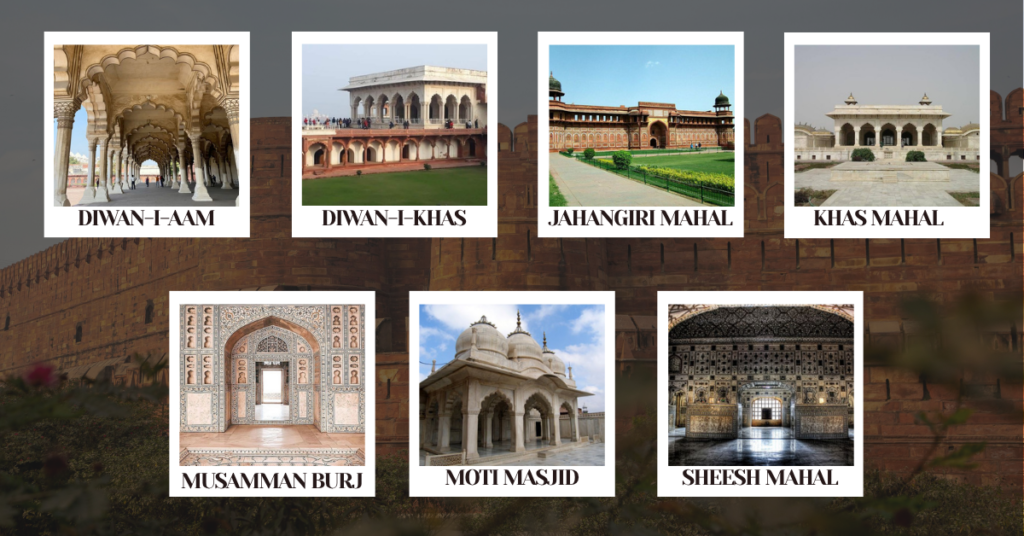
- Diwan-i-Aam— The Hall of Public Audience, where the emperor heard petitions from ordinary citizens. The emperor sat on a marble throne set high on a decorated platform while hundreds gathered in the open courtyard below.
- Diwan-i-Khas— The Hall of Private Audience, reserved for meetings with nobles, ambassadors, and senior ministers. Its columns feature fine pietra dura inlay work added during Shah Jahan’s reign.
- Jahangiri Mahal— The oldest surviving palace within the fort, built primarily by Akbar for his Rajput wife. It blends Hindu and Islamic architectural elements with unusual clarity, making it a fascinating study in cultural fusion.
- Khas Mahal— Shah Jahan’s private palace, flanked by two golden-roofed pavilions. The ceilings are exquisitely painted, the marble floors cool even in summer heat.
- Musamman Burj— The octagonal tower that became Shah Jahan’s prison. From its white marble balcony, you can see the Taj Mahal shimmering on the horizon.
- Moti Masjid— Aurangzeb’s Pearl Mosque, built in white marble. Currently closed to visitors but visible from multiple vantage points within the fort.
- Sheesh Mahal— The Glass Palace, whose interior walls are studded with tiny mirror fragments that create a dazzling starfield effect when candlelit.
Hidden Secrets of Agra Fort
Underground tunnels
The fort contains a network of underground passages, some of which have never been fully explored or opened to the public. Local historians believe several tunnels connected the fort to other parts of Agra, possibly extending as far as Fatehpur Sikri, about 40 kilometers away. Whether such long passages truly existed or are the stuff of legend remains unclear — the fort’s underground sections are largely sealed off.
Secret escape passages
Several of the fort’s internal structures include concealed doorways and narrow passages that would have allowed residents to move between sections unseen. These were practical necessities in a royal household full of political intrigue — an emperor needed to be able to move quietly when needed.
Hidden chambers
Archaeological surveys have repeatedly found sealed rooms and chambers within the fort’s thicker walls. Some were used for storing treasure; others may have served as secure hiding places during sieges. What lies in the still-unexplored sections is genuinely unknown.
Stories connected with royal imprisonment
Beyond Shah Jahan’s famous confinement, Agra Fort witnessed other imprisonments. His son Murad Baksh was held here briefly during the war of succession in 1658. The fort’s walls have kept secrets for multiple generations of a family that was simultaneously brilliant and deeply dysfunctional.
The Story of Shah Jahan’s Imprisonment
Why Aurangzeb imprisoned Shah Jahan
In 1658, Shah Jahan fell gravely ill. In the succession struggle that followed, his sons turned on each other. Aurangzeb, the third son, was the most ruthless and the most patient. He defeated his brothers in battle, had the eldest killed, and in September 1658 he confined his father within Agra Fort — stripping him of all power while allowing him to live in comfort. Aurangzeb’s stated justification was that Shah Jahan was too ill to rule and that the empire needed strong leadership. But most historians see the imprisonment as a straightforward power grab. Shah Jahan had dozens of servants and access to his remaining family. He was a prisoner, but a gilded one.
Shah Jahan’s final years inside Agra Fort
For eight years, Shah Jahan lived in the Musamman Burj — the octagonal tower he himself had built. He had his books, his music, a handful of loyal servants, and one devoted daughter, Jahanara Begum, who chose to remain with him rather than live in freedom. As his health declined, he is said to have spent hours each day simply looking out toward the Taj Mahal — the monument he had built for his beloved wife Mumtaz Mahal, who had died in 1631.
View of the Taj Mahal from Musamman Burj
When you stand on the marble balcony of Musamman Burj today, the Taj Mahal is visible to the southeast, rising above the riverbank. In Shah Jahan’s time it would have been even clearer. Travel writers have described the view as one of the most emotionally charged sightlines in the world — the living man in his tower, and the monument to his dead love on the horizon.
Emotional side of the historical story
Shah Jahan died in January 1666, reportedly holding a mirror so he could see the Taj Mahal’s reflection in his final hours when he could no longer lift his head. His daughter Jahanara Begum was with him. He was buried inside the Taj Mahal, beside Mumtaz — the only asymmetrical element in an otherwise perfectly symmetrical monument, and the one detail that tells you everything about how he died and what he meant to that place.
Connection Between Agra Fort and Taj Mahal
Shah Jahan and Mumtaz Mahal’s story
The Taj Mahal exists because of a death inside the Mughal court. Mumtaz Mahal, Shah Jahan’s third and most beloved wife, died in 1631 giving birth to their fourteenth child. Shah Jahan was reportedly devastated. He mourned publicly for a year and commissioned the Taj Mahal as her tomb almost immediately. Construction began in 1632 and took approximately 22 years to complete.
Taj Mahal view from Agra Fort
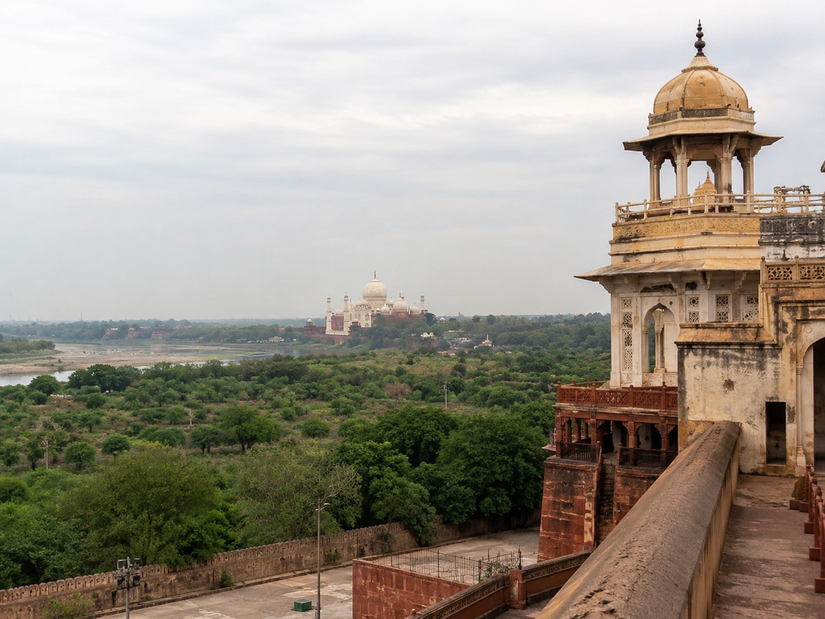
The Taj Mahal is visible from several points inside Agra Fort, but none as intimate or poignant as Musamman Burj. Many visitors find themselves genuinely moved when they understand what they’re looking at — a monument built by an emperor out of grief, and then used to torment that same emperor in his captivity.
Historical connection between both monuments
The two sites are physically close but historically intertwined at a much deeper level. Both were shaped by Shah Jahan. Both represent the peak of Mughal architectural ambition. Together they tell the full arc of his story — the triumph of building the Taj, and the sorrow of watching it from a window in old age, as a prisoner in his own palace.
Battles and Wars Connected to Agra Fort
Importance during Mughal conflicts
The fort changed hands several times in the turbulent century after Aurangzeb’s death. The Jat kings of Bharatpur seized it in 1761 and stripped many of its finest marble inlays, selling them to fund their campaigns. The Marathas held it next. Each occupier used the fort as both a military base and a symbol of power — control of Agra Fort meant control of northern India.
British occupation of Agra Fort
British forces under General Lake captured Agra Fort in October 1803, following the Battle of Delhi. The British incorporated it into their military infrastructure — repainting walls, demolishing some internal structures to build barracks, and converting sections of the royal palace into offices and storerooms.
Role during the Revolt of 1857
During the Indian Rebellion of 1857, Agra Fort became a refugee point for British civilians fleeing the surrounding region. Over 6,000 people — soldiers, merchants, and their families — took shelter within the fort’s walls. The fort held, though the city around it saw significant fighting. After the rebellion was suppressed, the British continued using the fort as a military cantonment until Indian independence in 1947.
Agra Fort Under British Rule
British military headquarters
From 1803 onward, the British treated Agra Fort primarily as a strategic military asset. They stationed a significant garrison here and used it as a command center for the region. The careful Mughal spatial planning — designed around court ritual and royal privacy — was largely ignored in favor of functional military use.
Structural damage during colonial rule
Much of what is lost from Agra Fort today was lost during the period of Maratha and British occupation. Marble panels were removed, fountains were broken or filled in, and entire wings of the palace complex were torn down to make room for military buildings that themselves no longer exist. The Archaeological Survey of India, established after 1858, worked to stop further degradation, but much had already been done.
Changes made by the British army
The British constructed several barracks within the fort that remained in use well into the 20th century. Some of these structures are still standing. The fort remained under military control until 1947. The Indian Army handed it over to the Archaeological Survey of India, which opened it fully to the public — though even today a portion of the fort remains an active military installation and is not accessible to visitors.
Interesting Facts About Agra Fort
- The Kohinoor diamond — one of the world’s most famous gems, now part of the British Crown Jewels — was kept in Agra Fort’s treasury for decades before it was eventually taken to Persia and then to Britain.
- Akbar reportedly had 500 buildings constructed within the fort during his reign. Most were made of wood or mud and have not survived, leaving only the stone structures visible today.
- The Sheesh Mahal’s mirrored ceiling was designed so that a single candle flame would appear as thousands of stars reflected across the walls and ceiling.
- The Delhi Gate’s iron-studded doors were designed to withstand a war elephant charge. The studs were sized and spaced specifically to prevent an elephant from pressing its forehead effectively against the door.
- Jahangiri Mahal, built by Akbar for his Hindu wife Jodha Bai, features a blend of Hindu and Islamic design so seamless that architectural historians still debate which elements belong to which tradition.
- The fort’s walls are not continuous — they are actually a series of linked bastions and curtain walls that together form an almost unbroken perimeter 2.4 kilometers around.
- A large stone bathtub, known as the Hauj-i-Kausar, stands in the Jahangiri Mahal’s courtyard. It was carved from a single block of stone and reputedly used by Nur Jahan, Jahangir’s powerful wife.
- During the 1857 Revolt, the British destroyed at least one complete palace wing within the fort to build emergency barracks. What stood there has never been fully documented.
- The fort has appeared on the Indian 100-rupee note. It remains one of the few historical monuments in India depicted on currency.
- Agra Fort and the Taj Mahal are connected by a secret riverside pathway that Mughal emperors used to travel between them — away from public view. Parts of this route have been rediscovered in recent archaeological surveys.
A Place That Demands You Slow Down
Agra Fort is not a ruin. It is not a frozen relic. It is a living document of an extraordinary period in human history — one written in red sandstone and white marble, in battles and betrayals, in love and captivity.
Come for the history. Stay for the human stories threaded through every courtyard and corridor. Stand at Musamman Burj and look toward the Taj Mahal. Let that view settle into you. Then you will understand why people who visit Agra often say the fort moves them in ways they didn’t expect.
Together, Agra Fort and the Taj Mahal don’t just draw millions of travelers from across the world — they remind all of us that great architecture is always, at its heart, a story about people.
If Agra’s layered history has sparked your curiosity, there’s no better way to experience it than in person. Pioneer Holidays offers thoughtfully planned agra tour packages that take you beyond the surface, and their taj mahal tour packages pair perfectly for a complete Mughal trail. Book your journey while the dates are open.
You May Also Read – What is the History of Taj Mahal and its construction?
