
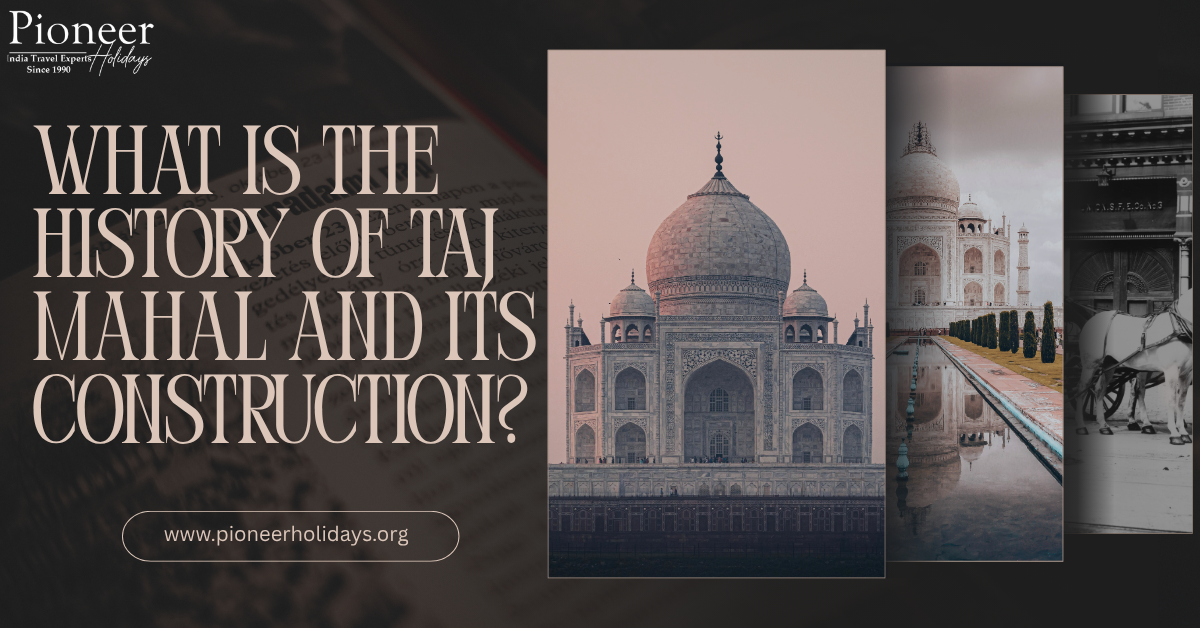
In this blog, “What is the History of Taj Mahal,” you will find in-depth, authentic information about one of the world’s most remarkable monuments — told from the perspective of someone who has stood before it hundreds of times and never stopped being moved by it. We will explore its origins and historical context through History & Background, understand its grand structure through Construction & Architecture, uncover the deeper meanings hidden in its Design & Symbolism, and separate truth from legend in Myths vs Facts.
History & Background
Introduction to Taj Mahal
The Taj Mahal stands on the banks of the Yamuna River in Agra, Uttar Pradesh — and the moment you see it for the first time, you understand immediately why it has captivated the world for nearly four centuries. Built entirely from white Makrana marble, it seems to glow from within rather than simply reflect light. At sunrise, it blushes with soft pink warmth. At noon, it blazes with a clean, brilliant white. By evening, it settles into a quiet golden hue that makes it look almost like something from a dream.
But the Taj Mahal is far more than beautiful marble. It is a monument of extraordinary precision, philosophical depth, and emotional weight. Every element of its design — the symmetry, the calligraphy, the gardens, the reflecting pool — was placed deliberately. Nothing is accidental. That is what makes it not just a building, but one of the finest expressions of human creativity ever constructed.
Who Built the Taj Mahal?
The Taj Mahal was commissioned by Mughal Emperor Shah Jahan, but it was never a one-man project. Shah Jahan conceived the vision and directed every major decision, but the monument itself was the product of a vast, coordinated effort involving some of the greatest architects, craftsmen, and engineers of the 17th century.
The chief architect was Ustad Ahmad Lahori, widely regarded as the most gifted designer of his era. He led a team that included specialists from Persia, the Ottoman Empire, and across India — stone carvers, marble inlay artists, calligraphers, and structural engineers — each contributing a specific layer of mastery to the whole. Historians estimate that approximately 20,000 artisans worked on the Taj Mahal at various stages of its construction. The result of their combined effort stands before us today, as precise and as breathtaking as the day it was completed.
Shah Jahan

Shah Jahan was the fifth emperor of the Mughal Empire, whose real name was Khurram. He was born on 5 January 1592 in Lahore. He was the son of the great Mughal emperor Jahangir and his mother’s name was Jagat Gosain (Jodha Bai). Shah Jahan was interested in art, architecture and governance since childhood, which later became the hallmark of his reign.
Shahjahan had a total of 7 marriages in his life, which was normal according to the royal traditions of that time. However, his most beloved and prominent wife was Mumtaz Mahal, whose real name was Arjumand Banu Begum. In history, she is considered to be Shahjahan’s closest and trusted companion.
Who Was Mumtaz Mahal?
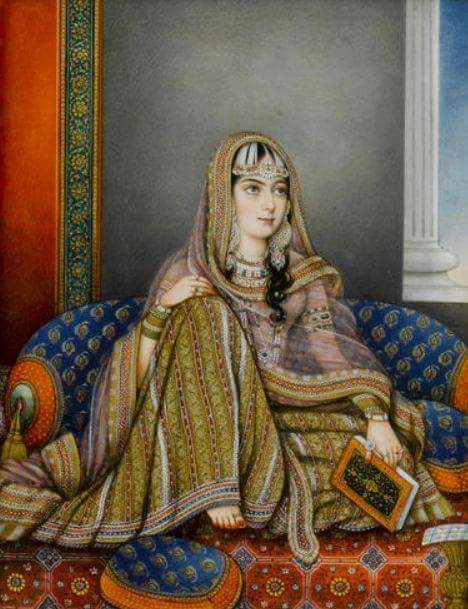
Mumtaz Mahal was a prominent queen of the Mughal era, whose real name was Arjumand Banu Begum. She was born in 1593 into a distinguished Persian family and was considered an educated, sensitive and influential woman of her time. She was married to Shah Jahan in 1612, after which she became his most beloved wife. Mumtaz Mahal was not limited to royal life only, but she also advised in administrative matters and was interested in public welfare works. She died during childbirth in 1631, which deeply affected the Mughal court.
The love story behind the Taj Mahal
To understand the Taj Mahal, you first need to understand the relationship that created it — because this is not simply a story about a king building a monument. It is a story about a man who lost the one person who made his world make sense.
Shah Jahan and Mumtaz Mahal were inseparable for nearly two decades. She was with him on campaigns, present at court decisions, and involved in his life in ways that went far beyond formal queenship. When she died in 1631, Shah Jahan was not just a grieving husband — he was a man who had lost his closest companion, advisor, and anchor.
Historical accounts describe him refusing food, abandoning music and festivities for two years, and emerging from mourning visibly aged. His response was to build something that would endure long after both of them were gone — a monument so perfectly beautiful that it would communicate to future generations exactly what she meant to him. That monument was the Taj Mahal.
Today, both Shah Jahan and Mumtaz Mahal rest inside it. Mumtaz was the first to be interred here, and when Shah Jahan died in 1666, he was buried beside her — fulfilling his own wish to remain with her even in death. Their symbolic cenotaphs are visible in the central chamber above ground, while their actual tombs lie in a sealed lower crypt beneath. The entire Taj Mahal is perfectly symmetrical — except for one detail. Shah Jahan’s tomb was added later, placed beside Mumtaz’s rather than centered, making it the only asymmetric element in an otherwise flawlessly balanced monument. Some historians see poetry in that imperfection. It was never supposed to be there — just as his death was something neither of them planned for.If you want to understand this love story in the place where it ends, most visitors find that a knowledgeable local guide brings it to life in ways that reading simply cannot. A private Taj Mahal tour gives you the space and the context to absorb it properly.
Timeline of Construction — When Did It Start and Finish?
The timeline of construction of Taj Mahal was clear and well organized. Its construction began in the year 1632 and the main mausoleum was completed around 1643. It then took until about 1653 to complete other parts of the complex—such as the gardens, the mosque, and external structures. Thus, the entire project took about 20–22 years to be completely completed.
Construction and Architecture
How Was the Construction Process of Taj Mahal?
Building the Taj Mahal presented engineers with a fundamental challenge from the very first day: the land on the banks of the Yamuna is soft, alluvial soil — not an ideal foundation for a massive marble complex. To solve this, the engineers sank deep, well-like shafts into the ground and filled them with stone and lime, creating a stable substructure. They then constructed a broad elevated platform, or plinth, on top — raising the entire monument above flood level and giving it the commanding visual presence it has today.
Transporting the marble itself was another feat. Makrana marble was quarried in Rajasthan and carried to Agra using a combination of bullock carts, specially constructed ramps, and river transport along the Yamuna. Elephants moved the heaviest stones into position on site. Thousands of artisans worked simultaneously on different parts of the structure — carving, inlaying, and fitting — in a carefully organised process that balanced speed with extraordinary precision. The result is a monument that has stood for nearly 400 years without significant structural compromise.
Which Architects and Craftsmen Were Involved?
Ustad Ahmad Lahori served as the project’s chief architect, responsible for translating Shah Jahan’s vision into a workable design and overseeing its execution across two decades. He was supported by specialists drawn from across the known world. Persian craftsmen contributed their tradition of fine geometric tilework and calligraphy. Ottoman designers brought expertise in dome construction. Indian artisans, who had spent generations developing the pietra dura stone inlay technique, were responsible for the intricate floral decoration that covers the marble surfaces.
In total, around 20,000 skilled workers contributed to the Taj Mahal. These were not anonymous labourers — many were the finest craftsmen of their generation, and their work here represents the apex of Mughal artistic achievement.
Architectural style of Taj Mahal
The Taj Mahal’s architecture draws from three distinct traditions — Mughal, Persian, and Indian — and blends them so seamlessly that the result feels entirely original. The governing principle throughout is perfect symmetry. Whether you approach from the main gateway, stand at the reflecting pool, or view the complex from the Yamuna side, every element mirrors its counterpart exactly. The main tomb, the four minarets, the mosque and its mirror-image guest house, the garden pathways — all balance each other with mathematical precision.
The central dome — a tall, slightly bulbous form known as an onion dome — is the monument’s defining visual feature. Its shape derives from Persian tradition, but its scale and execution are entirely Mughal. The four minarets at the corners lean very slightly outward, away from the main structure — a deliberate engineering decision to ensure that in the event of an earthquake or structural failure, they would fall away from the tomb rather than onto it. That kind of practical thinking, embedded invisibly into what appears purely decorative, is characteristic of the entire project.
The walls are covered in pietra dura inlay work — semi-precious stones including jasper, jade, turquoise, lapis lazuli, and carnelian set into the marble to form flowers, vines, and geometric patterns. Quranic calligraphy runs along the gateways and arches in black marble. Together, these elements create a surface that rewards close inspection as much as distant admiration.
Where Did the White Marble Used in Taj Mahal Come From?
The marble came from Makrana, a town in Rajasthan approximately 400 kilometres from Agra. Makrana marble is prized for a quality that sets it apart from any other white stone in the world: its extraordinarily fine crystalline structure, which gives it a luminosity that appears to come from within rather than simply reflecting light from the surface. Shah Jahan’s architects knew this, which is why no substitute was acceptable.
Getting the marble to Agra required a logistical operation of remarkable scale. Hundreds of bullock carts transported the stones overland, while the Yamuna River served as the main arterial route for the heaviest loads. Specially reinforced paths were built in sections where the terrain made cart transport difficult. By the time the last piece of marble was placed, the supply chain had operated continuously for over fifteen years.
Which Materials Were Used in Making Taj Mahal?
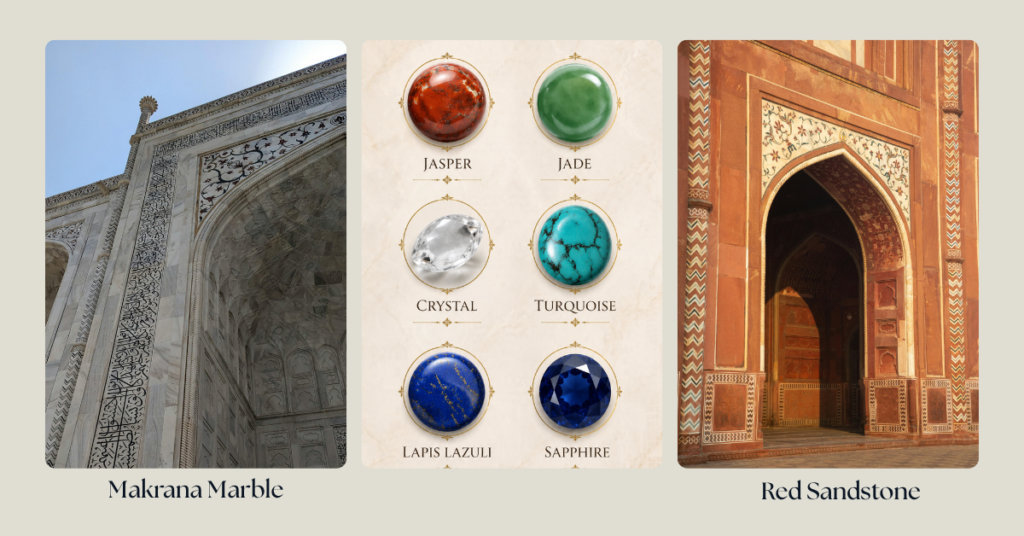
The materials used in the construction of Taj Mahal are the biggest reason for its beauty and durability. It is not just a building, but a fine example of advanced craftsmanship and material selection of that era.
The main material was white marble, which was brought from Makrana. Makrana marble is known for its high quality, luster and long lasting durability. From the face of this marble the Taj Mahal can be seen changing color according to the light.
Apart from this, red sandstone was also used extensively, which was mainly used in outer structures and gateways. This sandstone was brought from Rajasthan and nearby regions. To strengthen the structure, bricks and lime mortar were used, which created a strong base.
The most special thing about Taj Mahal is its intricate inlay work, which is called “pietra dura” technique. In this, precious and semi-precious stones like jasper, jade, crystal, turquoise, lapis lazuli and sapphire are embedded in marble. Apart from India, these stones were also brought from Central Asia and Middle East.
Black marble was used for calligraphy and decorative elements, which creates a strong contrast with the white marble. A combination of different types of stones has also been used in the floors and some internal sections.
All these materials were carefully selected on the instructions of Shah Jahan, so that the building would remain strong for centuries along with its beauty.
Significance of Symmetrical Design of Taj Mahal
The symmetry of the Taj Mahal is not decoration — it is the architecture’s fundamental language. Stand at any point along the central axis that runs from the main gateway through the reflecting pool to the tomb, and the complex divides into two perfect halves. The mausoleum, the minarets, the mosque, the guest house, the gardens, the pathways — every element has an exact mirror on the opposite side.
This was not simply an aesthetic preference. In the Mughal architectural tradition, symmetry carried spiritual meaning. It represented divine order — the idea that a perfectly balanced world reflects a higher, eternal reality. By designing the Taj Mahal along these principles, Shah Jahan was making a theological statement as much as an aesthetic one: this is a place where heaven and earth meet.
The four minarets illustrate how function and symbolism coexisted. They tilt very slightly outward — barely perceptible to the eye but precisely calculated — so that any structural failure would direct them away from the tomb. The Charbagh garden layout divides the surrounding space into four equal quadrants, reflecting the Islamic concept of paradise as a garden divided by four rivers. The water channels that define those quadrants are precisely aligned to reflect the mausoleum’s façade, doubling its visual presence.The symmetry of the Taj Mahal is why it reads clearly from every angle and at every distance — and why no photograph ever quite does it justice. Experiencing it in person, with the space to walk along the central axis and take in the proportions at different points, is something genuinely different. Many visitors find that a guided Taj Mahal tour from Delhi helps them understand these spatial relationships in ways that self-guided visits often miss.
Dome Structure and Its Engineering
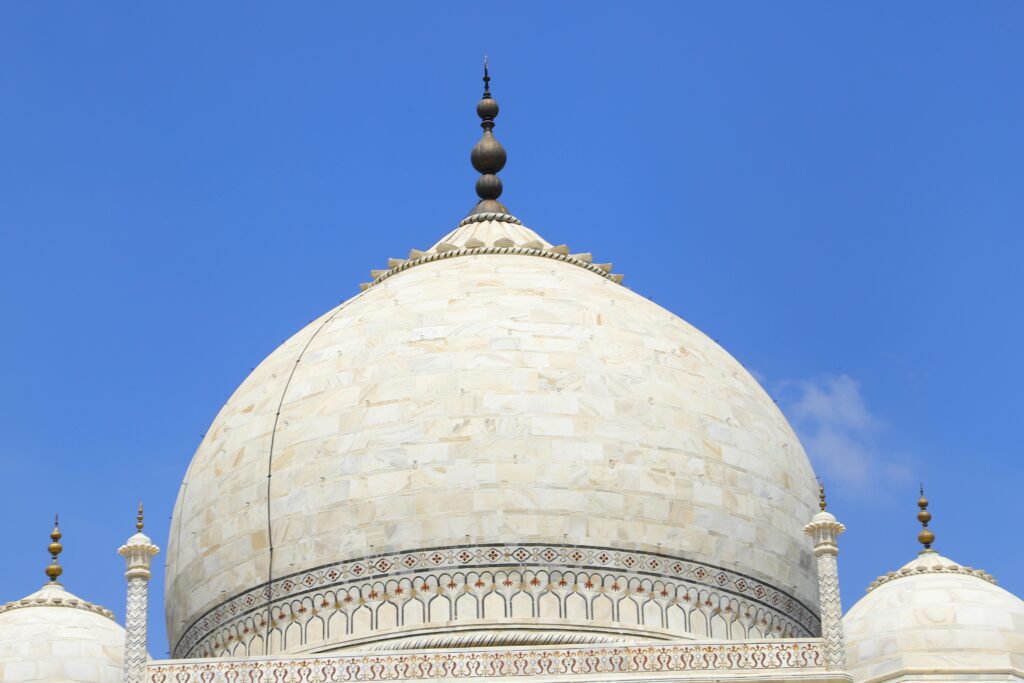
The Taj Mahal’s central dome is one of the great structural achievements of the pre-industrial world. It uses a double-dome system — an outer shell that provides the tall, dramatic silhouette visible from a distance, and a separate inner dome that defines the interior ceiling height. The gap between the two performs a function: it keeps the interior cool, reduces sound reverberation, and allows the outer dome to be proportioned for visual impact without making the interior space impractically tall.
The dome’s weight is distributed outward through four massive arched chambers and down into the plinth below, rather than bearing straight down through the walls. This load distribution — well understood by Persian and Mughal engineers of the era — is what allows the walls to remain relatively thin while supporting an enormous mass above them. The finial at the apex, which combines Hindu and Islamic design elements in a single form, contributes to both the aesthetic balance and the structural stability of the crown.
The dome stands approximately 73 metres above ground level. It has remained structurally intact for nearly 400 years, a testament to the engineering understanding its builders brought to every dimension of the project.
Design & Symbolism
What Does the Design of Taj Mahal Symbolize?
Every element of the Taj Mahal’s design carries meaning beyond its visual function. Shah Jahan and his architects conceived this monument not merely as a beautiful tomb but as a physical representation of paradise — a place where the divine order becomes visible in marble and stone.
The choice of white marble communicates purity and sanctity. In Islamic architectural tradition, white is associated with transcendence and the sacred. The perfect symmetry conveys balance and divine order — the idea that the universe, at its highest level, is harmonious and complete. The central dome rising skyward represents the ascent of the soul toward the divine. The four minarets, standing at the corners like guardians, frame and protect the sacred space at the centre.
The gardens reinforce this symbolism at ground level, translating the Quranic vision of paradise into a physical landscape. Water flows through the garden along the central axis, dividing the space into quadrants and reflecting the monument above it. This mirroring — the Taj Mahal reflected in still water — creates the visual effect of two worlds touching: the earthly and the spiritual.
Shah Jahan built a place where the boundary between those two worlds feels genuinely thin. Standing inside it, particularly in the early morning before the crowds arrive, most visitors feel something they find difficult to articulate afterwards. That feeling is intentional. It was designed in.
What Is the Role of Islamic Art and Calligraphy?
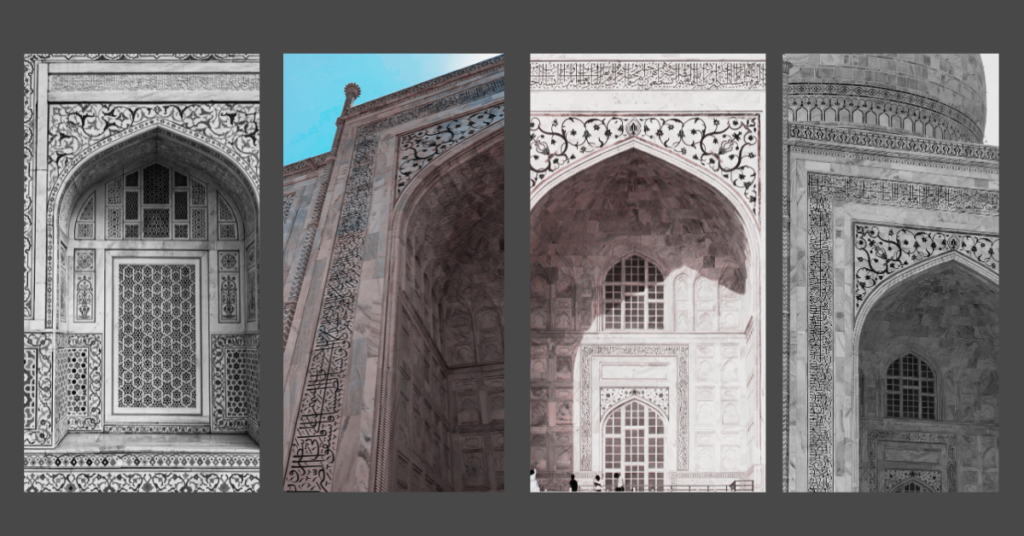
The Islamic art and calligraphy at the Taj Mahal serve a purpose far beyond decoration. They are part of the monument’s meaning — a visual and textual programme that guides the viewer from the physical world into a spiritual one.
The Quranic calligraphy on the gateways, arches, and entrance panels was executed by Amanat Khan, the finest calligrapher of the Mughal court. He solved a subtle but significant visual problem: as a viewer approaches the monument and the calligraphy bands rise higher above eye level, the letters at the top would naturally appear smaller. To compensate, Amanat Khan progressively enlarged the lettering toward the top of each panel, so that every line reads at the same apparent size from ground level. It is a sophisticated optical correction, and it works perfectly. Amanat Khan was so proud of this achievement that he signed several of the panels — a rare act of individual authorship within a tradition that typically prioritised anonymity. His signature remains visible today.
The geometric patterns throughout the complex — the interlocking stars, the repeating hexagons, the infinite lattices — carry their own symbolism. In Islamic art, endlessly repeating patterns represent eternity and the infinite nature of the divine. They cannot be said to begin or end at any specific point, which is precisely the intention. The floral inlay work, meanwhile, draws from natural forms but stylises them into something more perfect than nature itself — an artistic philosophy that reflects the Islamic understanding of art as the human attempt to approximate divine perfection.
Together, these elements create a layered visual experience. From a distance, the Taj Mahal reads as pure form and proportion. As you approach, the calligraphy and inlay become legible. Up close, the individual craftsmanship of each stone and letter becomes visible. At every scale, there is something remarkable to see.
Concepts of Garden
The garden in front of the Taj Mahal is not simply a pleasant approach to the monument. It is a designed representation of Jannat — the Islamic concept of paradise — translated into landscape form.
The layout follows the Charbagh style, in which a large garden is divided into four equal quadrants by water channels or paths. This division references a specific passage in the Quran describing paradise as a garden through which four rivers flow — rivers of water, milk, honey, and wine. By reproducing this structure in marble and stone, Shah Jahan’s architects turned the approach to the mausoleum into a symbolic journey: you cross paradise to reach the tomb of the woman for whom it was built.
The central water channel runs along the main axis between the gateway and the mausoleum. It serves both practical and symbolic functions — providing irrigation, creating the famous reflecting pool effect, and reinforcing the axis of symmetry that organises the entire complex. The still water reflects the Taj Mahal so precisely that the reflection appears almost more vivid than the monument itself, particularly in the early morning.
The trees and plants were chosen with the same intentionality as the marble and stone. Evergreen cypresses represent eternity and constancy. Fruit trees suggest abundance and life. The entire garden communicates the same message as the monument above it: this is a place outside ordinary time, where beauty and peace exist in permanent balance.
Interiors (Tombs, Carvings) of Taj Mahal
The interior of the Taj Mahal is quieter and more intimate than its exterior prepares you for. After the scale and grandeur of the approach, the central chamber feels almost still.
The chamber contains two cenotaphs — decorative tombs placed symbolically above ground. The larger one is Mumtaz Mahal’s; Shah Jahan’s is positioned beside it, slightly breaking the monument’s otherwise perfect symmetry. These are not the actual burial sites. The real tombs lie in a sealed lower crypt directly beneath the chamber, accessible only to conservation authorities. The cenotaphs above are covered in pietra dura inlay of exceptional quality — carnelian, lapis lazuli, jasper, and other semi-precious stones forming floral patterns of extraordinary delicacy and precision. After nearly four centuries, the colours remain vivid and the surfaces sharp-edged.
Surrounding the cenotaphs is a carved marble screen — a Jali — that filters light into the chamber and creates a shifting pattern of shadows throughout the day. This screen was carved from a single block of marble, and the filigree work within it is so fine in places that the stone appears almost translucent. It stands as one of the supreme examples of Mughal stone craft.
The walls and arches carry Quranic verses in black marble calligraphy, designed — as with the exterior panels — so that the lettering appears uniform in size from ground level, regardless of its actual height on the wall. The overall effect of the chamber is one of quiet, concentrated beauty. Every surface has been considered. Nothing is there by accident.
Myths vs Facts
Taj Mahal myths” often misrepresent the history of Taj Mahal, while facts reveal its true origins, construction, and cultural significance as a Mughal architectural masterpiece.
Myth 1: Did Shah Jahan plan to build a black Taj Mahal?
This story related to Taj Mahal has been going on among the people for a long time that Shah Jahan had planned to build a black Taj Mahal for himself on the other side of the Yamuna river. It is said that the white Taj Mahal was for his wife Mumtaz Mahal and he wanted to build a similar black mausoleum for himself, which would show both of them face to face.
This story gained strength when some European travelers mentioned it in their writings. In particular, the French traveler Jean-Baptiste Tavernier wrote in the 17th century that Shah Jahan wanted to build another Taj Mahal of black marble. Apart from this, remains of some black stones were also found in Mehtab Bagh area across the Yamuna, due to which people thought that these were the marks of the incomplete black Taj Mahal.
Fact – Historians and archeology experts investigated this matter, but no concrete evidence of the construction of the Black Taj Mahal was found. The black stones found there were actually white marble which had turned black with time.
Apart from this, it is not written anywhere in the official records of the Mughal period that Shahjahan had started any such project. According to some research, Mehtab Bagh was a garden which was designed in such a way that it would have a beautiful reflection of the Taj Mahal.
Therefore most historians consider this story to be a fiction. This story definitely sounds special, but it is not accepted as truth.
Myth 2: Workers’ hands were cut off.
Another very popular Taj Mahal myth is that after the construction of this grand building, Shah Jahan cut off the hands of the artisans who had built it. It is said that this was done so that they could never again build such a beautiful monument anywhere else. This story sounds quite harsh and shocking, so people quickly accept it as true.
This myth was also promoted by films, folklore and some guides, due to which it spread further. Many times this story is told to tourists as if it were a confirmed truth.
Fact – If we talk about history, there is no concrete evidence for this claim. There is mention of artisans, craftsmen and laborers in many documents and records of the Mughal period, but nowhere has it been said that they were treated like this.
Not only this, many of the artisans who worked in the construction of Taj Mahal later also worked on other buildings and projects. This makes it clear that no incident like amputation of his hands had taken place.
Some historians also believe that the artisans were hired with good money and respect, as Mughal architecture was at its peak at that time and skilled artisans were highly valued.
The real story states that the workers were offered a planned city next to the Taj mahal named Mumtazabad, where the skilled worker lived their lives along with their family. Now the same places is called Taj ganj and the descendants of the workers still live and thrive there.
Therefore, this story is considered to be just a rumor, which has nothing to do with real history.
Myth 3: Why has the color of Taj Mahal changed?
When you see the Taj Mahal at different times, it seems as if its color is changing. It appears light pink in the morning, completely white in the afternoon and turns slightly golden or light orange in the evening. This experience is quite special for people who see it for the first time, and many people associate it with some mystery or magic.
In fact, this is not a story or an illusion, but a play of nature and light. The Taj Mahal is made of white marble, and this stone reflects light in its own way. When sunlight falls on it from different angles, its color appears to change slightly.
Fact – The colour change is real — but the explanation is entirely scientific. The Taj Mahal is built from Makrana white marble, a stone renowned for its exceptionally fine crystalline structure. This marble has a natural luminosity that causes it to reflect and absorb light differently depending on the angle, intensity, and colour temperature of the sunlight falling on it.
At sunrise, the low-angle, warm light of early morning gives the marble a pink or rose-gold hue. Under the harsh, direct sunlight of midday, the marble reflects brightly and appears intensely white. As the sun sets, its warm amber light bathes the surface in a golden glow. The surrounding atmosphere — haze, humidity, and sky colour — amplifies these effects further.
This is why visiting the Taj Mahal at different times of day is considered such a rewarding experience. The colour change is one of the monument’s most beautiful natural qualities — no mystery required.
You May Also Like – The Science Behind the Taj Mahal’s Color-Changing Effect
Role of the Yamuna River in the Taj Mahal’s construction and design
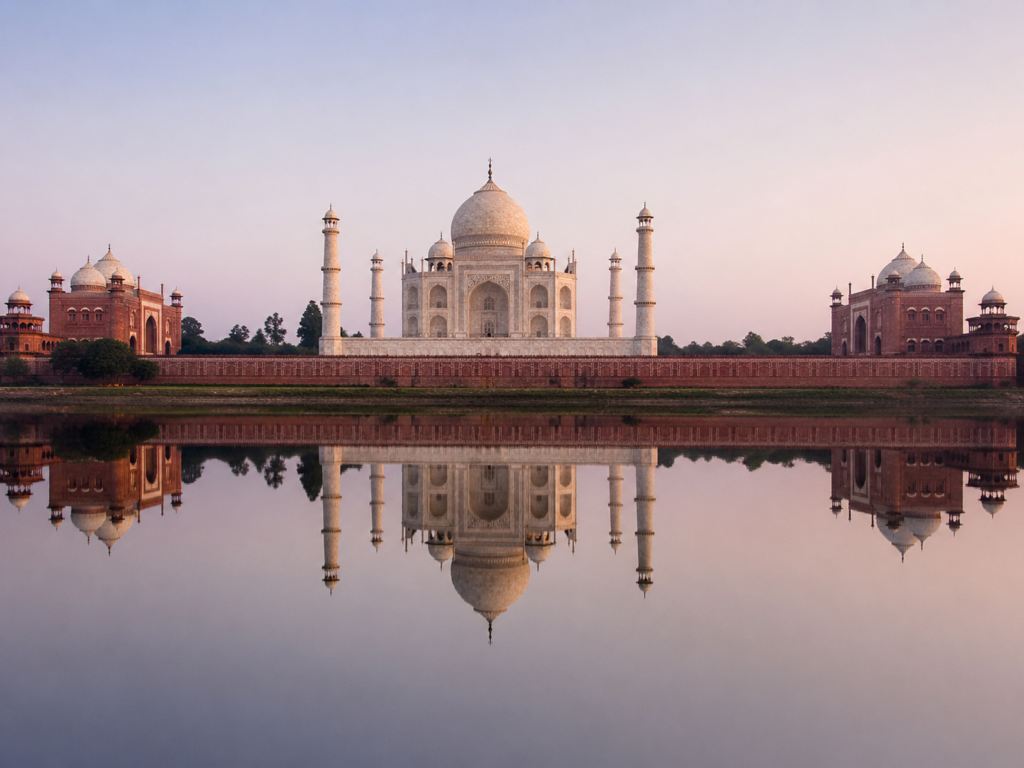
The Yamuna River was not simply a picturesque backdrop for the Taj Mahal. It was an active participant in the monument’s construction and remains fundamental to its design logic.
Help for a Strong Foundation
The alluvial soil along the Yamuna’s bank is naturally soft and moisture-retentive — not the ideal ground for a 70-metre marble monument. The engineers’ solution was to sink a series of deep masonry wells into the earth, filling them with rubble and lime to create a firm, load-bearing substructure. Crucially, the moisture from the nearby river kept the wooden elements within this foundation from drying out and cracking. The Taj Mahal has stood on this engineered foundation for nearly four centuries without significant settlement — a remarkable validation of the original engineering judgment.
Assistant in Transportation of Construction Materials
During the construction period, the Yamuna served as the primary transport route for heavy materials arriving from distant sources. Marble from Rajasthan, semi-precious stones from Central Asia and the Middle East, and sandstone from across the region all arrived in Agra partly by river. Water transport was far more efficient than overland routes for bulk loads, and the river’s direct access to the construction site reduced handling time considerably.
Impact on Design and Beauty
The Taj Mahal’s placement within its garden complex breaks the standard Mughal convention of positioning the main tomb at the centre. Here, the tomb sits at the northern end of the garden, directly against the river terrace — a deliberate compositional choice that opens the monument to views from the water and allows the Yamuna itself to function as a fourth side of the complex. The river also provides the conditions for the famous reflection effect: under calm conditions, the Taj Mahal’s entire facade is visible in the water below, creating a doubled image that has been the subject of paintings, photographs, and descriptions for centuries.
Religious and Symbolic Significance
In Mughal architecture, water carries consistent symbolic weight. It represents paradise, purity, and the divine presence. The garden’s water channels, the reflecting pool, and the Yamuna beyond all reinforce this symbolism at different scales — from the intimate (the still pool at your feet) to the monumental (the great river behind the tomb). The Taj Mahal does not simply sit beside the Yamuna. It is in conversation with it.
Why Agra was chosen as the location for the taj mahal ?
The construction of Taj Mahal is not only a symbol of love, but the location chosen for it was also decided very thoughtfully. There were many important reasons behind choosing Agra for this historical monument, which were related to the politics, geography and architecture of that time.
1. Major capital of the Mughal Empire
When Shah Jahan decided to build the Taj Mahal, Agra was a major capital of the Mughal Empire. It was easy to rule from here and all the necessary resources and artisans were easily available. This helped in completing the construction work systematically and quickly.
2. Special importance of Yamuna river
Agra was an ideal location due to its location on the banks of the Yamuna River. Building the Taj Mahal on the banks of the river was an important part of the architecture, as it not only provided a stable base for the monument, but also allowed marble and other building materials to be easily transported through water. Also, being on the banks of the river increases the beauty of the monument manifold.
3. Geography and suitability of land
The land of Agra was flat and strong, which was necessary for the construction of such a large monument. The location was suitable from an engineering point of view, allowing the heavy structure to remain stable for a long period of time.
4. Strategic and cultural importance
Agra was already an important cultural and trading centre. Many grand buildings already existed here, such as Agra Fort, due to which the area was considered favorable for architecture. The construction of Taj Mahal further strengthens the historical identity of this city.
5. Royal attitude and beauty
Shahjahan gave great importance to beauty and balance. The Taj Mahal was constructed on the banks of the Yamuna in such a way that its reflection is visible in the water, which makes its beauty more grand. This place perfectly reflects his architectural thinking and artistic vision.
If you are planning to visit the Taj Mahal, knowing its history transforms the experience completely. The monument rewards understanding. Whether you are visiting for a single day or building it into a longer Golden Triangle journey, exploring the best Taj Mahal tour packages with Pioneer Holidays and an experienced local guide ensures you see not just the marble, but everything the marble means.
With a strong track record of delivering reliable, high-quality travel experiences, we take pride in offering trusted services; you can also review our customer feedback on Tripadvisor and Viator to see what our guests have to say.
