
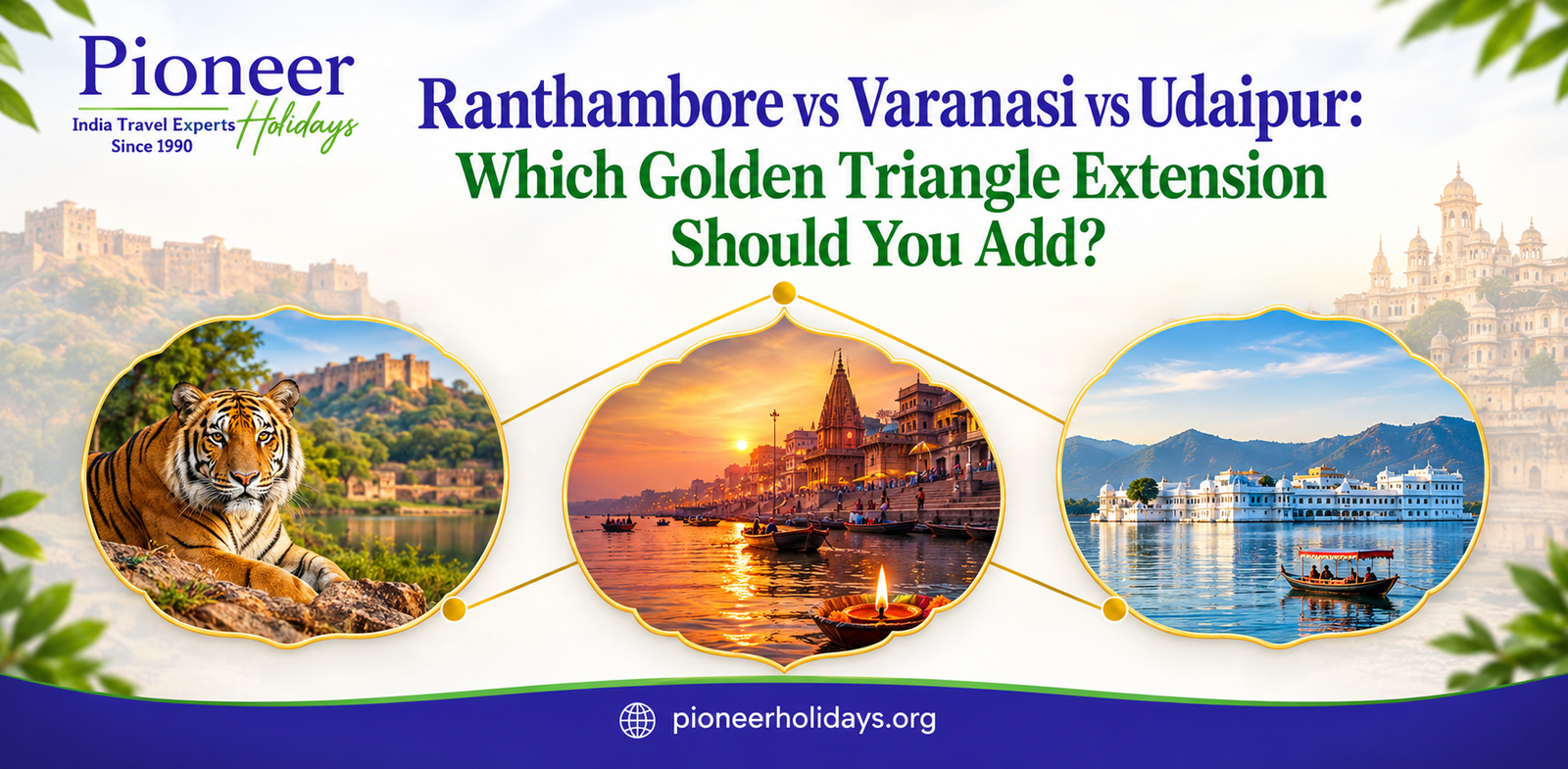
Delhi, Agra, and Jaipur cover the essentials of a first trip to India, but seven or eight days in those three cities eventually starts to feel like forts and palaces on repeat. That is why so many travelers look at a golden triangle tour extension once they see the base itinerary: a fourth stop that adds something the core route does not have. Ranthambore adds wildlife. Varanasi adds spiritual depth. Udaipur adds romance and scenery. All three are genuinely worth visiting, which is exactly what makes the choice difficult.
This guide, drawn from how Pioneer Holidays builds these itineraries for international travelers, compares the three side by side: what each one actually involves, how much time it needs, what it costs relative to the others, and which type of traveler tends to be happiest with each choice. Golden Triangle Tour Packages can be built around any single extension or, with enough days, more than one.
Why Travelers Add a Fourth Stop to the Golden Triangle
The classic Delhi, Agra, Jaipur route is compact by design. It was built to show the Mughal and Rajput highlights in the shortest reasonable time, which is exactly why it works for a first visit and exactly why it leaves gaps for a second one. Travelers who add an extension are usually looking for one of three things: a physical, unscripted experience that breaks up the monuments, a slower and more scenic close to the trip, or a deeper cultural layer that goes beyond forts and bazaars. Ranthambore, Udaipur, and Varanasi each answer a different one of those three needs, which is why comparing them head to head is more useful than reading about each in isolation.
Ranthambore: The Wildlife Extension
Ranthambore National Park sits in Rajasthan’s Sawai Madhopur district, about 180 km southeast of Jaipur, roughly a three to three and a half hour drive or a shorter train ride. Because it sits so close to the Rajasthan leg of the route, it is the easiest of the three extensions to bolt onto an existing Golden Triangle itinerary without a major detour.
What a Ranthambore Extension Actually Includes
The park is built around Ranthambore Fort and split into ten numbered safari zones. Zones one through five form the core area and generally see more tiger activity, while zones six through ten sit in the buffer area and offer a quieter, less crowded safari at the cost of a lower sighting chance. Safaris run twice a day, in the early morning and late afternoon, in either an open-topped canter that seats around twenty people or a smaller six-seat jeep that gives a more private and flexible experience. Zone assignment is handled by the forest department at the time of booking rather than chosen on the day, so travelers do not get to pick which zone they visit.
Tiger sightings are never guaranteed on any single safari, and any operator who promises one is overselling the experience. What Ranthambore reliably delivers is the setting itself: dry deciduous forest, three lakes inside the park, crumbling ruins scattered through the landscape, and enough birdlife that even a safari without a tiger sighting tends to feel worthwhile.
Best Time to Go and How Many Days You Need
The park is open from October through June and closed during the monsoon months of July to September. November through February brings cooler, more comfortable weather and strong birdwatching, while April through June is hotter but often produces better tiger sightings as animals move to water sources. Two nights with three to four safaris gives a realistic chance of a sighting; one night with a single safari is possible but leaves little room if that one safari comes up empty. Pioneer Holidays typically recommends the two-night version for exactly this reason.
Who Ranthambore Suits
Ranthambore works best for travelers with kids or teenagers, wildlife enthusiasts, and anyone whose trip has started to feel like fort after fort after fort. It is also the most schedule-friendly of the three extensions, since it barely stretches an existing Rajasthan route. A Golden Triangle Tour With Ranthambore typically adds only two or three extra nights to the standard route.
Varanasi: The Cultural and Spiritual Extension
Varanasi is the one extension that is not a short detour from the Rajasthan triangle. The city sits roughly 800 km east, in Uttar Pradesh, and is reached by a domestic flight from Delhi, Agra, or Jaipur rather than a road transfer. That geography is worth understanding before booking, because it changes the shape of the itinerary: Varanasi is usually added at the start or end of the trip, as its own self-contained leg, rather than woven into the middle of the Rajasthan route.
What a Varanasi Extension Actually Includes
Varanasi is one of the oldest continuously inhabited cities in the world and one of Hinduism’s most sacred sites, built along more than eighty ghats on the banks of the Ganges. The centerpiece for most visitors is the evening Ganga Aarti at Dashashwamedh Ghat, a fire and chant ceremony performed daily at sunset that draws large crowds of pilgrims and travelers alike. A sunrise boat ride along the ghats is the other essential experience, since the river looks completely different in the early morning light and at a quieter hour than the evening ceremony. Most itineraries also include a visit to Sarnath, the site a short drive outside the city where Buddha is said to have delivered his first sermon, along with the narrow lanes of the old city and its temples.
Best Time to Go and How Many Days You Need
October through March is the most comfortable window, with cooler daytime temperatures and clear evenings for the aarti. Summers from April through June are extremely hot, and the monsoon months of July and August make the steps of many ghats slippery and some of them temporarily inaccessible. Two full days is a reasonable minimum: one for the ghats and aarti, one for Sarnath and the old city. Travelers with a genuine interest in the culture often find themselves wanting a third day once they arrive.
Who Varanasi Suits
Varanasi suits travelers who came to India for something beyond the postcard stops of forts and palaces, and who are comfortable with a place that can feel intense, crowded, and unfiltered rather than curated for tourists. It rewards that curiosity more than any other extension on this list, but it is worth going in with realistic expectations about the crowds, the noise, and the pace of the old city. A Golden Triangle Tour with Varanasi is usually the extension travelers remember most vividly once they are home, even when it was the one they were least sure about beforehand.
Udaipur: The Romantic and Scenic Extension
Udaipur sits about 400 km southwest of Jaipur, reachable by a short flight, an overnight or day train, or a full day’s drive. Known as the City of Lakes, it is generally regarded as the most photogenic stop on any extended Rajasthan itinerary and is often used to close a trip on a slower, calmer note after the pace of Delhi, Agra, and Jaipur.
What an Udaipur Extension Actually Includes
The City Palace, built up over roughly four hundred years by successive Mewar rulers, sits directly on Lake Pichola and blends Rajput and Mughal architectural styles across a sprawling complex of courtyards, museums, and galleries. A boat ride on Lake Pichola is the other must-do, passing close to Jag Mandir island and the Lake Palace, the white marble hotel that appears on almost every postcard of the city. Beyond the lake, Udaipur’s old city has a gentler, more walkable feel than Jaipur’s, with rooftop cafes, narrow bazaars, and, for travelers who time it right, a sunset view over the city from Sajjan Garh, the Monsoon Palace on the hill above town.
Best Time to Go and How Many Days You Need
October through March again offers the most comfortable weather, with warm days and cool evenings. Summers are hot enough that daytime sightseeing becomes uncomfortable. Two nights is enough to cover the City Palace, a lake excursion, and a relaxed walk through the old city; a third night mainly adds time to slow down rather than additional sights to check off.
Who Udaipur Suits
Udaipur is the extension that suits couples, honeymooners, and anyone who wants their trip to end gently rather than with one more packed sightseeing day. It is also the extension where hotel choice affects the budget the most, since a lakeside room and a City Palace view can sit at very different price points for the same city. A Golden Triangle Tour with Udaipur is a natural way to close out a Rajasthan itinerary before flying home.
Ranthambore vs Varanasi vs Udaipur at a Glance
| Factor | Ranthambore | Varanasi | Udaipur |
| Distance from Jaipur | ~180 km (road or rail) | ~800 km (flight required) | ~400 km (road, rail, or flight) |
| Minimum nights recommended | 2 | 2 | 2 |
| Best months | October to June (April to June for higher tiger activity) | October to March | October to March |
| Core experience | Tiger safaris by jeep or canter | Ganga Aarti, sunrise boat ride, Sarnath | City Palace, Lake Pichola boat ride, old city |
| Fits into route as | A short side trip within Rajasthan | A separate leg, usually at the start or end | A closing leg to the Rajasthan route |
| Best suited to | Families, wildlife enthusiasts, active travelers | Travelers seeking cultural and spiritual depth | Couples, honeymooners, slower-paced travelers |
How to Decide Which Extension Fits Your Trip
Trip Length and Pacing
A six or seven day Golden Triangle leaves comfortable room for exactly one extension. Adding a second extension is possible, but it turns a focused trip into something closer to a two-week marathon, and by day nine or ten most travelers, families with young kids especially, are ready for a slower pace rather than another new city to unpack in.
Budget
Ranthambore’s added cost is mostly fixed: safari permits and park fees stay largely the same regardless of hotel category. Udaipur is where the budget swings the most, since the gap between a standard room and a lakeside or palace-view room is significant. Varanasi tends to be the least expensive of the three to add, which is part of why it gets overlooked even though many travelers rate it as the most memorable stop of the whole trip.
Traveling With Family or Young Children
Ranthambore is generally the easiest extension for families, since a jeep safari holds a child’s attention in a way that another palace tour often does not. Varanasi can be a rewarding experience for older children and teenagers but is less suited to very young kids, given the crowds and the early starts required for the boat ride. Udaipur sits comfortably in between and works well for families who want one slower, low-effort day before flying home.
Can You Add More Than One Extension?
Yes, and it is a common request, though a good operator will say honestly when a trip is starting to run too long. Ranthambore paired with Udaipur is a frequent combination, since both sit south of Jaipur and can be linked by road without backtracking. Adding Varanasi to either of those requires accepting that it will sit apart from the rest of the itinerary as its own flight-connected leg rather than a seamless add-on.
Planning the Right Extension With Pioneer Holidays
None of these three extensions is the objectively correct choice. They solve different problems, so the right one depends on what your base itinerary is missing. If the trip has felt like forts and palaces on repeat, Ranthambore breaks that pattern with something physical and unscripted. If you want the itinerary to slow down and end gently, Udaipur does that better than anywhere else on the route. If you are traveling for depth rather than scenery, Varanasi is the extension that actually delivers it.
Pioneer Holidays builds each of these extensions into a private itinerary rather than a fixed group departure, so the pacing, hotel category, and number of safaris or excursions can be adjusted to match how much time and budget you actually have. For travelers who are still weighing the options, the full range of base itineraries and extensions is laid out on the Golden Triangle Tour Packages page, with each extension built as a private tour rather than a one-size-fits-all package.
Frequently Asked Questions
Which Golden Triangle extension is best for first-time visitors to India?
Ranthambore is usually the easiest first extension because it requires the smallest detour from the standard Delhi, Agra, Jaipur route and needs no additional flight.
Is Varanasi worth adding if it requires a separate flight?
For travelers interested in India’s spiritual and cultural side, most who add it consider the flight worthwhile. It is a different kind of experience from Rajasthan’s forts and palaces, so it is worth going in with that expectation rather than treating it as a quick add-on.
How many extra days should I budget for a Ranthambore extension?
Two nights with three to four safaris gives a reasonable chance of a tiger sighting. A single overnight with one safari is possible but leaves no buffer if that safari does not produce a sighting.
Is Udaipur or Varanasi better for a honeymoon?
Udaipur is generally the stronger fit for a honeymoon, given its lakeside settings, palace hotels, and slower pace. Varanasi is a more spiritually and culturally focused stop rather than a romantic one.
Can Ranthambore and Udaipur be combined on the same trip?
Yes. Both sit south of Jaipur and can be linked by road without backtracking, which makes this one of the more common two-extension combinations.
What is the best time of year to add any of these three extensions?
October through March works well across all three destinations, offering comfortable temperatures for safaris in Ranthambore, ghat walks in Varanasi, and sightseeing in Udaipur. April through June can improve tiger sighting odds in Ranthambore specifically, but is hot in all three locations.
Do I need extra visas or permits for any of these extensions?
No additional visa is required since all three destinations are within India. Ranthambore safaris do require a forest department permit, which tour operators typically book in advance as part of the package.
Which extension is the least expensive to add?
Varanasi tends to be the least expensive of the three, since it does not carry the fixed safari permit costs of Ranthambore or the premium hotel pricing common in Udaipur.
