
Introduction
Rajasthan is not limited to just palaces, deserts and vibrant culture. If you look deeper, you will find that this northwestern state of India is home to some of the most fascinating wildlife habitats in the country. The Land of the Kings transforms into a wildlife paradise as you visit the protected areas. From the elusive Bengal tiger to the majestic Indian leopard, herds of spotted deer to the exotic blackbuck, Rajasthan’s wildlife sanctuaries and national parks tell a story of ecological richness that many tourists overlook.
What makes Rajasthan’s wildlife landscape particularly interesting is its diversity. There are dry desert ecosystems supporting unique species, semi-arid grasslands teeming with herbivores, and riverside areas where wildlife congregates. This diversity means that even within a relatively limited geographical area, you can encounter vastly different wildlife experiences. The state has a network of protected areas that act as important conservation areas, not just tourist attractions.
Explore Rajasthan Wildlife Sanctuaries with our Rajasthan Tour Packages
How Many National Parks and Sanctuaries Does Rajasthan Have?
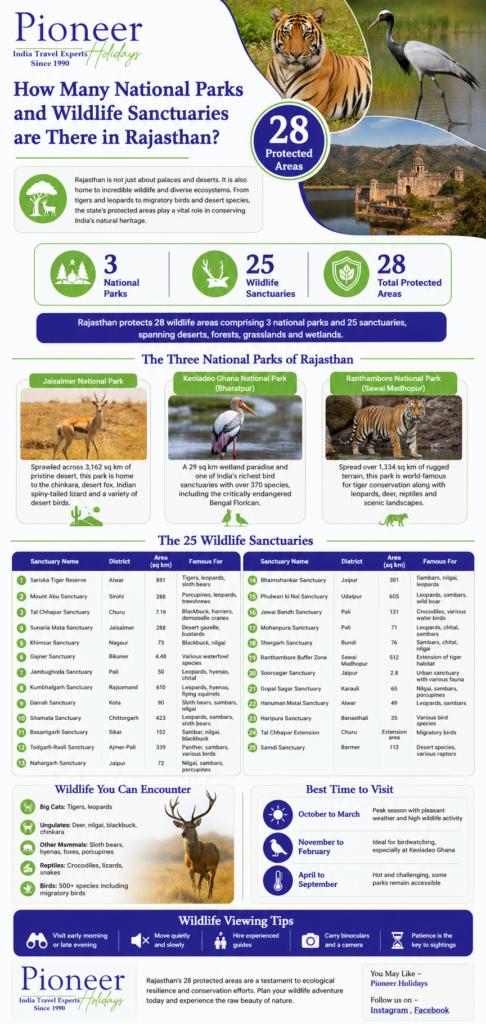
There are 3 national parks and 25 wildlife sanctuaries in Rajasthan. Thus, there are a total of 28 protected areas for conservation and wildlife management across the state. If you are not familiar with the scale of Rajasthan’s conservation efforts, these numbers may surprise you. The state covers approximately 342,000 square kilometres, and these protected areas span diverse terrain from the Thar Desert to the Aravalli ranges.
The Three National Parks of Rajasthan
Jaisalmer National Park, located in the western part of Rajasthan, is spread over a pristine desert area of about 3,162 square kilometers. The park is home to some of the species that have adapted wonderfully and are thriving in even the harshest environments of India. Here you will find the Indian spiny-tailed lizard, the exceptionally resourceful desert fox and various species of desert birds. The park also protects the chinkara (Indian gazelle) and the elusive wolf can sometimes be spotted. The terrain here is unique in itself—golden sand dunes, rocky plateaus and sparse vegetation create an otherworldly environment that makes for stunningly beautiful photographs at sunrise and sunset.
Keoladeo Ghana National Park (Bharatpur) Located in Bharatpur district, this park is spread over an area of just 29 square kilometers, making it one of the most densely populated bird sanctuaries in India. Despite its small size, it is far richer in terms of biodiversity. In the winter months, the park becomes a haven for migratory birds coming from Central Asia and Siberia. Over 370 bird species can be seen here, including the critically endangered Bengal Florican. The wetland ecosystem of the park forms a unique micro-habitat in the predominantly arid landscape of Rajasthan. It is a must-see for bird lovers, and for obvious reasons – the diversity and density of bird species found here is truly amazing.
Ranthambore National Park (Sawai Madhopur) is one of the most famous protected areas of Rajasthan. Ranthambore is spread over a rugged terrain of 1,334 square kilometres, with rocky dunes, dense forests and the picturesque Chambal river flowing through it. This park has received international recognition as a major project of tiger conservation. The landscape here looks like a scene from a movie—century-old forts stand amidst wildlife, creating a unique fusion of history and nature. Apart from tigers, leopards, sambar deer, chital, nilgai and many types of reptiles are found in this park. The tiger rescue and conservation project here is one of the most successful conservation stories.
The 25 Wildlife Sanctuaries
Rajasthan’s 25 wildlife sanctuaries include both lesser-known gems and recognized biodiversity hotspots. Here’s a comprehensive breakdown:
| Sanctuary Name | District | Area (sq km) | Famous For |
| Sariska Tiger Reserve | Alwar | 881 | Tigers, leopards, sloth bears |
| Mount Abu Sanctuary | Sirohi | 288 | Porcupines, leopards, treeshrews |
| Tal Chhapar Sanctuary | Churu | 7.19 | Blackbuck, harriers, demoiselle cranes |
| Sunaria Mata Sanctuary | Jaisalmer | 288 | Desert gazelle, bustards |
| Khimsar Sanctuary | Nagaur | 73 | Blackbuck, nilgai |
| Gajner Sanctuary | Bikaner | 4.48 | Various waterfowl species |
| Jambughoda Sanctuary | Pali | 50 | Leopards, hyenas, chital |
| Kumbhalgarh Sanctuary | Rajsamand | 610 | Leopards, hyenas, flying squirrels |
| Darrah Sanctuary | Kota | 90 | Sloth bears, sambars, nilgai |
| Sitamata Sanctuary | Chittorgarh | 423 | Leopards, sambars, sloth bears |
| Basantgarh Sanctuary | Sikar | 152 | Sambar, nilgai, blackbuck |
| Todgarh-Raoli Sanctuary | Ajmer-Pali | 339 | Panther, sambars, various birds |
| Nahargarh Sanctuary | Jaipur | 72 | Nilgai, sambars, porcupines |
| Bhaimshankar Sanctuary | Jaipur | 301 | Sambars, nilgai, leopards |
| Phulwari ki Nal Sanctuary | Udaipur | 605 | Leopards, sambars, wild boar |
| Jawai Bandh Sanctuary | Pali | 131 | Crocodiles, various water birds |
| Mohanpura Sanctuary | Pali | 71 | Leopards, chital, sambars |
| Shergarh Sanctuary | Bundi | 76 | Sambars, chital, nilgai |
| Rnathambore Buffer Zone | Sawai Madhopur | 512 | Extension of tiger habitat |
| Soorsagar Sanctuary | Jaipur | 2.8 | Urban sanctuary with various fauna |
| Gopal Sagar Sanctuary | Karauli | 65 | Nilgai, sambars, porcupines |
| Hanuman Matai Sanctuary | Alwar | 49 | Leopards, sambars |
| Haripura Sanctuary | Banasthali | 35 | Various bird species |
| Tal Chhapar Extension | Churu | Extension area | Migratory birds |
| Samdi Sanctuary | Barmer | 113 | Desert species, various raptors |
Deep Dive: The Standout Protected Areas
Why Ranthambhore Commands Attention
You can witness conservation firsthand while roaming in Ranthambore. The park’s success in tiger conservation is remarkable—from fewer than 20 tigers in the 1970s to a sizeable population today. The landscape here changes from dense sal and mixed deciduous forests to open grasslands, where you can see huge herds of spotted deer grazing. The Chambal River flowing through the park forms gorgeous valleys and provides a vital supply of water during the dry season. If you want to have an exciting wildlife viewing experience, the highest chances of seeing tigers in Rajasthan are in this park, although success always depends on luck and timing.
The Keoladeo Ghana Phenomenon
This sanctuary completely changed the principles of conservation in India. What was once a hunting ground became one of the world’s most important wetland ecosystems. During the peak winter months (November to February), the park is almost filled to the brim with birds. The shallow waters create ideal feeding grounds for storks, herons, eagles and countless smaller species. Local villagers once hunted here; They now work as guides and help conserve the same birds that their ancestors hunted. The story of the sanctuary shows how the combination of economic benefits and conservation can dramatically change human attitudes towards wildlife.
Sariska’s Second Chance
The Sariska Tiger Reserve faced a crisis in the early 2000s when tigers became completely extinct due to hunting and habitat degradation. The tiger rehabilitation project started thereafter became a model for tiger conservation in other places. Today, the sanctuary is blessed with several tiger families, healthy leopard populations and reviving ecosystems. The reserve’s stunning terrain—with hills rising abruptly from the forests—offers stunning views at every turn. Local guides often tell interesting stories of the sanctuary’s transformation from a wildlife wasteland to a thriving protected area.
Wildlife Species You Can Encounter
Big Cats
- Bengal tigers (Ranthambhore, Sariska)
- Indian leopards (widespread across sanctuaries)
Ungulates and Herbivores
- Spotted deer (chital) – abundant across multiple parks.
- Sambar deer – elusive, prefer forested areas.
- Nilgai (blue bull) – commonly seen in open areas.
- Chinkara (Indian gazelle) – adapted to desert zones.
- Blackbuck – specialized in grassland sanctuaries.
Other Mammals
- Sloth bears – found in rocky terrain.
- Hyenas – nocturnal scavengers.
- Flying squirrels – in forested zones.
- Indian wild boar – various sanctuaries.
- Porcupines – especially Mount Abu area.
- Desert foxes – Desert National Park.
Reptiles and Amphibians
- Mugger crocodiles – water bodies and sanctuaries.
- Indian spiny-tailed lizard – Desert National Park.
- Various snake species.
- Monitor lizards.
Birds
- Over 500+ species recorded across Rajasthan’s protected areas.
- Demoiselle cranes – winter migrants.
- Steppe eagles – raptors of the open skies.
- Bengal floricans – critically endangered.
- Various heron and egret species.
Practical Information for Your Visit
Best Time to Visit
- October to March: Peak season when weather is pleasant and wildlife activity increases.
- November to February: Ideal for birdwatching, especially at Keoladeo Ghana.
- April to September: Hot and challenging; some parks remain accessible but less comfortable.
Wildlife Viewing Tips
- Early morning and late evening offer the best wildlife sightings.
- Move quietly and slowly to avoid disturbing animals.
- Binoculars are essential, especially for birdwatching.
- Hire experienced local guides—they know animal behavior and movement patterns.
- Patience matters more than luck; sometimes you wait hours for a sighting.
Travel Logistics
- Most parks require permits; hire guides through official channels.
- Jeep safaris are standard in national parks.
- Walking safaris possible in some sanctuaries.
- Accommodation ranges from basic to luxury near major parks.
- Consider exploring Rajasthan with guided tours through established tour operators who handle logistics seamlessly.
If you are planning a comprehensive wildlife experience across Rajasthan’s diverse ecosystems, specialized Rajasthan tour packages can help you design itineraries that combine cultural experiences with wildlife adventures, ensuring you make the most of your time in these incredible protected areas.
Key Takeaways
- Rajasthan protects 28 wildlife areas comprising 3 national parks and 25 sanctuaries.
- Each area offers distinct ecosystems and species encounters.
- Tiger conservation success makes Ranthambhore and Sariska globally significant.
- Keoladeo Ghana supports more bird species than many larger reserves.
- Desert National Park showcases life in extreme arid conditions.
- Wildlife viewing success depends on season, timing, and guide expertise.
- These protected areas represent irreplaceable repositories of biodiversity.
Final Thoughts
The protected areas of Rajasthan tell stories of ecological resilience and dedication to conservation. These are not only places to see wildlife, but also landscapes where man has chosen to co-exist with nature. Whether you’re attracted by the chance to see a tiger, spot migratory birds, or simply want to experience secluded wildlife, these 28 protected areas offer some immersive experiences. The numbers may seem small—three national parks, twenty-five sanctuaries—but the experiences they provide and the species they protect make them among India’s most valuable natural assets.
Your next wildlife adventure is waiting for you in the protected areas of Rajasthan. Deserts, forests and water bodies all have their own stories—you just have to go there and listen to them.
You May Like – Pioneer Holidays
