
Introduction
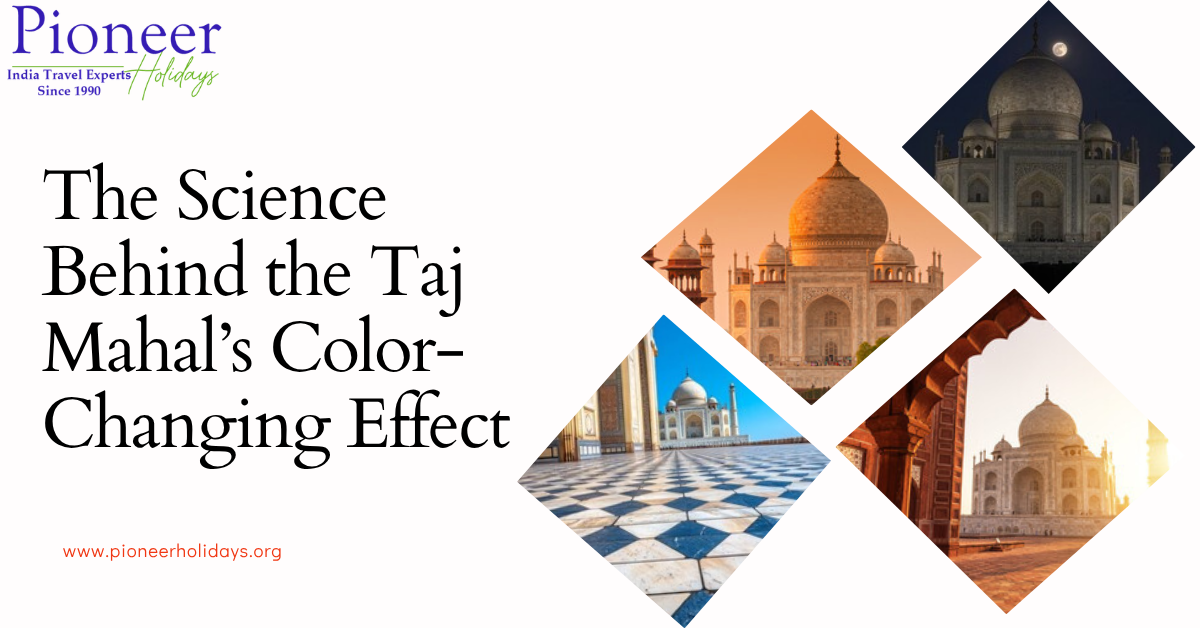
In the heart of India stands a monument that is not just seen—it is experienced. The Taj Mahal appears to change its color throughout the day. At sunrise, it glows with a soft pink hue; by midday, it shines in brilliant white; at sunset, it turns golden; and under moonlight, it takes on a bluish or silvery tone.
This is not magic or myth—it is pure science.
Commissioned by Shah Jahan, the Taj Mahal is not only a symbol of love but also a masterpiece of material science and architectural brilliance. Even today, its color-changing effect fascinates scientists, architects, and travelers alike.
In this article, we will explore how light, marble, atmospheric conditions, and human perception work together to create this extraordinary visual phenomenon.
Understanding the Core Material: Makrana Marble
The Taj Mahal’s color-changing effect begins with its primary building material—Makrana marble. This marble, sourced from Rajasthan, is known for its high purity and fine crystalline structure.
Why Makrana Marble is Unique
- Contains a high percentage of calcium carbonate.
- Has a translucent quality.
- Reflects and refracts light effectively.
- Absorbs minimal impurities compared to other marbles.
Unlike ordinary stone, Makrana marble interacts with light rather than simply reflecting it. This interaction is the foundation of the Taj Mahal’s changing appearance.
The Role of Light: A Scientific Perspective
Light is the most critical factor influencing how we perceive the Taj Mahal’s color. The monument doesn’t actually change color; instead, our perception changes based on how light behaves.
Key Scientific Principles Involved
- Reflection – Light bouncing off the marble surface.
- Refraction – Light bending as it enters the marble.
- Scattering – Diffusion of light due to atmospheric particles.
Each of these processes varies depending on the time of day, weather conditions, and the angle of sunlight.
Time-Based Color Transformation
The Taj Mahal appears different throughout the day due to changes in sunlight intensity and wavelength.
Morning (Sunrise)
At sunrise, the Taj Mahal often appears pinkish.
Why this happens:
- The sun is low on the horizon.
- Light passes through more atmosphere.
- Shorter wavelengths (blue) scatter away.
- Longer wavelengths (red/pink) dominate.
This is the same reason sunsets appear red. The marble reflects these warmer tones, giving the monument a soft pink glow.
Midday (Noon)
By noon, the Taj Mahal looks bright white.
Scientific explanation:
- Sunlight is more direct and intense.
- Full spectrum of light reaches the surface.
- Minimal atmospheric scattering.
- Marble reflects nearly all wavelengths equally.
At this time, the monument appears closest to its “true” color—pure white.
Evening (Sunset)
During sunset, the Taj Mahal takes on a golden or orange hue.
Reasons:
- Sunlight again travels through a thicker atmosphere
- Warm wavelengths dominate
- Dust and pollution particles enhance scattering
The marble captures these tones, creating a warm and romantic glow.
Night (Moonlight)
Under moonlight, the Taj Mahal appears bluish or silvery.
Why this occurs:
- Moonlight is reflected sunlight, but less intense.
- Human eyes perceive colors differently in low light.
- Blue wavelengths become more noticeable.
This creates a surreal and almost ethereal appearance.
Color Changes of the Taj Mahal Throughout the Day
| Time of Day | Dominant Color | Scientific Reason | Visual Effect |
|---|---|---|---|
| Sunrise | Pinkish | Scattering of shorter wavelengths | Soft, romantic glow |
| Noon | Bright White | Direct sunlight reflection | Pure and radiant |
| Sunset | Golden/Orange | Dominance of longer wavelengths | Warm and majestic |
| Moonlight | Bluish/Silver | Low light perception shift | Dreamlike and mystical |
Atmospheric Influence: The Invisible Artist
The air surrounding the Taj Mahal plays a crucial role in its color transformation.
Key Atmospheric Factors
- Dust particles
- Humidity levels
- Air pollution
- Seasonal fog
These elements affect how light scatters before reaching the monument. For example:
- Winter fog softens the colors.
- Summer dust enhances golden tones.
- Pollution can dull the brightness.
This means the Taj Mahal never looks exactly the same twice.
Optical Illusions and Human Perception
Another fascinating layer is how our eyes and brain interpret color.
How Perception Shapes Reality
- Human eyes adjust to light intensity.
- Surrounding colors influence perception.
- Contrast with sky changes visual output.
For instance:
- A blue sky enhances the whiteness.
- A cloudy sky makes it appear duller.
- A sunset sky intensifies warm tones.
This psychological aspect adds a subjective dimension to the experience.
Architectural Design and Symmetry
The Taj Mahal’s design also contributes to its color-changing illusion.
Key Design Elements
- Perfect symmetry.
- Smooth marble surfaces.
- Large dome reflecting light uniformly.
- Reflective water bodies in the garden.
The reflection in the pools doubles the visual effect, making the color transitions even more dramatic.
The Role of Pietra Dura Inlay Work
The intricate inlay work using semi-precious stones adds another layer of visual complexity.
How It Enhances Color Perception
- Stones reflect light differently than marble.
- Creates contrast and depth.
- Enhances brightness under sunlight.
These details become more visible at certain times of the day, subtly altering the monument’s appearance.
Seasonal Variations in Color
The Taj Mahal’s color also changes with seasons.
Seasonal Effects
- Winter: Mist creates a soft, diffused look.
- Summer: Harsh sunlight increases brightness.
- Monsoon: Clouds create dramatic contrasts.
Each season offers a unique visual experience, making it a year-round attraction.
Environmental Concerns and Their Impact
While the Taj Mahal’s color-changing effect is natural, environmental factors are beginning to interfere.
Major Concerns
- Air pollution causing yellowing of marble.
- Acid rain affecting surface quality.
- Industrial emissions nearby.
Conservation efforts are ongoing to preserve its original beauty, but these factors can alter how the monument reflects light.
Why This Phenomenon Matters for Travelers
Understanding the science behind the Taj Mahal’s color transformation enhances the travel experience.
Practical Insights for Visitors
- Visit at different times of the day.
- Sunrise offers the most unique hues.
- Full moon nights provide a rare view.
- Weather conditions can change the experience.
This knowledge allows travelers to plan better and appreciate the monument beyond its surface beauty.
Key Takeaways
- The Taj Mahal does not change color physically.
- Light behavior is the primary cause.
- Makrana marble plays a crucial role.
- Atmospheric conditions enhance the effect.
- Human perception adds a psychological layer.
Conclusion
The Taj Mahal is often described as a symbol of love, but it is equally a masterpiece of science and design. Its color-changing effect is not a coincidence—it is the result of a perfect harmony between material, light, atmosphere, and human perception.
What makes this phenomenon truly special is its unpredictability. No two visits are ever the same. The monument adapts to its environment, reflecting the sky, the air, and even the emotions of the observer. This dynamic quality transforms the Taj Mahal from a static structure into a living experience.
Frequently Asked Question
1. Why does the Taj Mahal change color throughout the day?
The Taj Mahal appears to change color due to the way its white Makrana marble reflects and absorbs sunlight at different times. In the morning, it looks pinkish due to soft light scattering, turns bright white under midday sun, and takes on a golden or orange hue during sunset because of the lower angle of sunlight and atmospheric particles.
2. What role does marble play in the Taj Mahal’s color-changing effect?
The Makrana marble used in the Taj Mahal has semi-translucent properties. This allows light to penetrate slightly beneath the surface and scatter, creating subtle variations in color depending on light intensity, angle, and environmental conditions.
3. How does sunlight affect the appearance of the Taj Mahal?
Sunlight changes in color temperature and angle throughout the day. Cooler tones in the morning create a bluish-pink tint, while warmer tones during sunset give the monument a golden glow. This interaction between sunlight and marble is the primary reason behind its shifting colors.
4. Does pollution impact the Taj Mahal’s color?
Yes, pollution significantly affects the Taj Mahal’s appearance. Air pollutants like sulfur dioxide and particulate matter can settle on the marble surface, causing yellowing or dullness. This is why conservation efforts are continuously implemented to preserve its original brilliance.
5. Can weather conditions influence the Taj Mahal’s color changes?
Absolutely. Fog, humidity, and dust particles in the air can scatter light differently, enhancing or muting the color transitions. For example, misty mornings can make the Taj Mahal look more ethereal and pale.
6. Why does the Taj Mahal look different at night?
At night, especially under moonlight, the Taj Mahal appears bluish or silvery. Moonlight is softer and cooler compared to sunlight, and the marble reflects it in a way that creates a glowing, almost luminous effect.
7. Is the color change of the Taj Mahal an optical illusion?
It is not just an illusion—it’s a real scientific phenomenon involving light reflection, refraction, and atmospheric scattering. However, human perception also plays a role, as our eyes interpret colors differently under varying lighting conditions.
8. What is the best time to witness the Taj Mahal’s color-changing effect?
The best times are sunrise and sunset. During these periods, the angle of sunlight and atmospheric conditions create the most dramatic and visually striking color transitions, making the experience truly memorable.
You May Also Like – Pioneer Holidays , Taj Mahal Tour Packages
