
If you have ever stood in front of the massive red sandstone walls of the Red Fort in Delhi and felt a rush of awe, you are not alone. Millions of visitors from across India and around the world feel the same way every year. At Pioneer Holidays, we believe that truly understanding a monument makes the experience far richer than simply taking photos outside its gates. That is why we put together this detailed guide on the history of Red Fort — one of India’s most iconic and historically significant structures.
From the ambitions of a mighty Mughal emperor to the echoes of India’s independence struggle, the Red Fort carries centuries of stories within its walls. Let’s walk through them together.
Quick Facts About Red Fort
| Feature | Details |
| Official Name | Lal Qila (Red Fort) |
| Location | Netaji Subhash Marg, Lal Qila, Chandni Chowk, Delhi – 110006 |
| Built By | Emperor Shah Jahan |
| Construction Started | 1639 CE |
| Completed | 1648 CE |
| Architectural Style | Mughal, Persian, Hindu, Timurid |
| Main Material | Red Sandstone |
| UNESCO Status | World Heritage Site (since 2007) |
| Visiting Hours | 9:30 AM – 4:30 PM (Closed on Mondays) |
| Entry Fee | ₹35 for Indians, ₹550 for Foreign Nationals |
| Best Time to Visit | October to March |
Introduction of the Red Fort
What is the Red Fort?
The Red Fort — or Lal Qila in Hindi — is a massive fortified palace complex built in the 17th century during the height of the Mughal Empire. It served as the primary royal residence and seat of power for Mughal emperors for nearly 200 years.
Today, it stands as one of India’s most recognised landmarks. Every year on August 15th, the Prime Minister of India hoists the national flag from its iconic Lahori Gate — a tradition that has continued since the country’s first Independence Day in 1947.
Where is the Red Fort Located?
The Red Fort sits on the western bank of the Yamuna River in the heart of Old Delhi. It overlooks the historic neighbourhood of Chandni Chowk, one of Delhi’s oldest and most vibrant bazaars. The fort covers an area of approximately 254 acres and stretches about 2.4 kilometres in perimeter.
Why is the Red Fort Famous in India?
The fort is famous for several reasons. It was the nerve centre of Mughal power for two centuries. It witnessed some of the most dramatic events in Indian history, from invasions and looting to colonial rule and national liberation. And even today, it remains a symbol of India’s sovereignty, strength, and cultural pride.
Who Built the Red Fort?
Shah Jahan and the Mughal Empire
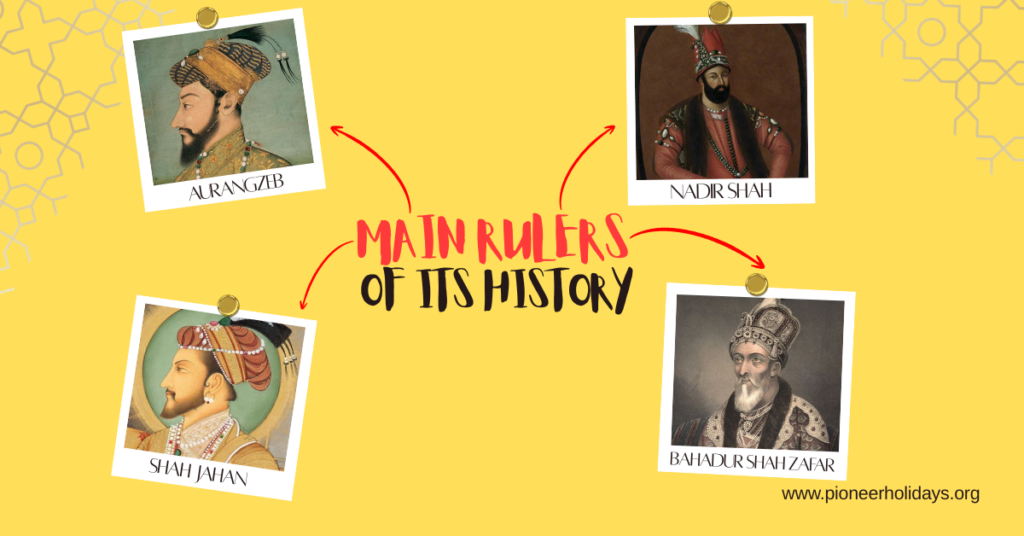
The Red Fort was built by Emperor Shah Jahan, the fifth ruler of the Mughal dynasty. Shah Jahan, whose full name was Shahab-ud-din Muhammad Khurram, ruled the Mughal Empire from 1628 to 1658. He is perhaps best known for commissioning the Taj Mahal in Agra in memory of his beloved wife Mumtaz Mahal.
But Shah Jahan was not just a builder of love monuments. He was a man of grand imperial vision who wanted his reign to leave an unmistakable architectural legacy across the subcontinent.
Why Shah Jahan Wanted a New Capital
At the time Shah Jahan came to power, the Mughal capital was in Agra. As his empire expanded and his court grew, Agra started to feel inadequate for the scale of governance he envisioned. Shah Jahan dreamed of a new, purpose-built capital that would reflect the glory and grandeur of the Mughal Empire at its peak.
In 1638, he decided to shift the capital to Delhi and commissioned the construction of an entirely new city — Shahjahanabad — along with a magnificent fort at its heart.
The Main Purpose Behind Building the Fort
The Red Fort was designed to serve as the royal residence and administrative hub of the Mughal Empire. It housed the emperor and his family, the royal court, government offices, and thousands of courtiers, soldiers, servants, and attendants. In essence, it was a self-contained city within a city.
When Was the Red Fort Built?
Construction Started in 1639
Construction of the Red Fort began on 12 May 1639. The project was overseen by the chief architect Ustad Ahmad Lahauri, who is also credited as the principal designer of the Taj Mahal. The fort was named Qila-i-Mubarak, meaning “the Blessed Fort,” during the early stages of construction.
Completion of the Fort in 1648
The fort was completed in 1648 after approximately ten years of construction. Shah Jahan officially moved his court from Agra to the Red Fort in that same year, making it the new seat of Mughal imperial power.
How Long Did It Take to Build?
The construction of the Red Fort took roughly ten years from start to finish. Given the scale and complexity of the project — thousands of craftsmen, artisans, engineers, and labourers worked together — this was a remarkable feat of organisation and craftsmanship. The fort showcases the extraordinary skill that Mughal-era artisans had developed over generations.
Why Was the Red Fort Built?
Red Fort as the Mughal Royal Residence
The primary purpose of the Red Fort was to serve as the royal palace of the Mughal emperors. The complex included elaborate residential halls, pleasure gardens, mosques, and private bathing chambers — everything an emperor and his court required to live in supreme comfort and style.
Political Importance of the Fort
Beyond being a residence, the fort was the centre of Mughal political power. Public audiences (durbars) were held here, important decisions about the empire were made within its walls, and foreign dignitaries were received in its grand halls. The Diwan-i-Aam and Diwan-i-Khas — the two main audience halls — were where the emperor met both commoners and nobles.
Security and Defense Purpose
The fort also served a critical military function. Its massive walls, some rising up to 33 metres (110 feet) high, were built to withstand attacks. A deep moat once surrounded the fort’s perimeter, adding another layer of protection. The two main gates were heavily guarded, and the fort’s elevated position near the Yamuna River gave it a strong natural defensive advantage.
History of Mughal Rulers Connected to the Red Fort
Shah Jahan’s Rule
Shah Jahan occupied the Red Fort from 1648 until 1658, when his own son Aurangzeb imprisoned him. During his decade in the fort, Shah Jahan oversaw the completion of many of its most beautiful interiors. He is said to have spent hours in the Diwan-i-Khas, reportedly remarking that if paradise existed on earth, it was here. After Aurangzeb placed him under house arrest, Shah Jahan spent the rest of his life looking towards the Taj Mahal from his room in Agra Fort, never returning to Delhi.
Aurangzeb and His Changes in the Fort
Aurangzeb, the sixth Mughal emperor, took control of Delhi in 1658. He was known for his austere personal style and strong religious convictions. He added the Moti Masjid (Pearl Mosque) inside the fort complex around 1659 — a small but beautifully crafted white marble mosque reserved for his personal use. While Aurangzeb expanded the empire militarily, his rigid policies contributed to internal divisions that would eventually weaken the Mughal grip on power.
Later Mughal Emperors
After Aurangzeb’s death in 1707, a series of Mughal emperors ruled from the Red Fort, though most held diminishing real power. The empire began to fragment as regional kingdoms grew stronger and new powers — including the Marathas, Sikhs, and eventually the British — began to challenge Mughal authority.
During this period, the fort itself suffered significant losses. Precious objects were looted or sold, and some structures fell into disrepair as the empire’s finances collapsed.
Bahadur Shah Zafar – The Last Mughal Ruler
Bahadur Shah Zafar was the last Mughal emperor. A poet and mystic more than a warrior, he ascended the throne in 1837 and ruled as a largely symbolic figure under British East India Company supervision. In 1857, the Revolt of 1857 brought soldiers and civilians to the gates of the Red Fort seeking his leadership. Though reluctant, Bahadur Shah Zafar became the symbolic figurehead of the revolt. After its failure, the British tried him in the Red Fort itself, found him guilty of treason, and exiled him to Rangoon (now Yangon, Myanmar), where he died in 1862 — far from the city and the fort he called home.
Key Historical Events: Timeline of the Red Fort
| Year | Event |
| 1639 | Construction of Red Fort begins under Shah Jahan |
| 1648 | Construction completed; Mughal capital shifts to Delhi |
| 1658 | Aurangzeb imprisons Shah Jahan; takes control of Delhi |
| 1707 | Death of Aurangzeb; Mughal decline begins |
| 1739 | Nadir Shah invades Delhi; loots the fort and takes the Peacock Throne |
| 1756–57 | Ahmad Shah Durrani attacks and plunders Delhi |
| 1803 | British East India Company takes control of Delhi |
| 1857 | Revolt of 1857; Bahadur Shah Zafar’s trial held at Red Fort |
| 1858 | British Crown formally takes over India |
| 1858–1947 | British use parts of the fort as a military garrison |
| 1945 | INA trials held at Red Fort |
| 1947 | Jawaharlal Nehru hoists the Indian flag at Lahori Gate on August 15 |
| 2007 | Red Fort declared a UNESCO World Heritage Site |
Major Historical Events of the Red Fort
Nadir Shah’s Attack in 1739
One of the most devastating events in the fort’s history took place in 1739, when Nadir Shah, the Iranian conqueror, invaded Delhi. His forces massacred tens of thousands of residents in the city. Inside the Red Fort, Nadir Shah plundered treasuries and carried away an enormous amount of wealth.
Looting of the Peacock Throne
Among the most prized objects taken by Nadir Shah was the Peacock Throne — perhaps the most extravagant throne ever made. Originally commissioned by Shah Jahan and encrusted with thousands of diamonds, rubies, emeralds, and pearls, the throne was carried off to Persia and was never returned to India. Some historians estimate its value, in modern terms, in the hundreds of millions of dollars.
Decline of the Mughal Empire
Following Nadir Shah’s invasion, the Mughal Empire never truly recovered. A series of weak emperors, internal conflicts, and multiple foreign invasions left the empire a shadow of its former self. By the early 19th century, the British East India Company effectively controlled vast parts of the subcontinent, including Delhi.
The Revolt of 1857
The year 1857 marked a turning point in Indian history. Soldiers of the East India Company’s army — both Hindu and Muslim — rose up in rebellion against British rule. The Red Fort became a symbol of this resistance when the rebels marched on Delhi and urged the aged Bahadur Shah Zafar to lead them. Though the revolt spread across much of northern India, it was eventually suppressed by British forces.
British Capture of the Red Fort
After crushing the revolt, the British took full control of the Red Fort in September 1857. Bahadur Shah Zafar was captured, tried for treason inside the fort he once called home, and exiled to Burma. The British transformed parts of the fort into military barracks, and several Mughal-era structures were demolished to make way for British army buildings.
Red Fort During British Rule
British Control After 1857
For nearly 90 years after 1857, the Red Fort served primarily as a British military garrison. The soldiers stationed here had little respect for the fort’s Mughal heritage, and many original structures were either demolished or severely modified.
Destruction of Mughal Buildings
Historical records suggest that more than two-thirds of the original Mughal buildings within the fort were destroyed during the British period. The loss was enormous — exquisite marble pavilions, garden structures, and residential quarters that had taken years to build were torn down within decades to accommodate British military infrastructure.
Bahadur Shah Zafar’s Trial and Exile
October 1858, Bahadur Shah Zafar was tried inside the Red Fort by a British military tribunal. He was accused of being a rebel against the Crown. Found guilty, the last Mughal emperor was exiled to Rangoon with a small group of family members. He died there in 1862, aged 87, without ever seeing Delhi again. His death marked the complete end of the Mughal dynasty.
Red Fort and India’s Independence
Role in India’s Freedom Struggle
The Red Fort did not just witness Mughal power — it also became deeply connected with India’s freedom struggle. For nationalist leaders and ordinary Indians alike, the fort represented something larger than any empire: it was a symbol of Indian civilisation, resilience, and the desire for self-rule.
INA Trials at the Red Fort
In 1945, the British held the famous Indian National Army (INA) trials at the Red Fort. Soldiers of the INA — the army raised by Subhas Chandra Bose to fight for India’s independence — were put on trial for treason. Rather than damaging the independence movement, these trials galvanised public sentiment against British rule. The defendants became heroes in the eyes of millions of Indians, and the trials helped fuel the final push towards independence.
Jawaharlal Nehru’s First Flag Hoisting
On 15 August 1947, India officially gained independence from British rule. The country’s first Prime Minister, Jawaharlal Nehru, hoisted the Indian national flag from the ramparts of the Lahori Gate of the Red Fort. This single act transformed the fort’s identity permanently — from a symbol of Mughal and colonial power to a symbol of free India.
Independence Day Celebrations at Red Fort
Since 1947, every Indian Prime Minister has continued this tradition on Independence Day. The Prime Minister hoists the national flag, delivers an address to the nation, and watches a parade — all from the historic Lahori Gate of the Red Fort. It is arguably the most watched political event in India every year, and it turns the Red Fort into the emotional heart of the country for that one special day.
Architecture of the Red Fort
Mughal and Persian Design Style
The Red Fort is a masterwork of Mughal architecture, a style that seamlessly blends Persian, Central Asian, and Indian design traditions. The fort’s overall plan follows the style of Timurid palaces of Central Asia, while the decorative elements draw heavily from Persian and indigenous Indian craftsmanship.
The result is an architecture that feels simultaneously grand and refined — enormous walls that project power, yet interiors filled with delicate inlay work, flowing water channels, and lush gardens.
Red Sandstone Construction
The fort takes its name from the deep red sandstone used to construct its massive outer walls and main structures. The stone was quarried from Fatehpur Sikri and other regions near Agra and Delhi. Inside, however, many of the finest pavilions and the private royal chambers were built using white marble, often decorated with floral patterns in semi-precious stone inlay (a technique called pietra dura).
Beautiful Gardens and Water Channels
Inside the fort, the Mughal love for gardens and water was given full expression. The complex originally contained elaborate gardens with fragrant flowers, fruit trees, and fountains. Water was carried through a system of channels — the Nahr-i-Bihisht (Stream of Paradise) — that ran through the main halls and gardens, keeping the interiors cool and pleasant. Much of this water system has been lost or gone dry over the centuries, but restoration efforts have revived parts of it.
Key Structures Inside the Red Fort
Diwan-i-Aam (Hall of Public Audience)
The Diwan-i-Aam was where the emperor held public audiences and heard petitions from ordinary citizens. It is a large, open hall with 60 red sandstone pillars. At its rear sat the emperor on an elevated marble throne, flanked by beautifully decorated panels.
Diwan-i-Khas (Hall of Private Audience)
The Diwan-i-Khas was reserved for the emperor’s meetings with nobles, ministers, and foreign ambassadors. Built entirely in white marble, it is one of the most exquisite halls in the fort. It was here that the legendary Peacock Throne once stood. An inscription on its walls reads: “If there be paradise on earth, it is here, it is here, it is here.”
Rang Mahal (Palace of Colours)
The Rang Mahal was the primary residence of the emperor’s wives and mistresses. Its name comes from the ornate painted decorations that once adorned its interiors. A marble basin in its centre was fed by the Nahr-i-Bihisht, and the flowing water — combined with ivory-white marble walls — must have created a breathtaking living space.
Moti Masjid (Pearl Mosque)
Built by Aurangzeb in 1659, the Moti Masjid is a small but perfectly proportioned mosque carved in pure white marble. It was constructed for the emperor’s private use. Its three domes and delicate arches reflect the refined aesthetic sensibility of the Mughal period.
Mumtaz Mahal
The Mumtaz Mahal is another residential palace within the fort complex, believed to have housed other members of the royal harem. Today, it functions as a museum displaying Mughal-era artefacts including paintings, textiles, manuscripts, and weapons.
Main Gates of the Red Fort
Lahori Gate
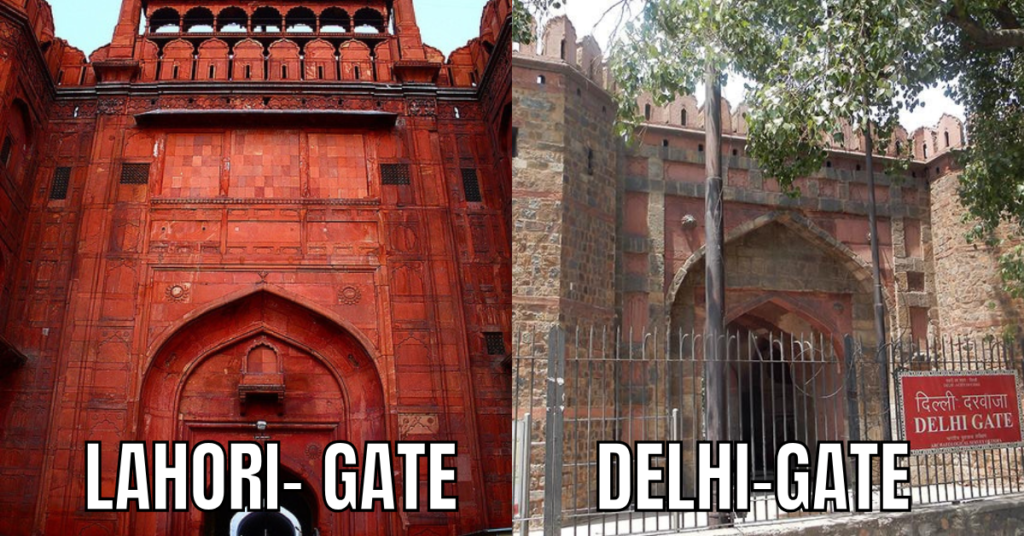
The Lahori Gate is the main public entrance to the Red Fort and faces west, towards Lahore (in present-day Pakistan). This is the gate that Prime Ministers use every Independence Day to hoist the flag. The gate opens into Chhatta Chowk — a covered bazaar that once sold silks, jewels, and luxury goods to the royal household, and today sells souvenirs and handicrafts to visitors.
Delhi Gate
The Delhi Gate faces south and was originally the ceremonial entrance reserved for the emperor. It is similar in design to the Lahori Gate but slightly smaller. Today, it is also open to visitors.
Importance of the Main Entrance
The gates of the Red Fort were not just functional — they were architectural statements. Their massive proportions, flanking towers, and elaborate carvings were designed to awe anyone approaching the fort and to reinforce the might and authority of the emperor within.
Interesting Facts About the Red Fort
- The Peacock Throne, which once sat in the Diwan-i-Khas, was encrusted with over 26,000 precious and semi-precious gemstones. After Nadir Shah took it to Persia in 1739, its whereabouts became a historical mystery.
- The Nahr-i-Bihisht (Stream of Paradise) was an engineering marvel — a canal that channelled water from the Yamuna River through the main palace halls and gardens.
- The fort has a famous Sound and Light Show every evening that narrates its history dramatically. It runs in both Hindi and English on alternate evenings and is highly recommended for first-time visitors.
- During the Mughal period, the area around the fort known as Meena Bazaar was a marketplace where royal women could shop — it was off-limits to ordinary men.
- The fort’s walls were once whitewashed at some point in the British period, covering the red sandstone. The paint was stripped later to reveal the original stone.
Visiting the Red Fort — Practical Tips for Travellers
Visiting the Red Fort is a deeply moving experience, whether you are a history enthusiast, a cultural traveller, or someone who simply wants to understand the roots of modern India. Here are a few insights to help you make the most of your visit:
- Arrive early — The fort gets very crowded by mid-morning, especially on weekends and public holidays. An early morning visit gives you the chance to explore in relative peace.
- Allow 2–3 hours — The complex is large. Budget at least two to three hours to explore the main structures comfortably.
- Don’t miss the museum — The Mumtaz Mahal museum houses a fine collection of Mughal-era objects and is often skipped by visitors in a hurry.
- Attend the Sound and Light Show — The evening show is a wonderful way to absorb the fort’s history in an engaging format. Check current timings before your visit, as they vary by season.
- Hire a licensed guide — The fort’s history is deep and layered. A knowledgeable guide can bring the halls, gardens, and structures to life in a way that self-exploration simply cannot.
- Wear comfortable footwear — You will be walking on stone and marble surfaces for an extended period.
Historical Importance of the Red Fort
Why the Red Fort Is a Symbol of India’s Pride
The Red Fort is more than a monument. It is a thread that connects India’s past to its present. It has witnessed the rise and fall of one of the world’s greatest empires, the trauma of foreign invasion and colonial rule, and the birth of a free nation.
For Mughal history enthusiasts, it is an unparalleled window into the grandeur of the empire. For students of colonial history, it is a reminder of both resistance and loss. And for every Indian citizen, it is a symbol of nationhood — a place where, every August 15th, the Prime Minister stands before the country and speaks to its future. That is the power of the Red Fort. No other monument in India carries quite the same weight of history across so many different eras.
Frequently Asked Questions (FAQs) About Red Fort
1. Who built the Red Fort in Delhi?
Emperor Shah Jahan, the fifth Mughal emperor, built the Red Fort. Construction began in 1638 and was completed in 1648.
2. Why is it called the Red Fort?
The fort is built primarily from deep red sandstone, which gives its walls their distinctive reddish colour — hence the name “Red Fort” or Lal Qila in Hindi.
3. When was the Red Fort declared a UNESCO World Heritage Site?
The Red Fort was inscribed as a UNESCO World Heritage Site in 2007, in recognition of its outstanding architectural and historical significance.
4. What happened to the Peacock Throne from the Red Fort?
The Peacock Throne was looted by the Persian conqueror Nadir Shah during his invasion of Delhi in 1739. It was taken to Persia and never returned to India. Its current whereabouts remain unknown.
5. Why is the flag hoisted at Red Fort on Independence Day?
The tradition began on 15 August 1947, when India’s first Prime Minister Jawaharlal Nehru hoisted the national flag from the Lahori Gate. This symbolic act has continued ever since, making the Red Fort the venue for India’s annual Independence Day celebrations.
6. What is the best time to visit Red Fort?
The best time to visit is from October to March, when Delhi’s weather is cool and pleasant. Summer (April–June) can be extremely hot, making outdoor exploration uncomfortable.
7. Is the Sound and Light Show at Red Fort worth watching?
Absolutely. The show runs in Hindi and English on alternate evenings and narrates the history of the fort and the Mughal Empire in a dramatic and engaging way. It is one of the most popular evening attractions in Delhi.
Conclusion
The Red Fort is not just a building — it is a living chapter of Indian history. From the day Emperor Shah Jahan laid its foundation in 1638 to the moment Jawaharlal Nehru first raised the tricolour above its Lahori Gate in 1947, every brick of this fort has absorbed centuries of stories, struggles, and triumphs.
At Pioneer Holidays, we always encourage travellers to look beyond the surface of a monument and understand the history that made it what it is. Because when you walk through the Red Fort with that knowledge, it stops being just a tourist stop and becomes something profoundly meaningful.
Whether you are planning your first trip to Delhi or your tenth, the Red Fort deserves your full attention — and a few hours of unhurried exploration.
Looking to explore Delhi’s historic landmarks with expert guidance? Pioneer Holidays offers Delhi Tour Packages. Get in touch with our team to plan your perfect history-focused trip to India’s capital.
You May Also Like – What is the History of Taj Mahal and its construction? , What Is the History of Agra Fort?
