
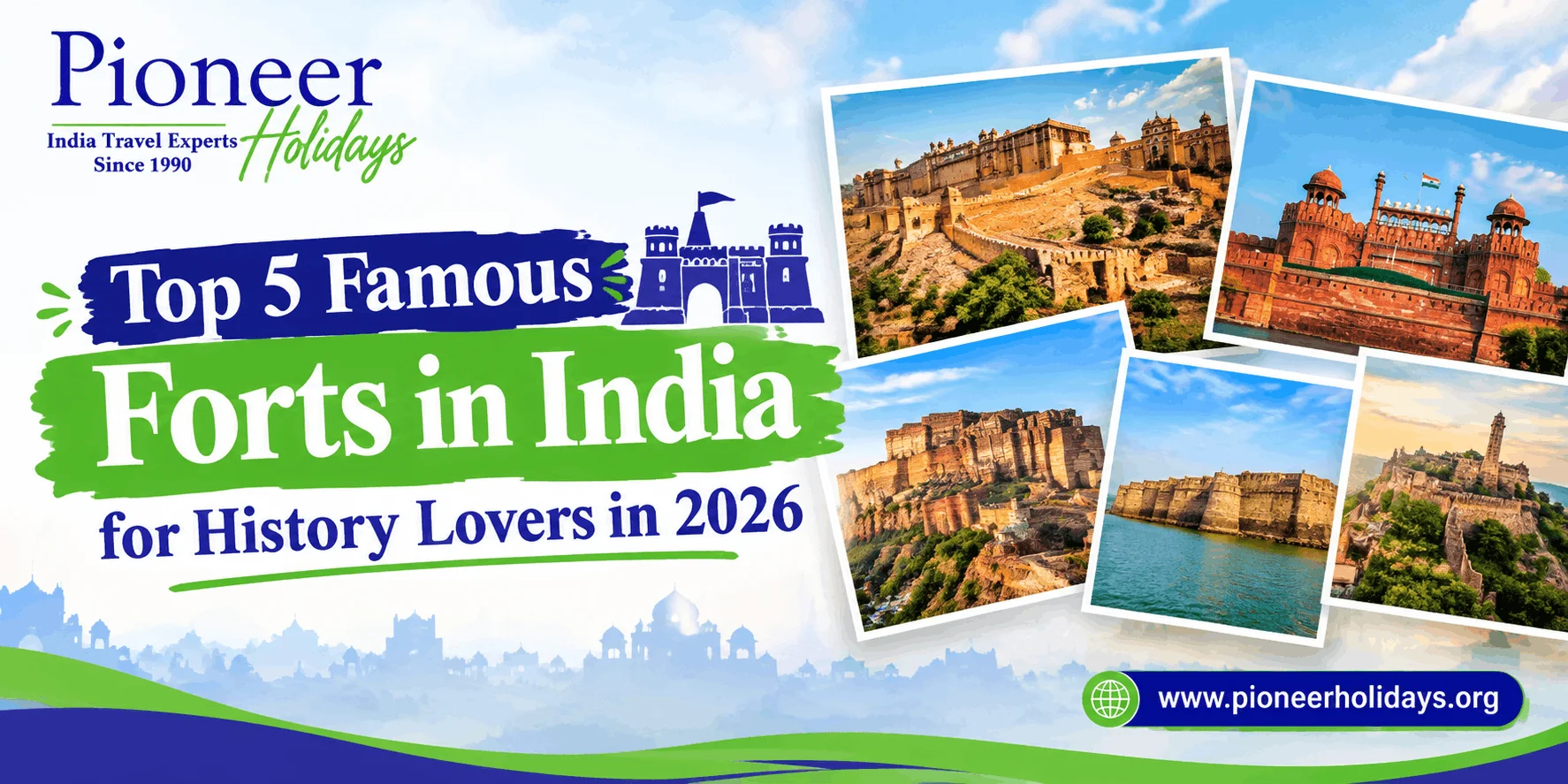
India has thousands of forts, but only a few let you read the country’s history directly in stone, from Mughal capitals built for emperors to desert citadels where families still live. If you are planning a trip around India’s famous forts, the real challenge is deciding which ones deserve your limited days. This guide narrows the choice to five forts across Delhi, Agra, and Rajasthan, with the history, highlights, and practical details many lists skip.
If you want more than a photo stop, each fort offers a different story, from Mughal court life to Rajput military architecture.
Famous Forts in India at a Glance
These are five of the most rewarding forts to visit in India if you want a mix of Mughal grandeur and Rajput defence, and all five sit on the well-travelled northern circuit. Here is how they compare before we look at each one.
| Red Fort | Delhi | 1638 to 1648 | Shah Jahan’s palace fortress | UNESCO World Heritage Site, 2007 |
| Agra Fort | Agra, Uttar Pradesh | From 1565 | Akbar’s sandstone fort with marble palaces | UNESCO World Heritage Site, 1983 |
| Amer Fort | Jaipur, Rajasthan | From 1592 | The Sheesh Mahal and lake views | UNESCO World Heritage Site, 2013 |
| Mehrangarh Fort | Jodhpur, Rajasthan | Around 1459 | Towering walls and a major museum | Not UNESCO listed |
| Jaisalmer Fort | Jaisalmer, Rajasthan | 1156 | A living fort in the Thar Desert | UNESCO World Heritage Site, 2013 |
One correction is worth making early. Mehrangarh is often described as a UNESCO site, but it is not among the six Hill Forts of Rajasthan listed in 2013. Those six are Amer, Jaisalmer, Chittorgarh, Kumbhalgarh, Ranthambore and Gagron.
Red Fort, Delhi: Shah Jahan’s Palace Fortress
Shah Jahan began the Red Fort in 1638, when he moved the Mughal capital from Agra to Delhi, and work finished in 1648. It served as the main residence of the Mughal emperors for nearly 200 years, until 1857. Its red sandstone walls run for more than two kilometres, and UNESCO listed the complex in 2007. Every Independence Day, the Prime Minister addresses the nation from its ramparts.
What to See Inside
Enter through the Lahori Gate and walk down Chhatta Chowk, a covered arcade that once supplied the court with silks and jewellery. Beyond it lie the Hall of Public Audience, where the emperor heard petitions, and the Hall of Private Audience, which once held the Peacock Throne before Nadir Shah carried it away after sacking Delhi in 1739. The Rang Mahal, the Moti Masjid built by Aurangzeb and the museums inside add depth for visitors who want more than architecture.
Visiting Tips
The fort is closed on Mondays. Opening hours and ticket rates are set by the Archaeological Survey of India, so check the official listing before you go. Expect security screening at the entrance and carry photo identification. Allow two to three hours, then walk on to Jama Masjid and the lanes of Chandni Chowk. If you would rather not manage the logistics yourself, New Delhi Tour Packages that combine the fort with Humayun’s Tomb and Qutub Minar can save a lot of transfer time.
Agra Fort: Akbar’s Sandstone Citadel and Shah Jahan’s Marble
Agra Fort is one of India’s most important Mughal-era monuments. It is often mistaken for the Red Fort in Delhi; however, these are two separate monuments. Akbar began rebuilding the Agra Fort in 1565 as both a military base and a royal residence on the banks of the Yamuna. His grandson Shah Jahan later replaced much of the interior with white marble palaces, so the fort shows two phases of Mughal taste inside one set of walls. UNESCO listed it in 1983.
Look for the Jahangiri Mahal, a palace from Akbar’s era, and the Hall of Public Audience before you reach the Musamman Burj, an octagonal marble tower facing the Taj Mahal. Tradition holds that Shah Jahan spent his final years here, confined by his son Aurangzeb from 1658 until he died in 1666.
The fort stands about 2.5 kilometres from the Taj Mahal, so the two are easy to see on the same day. A good rhythm is the Taj at sunrise and the fort in the late morning. The fort is also a strong alternative on Fridays, when the Taj Mahal is closed to general visitors. If you want both monuments handled in one well-paced day, Taj Mahal Tour Packages are worth comparing.
Amer Fort, Jaipur: Rajput Splendour Above Maota Lake
Amer Fort rises from a forested hill about 11 kilometres from Jaipur. Raja Man Singh began it in 1592 on the site of an older fort, and later rulers expanded it until the Kachwaha capital moved to Jaipur in 1727. It is one of the six Hill Forts of Rajasthan that UNESCO listed in 2013.
The climb leads into Jaleb Chowk, the main courtyard, and then through the painted Ganesh Pol to the private apartments. The Sheesh Mahal, with walls and ceilings set in mirror and coloured glass, is the highlight, and the nearby Sukh Niwas is known for its cooling water channel. A passage links Amer to Jaigarh Fort on the ridge above, a reminder that this was a working military site.
Arrive soon after opening to beat the tour buses and the midday heat. You can walk up or take a jeep, and many travellers now skip elephant rides because of animal welfare concerns. Amer, the Red Fort and Agra Fort all lie on the Delhi, Agra and Jaipur circuit, which is why Golden Triangle Tour Packages are a practical way to see three of these forts in under a week.
Mehrangarh Fort, Jodhpur: A Citadel Above the Blue City
Rao Jodha, the Rathore ruler of Marwar, laid the foundation of Mehrangarh on 12 May 1459 after moving his capital from Mandore. The fort stands about 122 metres above the plain, and most of the structure you see today dates from the 17th century. The sheer walls make it one of the most imposing forts in the country.
What sets Mehrangarh apart is its museum, run by the Mehrangarh Museum Trust since 1972. Galleries hold royal palanquins, howdahs, miniature paintings, weapons, costumes and musical instruments, while the ramparts give views over Jodhpur’s blue houses. Cannonball marks from old sieges are still visible near the gates. Allow at least three hours.
Jodhpur sits between Jaipur and Jaisalmer, so it slots naturally into Rajasthan Tour Packages that follow the desert route.
Jaisalmer Fort: The Living Golden Fort of the Thar
Rawal Jaisal built Jaisalmer Fort in 1156 on Trikuta Hill, and its honey coloured sandstone glows gold at sunset. Unlike most famous forts in India, which are now monuments and museums, this one is still a neighbourhood. Families live inside the walls, with shops, guest houses and havelis packed into narrow lanes. UNESCO listed it in 2013.
Spend your time walking the lanes, visiting the Jain temples inside and following the ramparts for views across the desert city. Sunset is the best hour. Water and drainage in the old fort are under pressure from tourism, so staying outside the walls is a considerate choice. Reaching Jaisalmer from Jodhpur takes about five hours by road, which is why it suits travellers with ten days or more.
How to Combine These Forts in One Trip
You do not need to see all five on one journey. Two routes work well:
- The Golden Triangle route covers the Red Fort in Delhi, Agra Fort and Amer Fort in Jaipur, and takes five to six days at a comfortable pace.
- The extended Rajasthan route adds Mehrangarh in Jodhpur and Jaisalmer Fort, bringing the trip to roughly ten to twelve days, since road transfers between Jaipur, Jodhpur and Jaisalmer take about five to six hours each.
To see several famous forts in India without rushing, avoid putting two large forts in one day, because each deserves two to three hours. Pioneer Holidays can shape either route around your pace, with early entries and slower afternoons built in.
Best Time to Visit and Practical Tips
October to March is the most comfortable season for all five forts. Days are cooler for climbing ramparts, though Jaisalmer nights can turn cold in December and January. From April to June, temperatures in Rajasthan rise sharply, and the forts offer little shade.
- Check closures before you travel. The Red Fort is closed on Mondays, and monuments occasionally close for events or security reasons.
- Book a licensed guide for the Red Fort and Agra Fort, where signage is limited.
- Wear comfortable shoes with good grip, since Amer and Mehrangarh involve steep ramps and uneven stone.
- Carry water, sun protection and photo identification. Foreign nationals usually pay higher entry rates at ASI monuments.
- Start early, especially during the busy winter months, when crowds and heat build by midday.
More Famous Forts in India Worth Adding
If you have extra days, these ancient forts in India round out the picture:
- Chittorgarh Fort in Rajasthan, one of the largest forts in India and part of the UNESCO Hill Forts group.
- Kumbhalgarh Fort, also UNESCO listed and known for its long perimeter wall.
- Golconda Fort near Hyderabad, linked with the Qutb Shahi dynasty and the historic diamond trade.
- Gwalior Fort in Madhya Pradesh, a hill fort that dominates the city below.
Final Thoughts
These five forts cover Mughal power, Rajput pride and desert resilience in a single route, which makes them a strong introduction to India’s historic forts for a first serious heritage trip. Pick the ones that match your time and season, read a little of their history before you arrive, and leave room to wander. When you are ready to turn this list into a route, Pioneer Holidays can help you match forts to your pace and budget.
Frequently Asked Questions
Which are the most famous forts in India?
Among the most famous forts in India are the Red Fort in Delhi, Agra Fort, Amer Fort in Jaipur, Mehrangarh Fort in Jodhpur and Jaisalmer Fort. Chittorgarh, Kumbhalgarh and Golconda are strong additions if you have extra time.
Which forts in India are UNESCO World Heritage Sites?
The Red Fort in Delhi was listed in 2007 and Agra Fort in 1983. In 2013, six Rajasthan forts were listed together as the Hill Forts of Rajasthan: Amer, Jaisalmer, Chittorgarh, Kumbhalgarh, Ranthambore and Gagron. Mehrangarh is not on the list.
What is the best time to visit forts in India?
October to March is the most comfortable period, with cooler days for climbing ramparts and walking large complexes. Summers from April to June are very hot, especially in Rajasthan.
How many days do I need to see these five forts?
The Red Fort, Agra Fort and Amer Fort fit into five to six days on the Golden Triangle route. Adding Mehrangarh and Jaisalmer Fort usually brings the trip to ten to twelve days.
Is the Red Fort in Delhi the same as Agra Fort?
No. They are separate forts in different cities. Agra Fort was begun by Akbar in 1565, while the Red Fort in Delhi was begun by Shah Jahan in 1638.
Is the Red Fort open every day?
No, it is closed on Mondays. Hours and ticket rates can change, so check the Archaeological Survey of India listing before you visit.
Do I need a guide to visit these forts?
A licensed guide is strongly recommended, especially at the Red Fort and Agra Fort where signage is limited. Pioneer Holidays can arrange guides as part of a planned itinerary.
